

Ebook Info
- Published: 2018
- Number of pages: 248 pages
- Format: PDF
- File Size: 2.73 MB
- Authors: George Magnus
Description
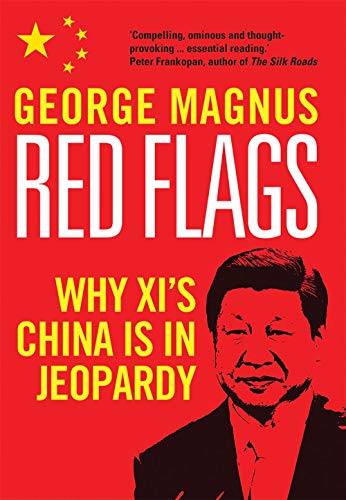
A trusted economic commentator provides a penetrating account of the threats to China’s continued economic rise Under President Xi Jinping, China has become a large and confident power both at home and abroad, but the country also faces serious challenges. In this critical take on China’s future, economist George Magnus explores four key traps that China must confront and overcome in order to thrive: debt, middle income, the Renminbi, and an aging population. Looking at the political direction President Xi Jinping is taking, Magnus argues that Xi’s authoritarian and repressive philosophy is ultimately not compatible with the country’s economic aspirations. Thorough and well researched, the book also investigates the potential for conflicts over trade, China’s evolving relationship with Trump, and the country’s attempt to win influence and control in Eurasia through the Belt and Road initiative.
User’s Reviews
Editorial Reviews: Review “A comprehensive and valuable survey of the threats facing China’s economy.”—Edward Chancellor, Wall Street Journal“George Magnus offers a forensic take on why the Chinese economy will continue to be bedevilled by politics and why it matters.”—Isabel Hilton, New Statesman“Red Flags lands with exquisite timing”—Richard McGregor, Financial Times”For insight into the dilemmas and decisions China’s leaders, notably Xi Jinping, will face in the next decades, it would be hard to beat Red Flags.”—Diane Coyle, author of GDP: A Brief but Affectionate History”An excellent, tightly argued and fluently written analysis of the challenges that lie behind the China Dream.”—Jonathan Fenby, author of Will China Dominate the 21st Century?”An immensely important and powerful book from one of our premier commentators on economics.”—Rana Mitter, author of China’s War with Japan, 1937–1945″A nuanced, historically informed and highly readable account of why we should never be complacent about the People’s Republic.”—Kerry Brown, author of CEO, China”Compelling, ominous and thought-provoking, George Magnus has written a book that should be essential reading for anyone trying to make sense of what is happening in China— and why it will have a global impact.”—Peter Frankopan, author of The Silk Roads About the Author George Magnus is an associate at the China Centre at Oxford University, a research associate at the School of Oriental and African Studies, and former chief economist of UBS. He has written extensively about China in the Financial Times, Prospect, and other economic and financial publications.
Reviews from Amazon users which were colected at the time this book was published on the website:
⭐China’s growth potential and trajectory remains one of the most important determinants of global growth at the moment and for the foreseeable future. Furthermore as it has interlinked with the world to an unprecedented degree, its influence on global economic activity is now often central to how assets prices are being determined and the future is being projected. In a time in which there are increased frictions in the arena of global trade, having visibility on China’s growth trajectory in a variety of circumstances is extremely valuable. This book does not give that, but it foes give perspective on the challenges China faces at this stage in its economic development. George Magnus has been an advisor to investment banks and an academic for decades focusing on China so his opinions and analysis are well informed. The author tries to inform the reader as to the history as well as future challenges China will face and gives substance to all of his claims.The author gives an effective economic history of China in Red Flag. He is certainly concerned with the growing autocratic nature of China with the consolidation of power with Xi and reminds the reader of one man rule with Mao. He gives the history of China opening up and the reforms the Party undertook 30 years ago that culminated in joining the WTO. The author highlights that the current issues that the US has unilaterally decided to dispute with China is not unfounded but is poorly thought out in strategy. He believes solutions should be multi-lateral and trading arrangements like the TPP should have been followed to better nudge behavior. The author analyses several issues he sees as potential traps for China. He discusses the debt trap which is largely the unsustainable credit intensity and the challenges of deleveraging. The author works through arithmetically why deleveraging is so challenging and how slower growth is a almost certain condition for rebalancing. The author also discusses the Renminbi trap and the impossibility of having control over the currency, have an open capital account and an independent monetary authority. For China it is the capital account which is the risk. The author describes how being added to the SDR basket is a superficial move and in the absence of an open capital account, the CNY will never be a large portion of settled trading volume. The author moves onto the demographic challenges which were catalyzed with the one-child policy. China’s dependency ratio will increase rapidly in the coming decades due to the craziness of the one-child policy which also skewed the gender balance. This will further strain state finances as their obligations will balloon. The author discusses the middle income trap, though this concept is more amorphous and describes how China needs more vibrant consumer driven economy with less state intervention to deliver the appropriate goods and services to a society getting richer. This is definitely a questionable conclusion as many would argue China’s entrepreneurial class are world leading. The author gets into the real time issues China is facing with trade. These are deep issues as China is not opening itself up in many critical areas to trade for its domestic markets. Furthermore its economic model does not really allow for reciprocity. These issues will plague relations for the visible future. As mentioned above, the US’s approach is frowned upon by the author as giving China the upper hand as it has no strategic depth and is purely self interested and tactical. The author then gives an overview of the economic system and the difficulties in assuming the future will be like the past. There has been a growing view that the economic models of the West are failing and a growing arrogance that the China model is resilient in the post financial crisis world. There is empirical evidence to support those views but they are merely recent history. The author argues that the real challenges for China lie in the future as it grows more internally conflicted between being friendly to markets while putting the Party as the center of all priorities. This conflict is what the author believes one must focus on. He discusses Xi Xinping’s China and highlights the rhetoric of the benefits of globalization from Xi need to be seen through the lens of China rationalizing its self interest to a certain extent.Red Flags does a good job of giving an overview of the challenges China will face in the coming decades. There are books which can look at the same data and come to different conclusions so it is important to not believe that this analysis is destiny but it is important to recognize there are many fragilities that China must wearily face sooner rather than later. The book also gives a very up to date overview of China’s competitive advantages in new technologies as well as geopolitical fissures. This is a good book to read for all those interested in China’s political economy in a multi-polar world.
⭐From the very first few pages the author’s ideology seeps into the pages, seeing the CCP and Xi Jinping in simplistic manichean terms. His description of the West as having investors deal with bad decisions is laughable, given the repeated state bailouts of such investors and the huge amounts of corporate welfare and graft facilitated through military budgets and “public-private” partnerships designed to dump any investment risk upon the state. His magical belief in more liberalism as the answer to any problem is evident throughout.He states that in the next few years China will need to reduce leverage (Xi is on this one), reduce income inequality (again Xi on this one), strengthen the social safety net (yep, on this one), move balance from investment to consumption (definitely a work in progress) – so what’s the problem? An issue is his mistaking for proper levels of regulation and government actions to remove rentier and exploitative attempts (e.g. Jack Ma’s attempt to grow exploitative consumer lending while dumping the risks on state banks, social media company’s commoditization of the social sphere), things desperately needed in the West.One risk he sees are a debt trap which the state can deal with given the lack of external debts and the significant role of the state in the banking system. This is also one of the reasons for shutting down Jack Ma’s exploitative consumer lending plans. Given the current trend GDP growth of 6% it may also be possible for China to grow out of the current debt levels, as the US did after WW2.Another risk is the renminbi, but the maintenance of a current account surplus and capital controls nullifies much of this risk.Another is supposedly a demographic trap, but China has far to go in increasing the productivity of its working population before it reaches Western levels – making it relatively easy to offset a slow demographic decline. It will also go through multiple stages of moving lower value production to foreign nations as it becomes richer. When an economy still has the capability of growing at 5-6% such issues are manageable. Very different to the case of Japan which is already very rich and therefore has a GDP that has stagnated for decades.The author also identifies the middle income trap, but given China’s focus on STEM graduates and massive state investments in technology (as the US did in the post-WW2 period) that facilitates private industry technology development. Here, the authors liberalism gets in the way as he pushes all of the usual liberal tenets (private property, “governance”) while not properly studying a Chinese history that has always managed a pragmatic balance between the state and the merchants, with Xi balancing a bit toward the state and moves against corruption in a corrective of the extremes of the post-2000 growth period. This is a pragmatism that values a balance rather than a belief in the betterness of a “free market” that does not really exist in any nation. Again the West could greatly benefit from such moves, as the “private sector” continues to consume the society upon which it relies. No mention is made of the US’s explicit aims of damaging Chinese technology companies to keep China from escaping the middle income trap.If the author were to better study the success of the “Asian Tigers” and Japan in reaching much higher levels of GDP per capita than China has currently through state directed capitalism he would better understand the future of China. It is notable that in the 1980s and 1990s the US utilized all the levers of power at hand to deconstruct the highly successful state managed capitalisms of Japan and South Korea, actions which neither state has recovered from. It does not have the same ability to force China to change its development model.With the incredible incompetence of the West with respect to the handling of COVID (contrasted with China’s highly successful policies), the US retreat from Central Asia, ASEANs refusal to act as a US proxy, and China’s increasing successes in the fields of technology (e.g. the Mars mission, EVs, super computers, drones, AI etc.) Xi Jinping’s China looks less like a “mess of economic contradictions” and more like a winning formula. Statements such as “the US patience have run out” belie the author’s Eurocentric and liberalist blinders, irrespective of his long engagement with China. It seems that he has spent little time to understand China and its rich political, economic and social history that represent a fundamentally different civilizational project than the West’s.
⭐In “the West,” we’ve been raised to believe that the way forward for nations that seek progress is a state which provides strong institutions within which millions of individuals can make billions of mistakes, from which we can collectively glean the necessary lessons to build a better future. But since the crisis of 2008 (to say nothing of Brazil’s 7-1 loss to Germany in 2014) an alternative narrative has emerged: men in gray suits, with access to data and vast resources can “beat the market” through intelligent, informed decisions.So what’s it going to be? The free market that can wander into deep crises or the intelligently planned economy that keeps things on the straight and narrow? Does China hold the secret to growth?George Magnus is writing with the benefit of having read Acemoglu and Robinson’s answer to this important question (namely that you need both inclusive economic institutions and inclusive political institutions to achieve lasting growth, and thus that China will fail) and indeed explicitly refers to their magnum opus, “Why Nations Fail.” Regardless, he prefers to duck the question and dwell on four hurdles China will have to clear before we get to the big stuff.Much as I’d love to hear what he’s got to say about the big questions, and much as I care a lot less about the four questions he poses than I care about (for example) why a competent Chinese scientist / artist / intellectual / teacher / dolphin trainer would want to stay in a country where machines read his every email and constantly register his whereabouts, “Red Flags” makes for persuasive reading, because it spells out four threats Xi and his party (that is rapidly displacing all other institutions of the state, Magnus alleges) face right here, right now:1. Do they bail out the rogue lenders or do they force the already twice bailed-out local governments and banks into “balance sheet recession with Chinese characteristics?” Can the country withstand the necessary fall in GDP that will accompany the necessary refocusing away from debt-fuelled growth?2. What gives? Free movement of capital across the Chinese border, the risk-free rate of return on assets within the Chinese economy (with the associated rate of GDP growth) or the hyper-politicized exchange rate for the Renminbi?3. What’s to be done about the fact that China is ageing faster than any other nation on Earth? Here George Magnus, author of “The Age of Aging” does not mince words: nothing! Even the US, I seem to remember from reading that book, could re-draw its border to include Mexico and its demographics would not change in a big way. China is simply going to age, end of.4. The middle-income trap: China’s working population has been shrinking since 2012. It will be the first country of its kind (of the kind that bootstrapped its way out of poverty via a combination of increasingly sophisticated manufacturing and protectionism) to get old before it’s gotten rich, with all that may entail for people’s sense of gratitude to the institutions of government.This fourth “red flag” is in truth the theme of the whole book: China has reached the end of the road that started with Deng’s reforms and ended with Xi’s appointment at the top. Magnus picks up on Richard Koo’s original observation that China has reached a “Lewis turning point” in its labor market and looks for the equivalent across all institutions, to conclude that the new emperor has his work cut out.There are bonus chapters on Chinese history, on the Belt and Road initiative and on trade, and all are written along exactly those lines: so far so good, but sometime very soon you hit a fork in the road. Not only that, but wisdom will not suffice when those choices are made: China will need luck on her side.I was persuaded.
⭐This is about the third book I have recently read written by authors with deep knowledge and understanding of China. This one specifically concentrates on Xi Jinping’s China over which he took control in 2012 and fixes on the possible reasons it may fail or, at least, stumble pretty badly. The book was published in 2018, so is pretty current.The author maintains that there are four “traps” for China: Debt trap; Renminbi trap; Demographic trap and, fourthly, the Middle Income trap.The arguments put forward make a lot of sense, but only time will tell.Regardless, the author is very correct in saying that”The new ideological path on which Xi’s China is set marks a break from the pragmatism that characterised China under previous leaders, and increases the likelihood of mishaps and, perhaps in the medium to long term, instability”.Unfortunately for me, and other non-Chinese experts, I have no way of really knowing hoe Xi’s China is doing, although it seems to have been very successful in penetrating the west. That Xi has shaken, and is shaking, the world cannot be in doubt. That the west will push back adequately and quickly is in doubt.Regardless, thank you Mr. Magnus for a very interesting, informative and educative read.
⭐Magnus gives a strong account of the challenges China faces, mainly through the discussion of four particular hurdles:1. the debt trap (if deleveraging means no more debt-fuelled growth,2. the contradictions of the renminbi (if China really has ambitions to make its currency global, will it loosen capital controls and run the considerable risk of capital flight?)3. ageing demographics (China is getting older faster than any other country – here Magnus is in his element)and 4. the middle income trap (the one bit I felt could have been explained better)It is an easy read and is engaging enough that the 200-odd pages don’t feel lengthy.Given China’s wobble in 2018, this is very useful for anyone trying to understand the (usually opaque) goings on in China and what is in store in the medium term.
⭐Makes for heavy reading. A book full of statistics with the back grounding of one of the most sophisticated countries in the world, the revolutions and wars leading to the financial difficulties and failures of the past which Xi Jinping is burying. He is determined to take China into a far more domineering and aggressive world player than Moa Zedong ever imagined.Should they ever invade Europe, they don’t need to bring anything with them. We have bought everything from them.
⭐A very interesting book by one of London’s top economists. It is also a welcome antidote to all those books that tell us why China is going to dominate the world in the 21st-century.
Keywords
Free Download Red Flags: Why Xi’s China Is in Jeopardy in PDF format
Red Flags: Why Xi’s China Is in Jeopardy PDF Free Download
Download Red Flags: Why Xi’s China Is in Jeopardy 2018 PDF Free
Red Flags: Why Xi’s China Is in Jeopardy 2018 PDF Free Download
Download Red Flags: Why Xi’s China Is in Jeopardy PDF
Free Download Ebook Red Flags: Why Xi’s China Is in Jeopardy