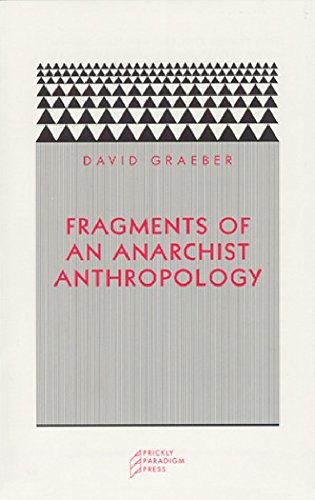
Ebook Info
- Published: 2006
- Number of pages: 71 pages
- Format: PDF
- File Size: 0.40 MB
- Authors: David Graeber
Description
Everywhere anarchism is on the upswing as a political philosophy – everywhere, that is, except the academy. Anarchists repeatedly appeal to anthropologists for ideas about how society might be reorganized on a more egalitarian, less alienating basis. Anthropologists, terrified of being accused of romanticism, respond with silence…But what if they didn’t? This pamphlet ponders what that response would be and explores the implications of linking anthropology to anarchism. Here, David Graeber invites readers to imagine this discipline that currently only exists in the realm of possibility: anarchist anthropology.
User’s Reviews
Reviews from Amazon users which were colected at the time this book was published on the website:
⭐James Woodburn (“Egalitarian Societies”, Man 17,3 (1982):431-451) offers the following general description of a large number of extant hunter-gatherer societies: “Social groupings are flexible and constantly changing in composition…People are not dependent on specific other people for access to basic requirements” and “relationships between people, whether relationships of kinship or other relationships, stress sharing and mutuality but do not involve long-term binding commitments and dependencies.” (p. 434) These societies, he suggests, are “profoundly egalitarian… [they] systematically eliminate distinctions–other than those between the sexes–of wealth, of power and of status… relationships between men and women are quite variable in these societies, although in all of them women have far more independence than is usual in [modern societies].”Christopher Boehm concurs with Woodburn in his famous book Hierarchy in the Forest (2000). He observes that we humans share with other primates the striving for hierarchical power, but hunter-gatherers successfully countered the dominance aspirations of “bullies” by what he calls “reverse dominance hierarchy.” By this he means that hunter-gatherers do not accept being controlled by an alpha-male, and are extremely sensitive to attempts of group members to accumulate power. When an individual appears to be stepping out of line by threatening or killing group members, he will be warned and punished. If this behavior continues and he cannot be ostracized, the group will delegate one or more members (usually including at least one close relative of the offender) to kill him. Boehm’s message in Hierarchy in the Forest is that “egalitarianism…involves a very special type of hierarchy, a curious type that is based on antihierarchical feelings” and that we are genetically predisposed to exhibit these antihierarchical feels, because individuals with excessively pro-hierarchical feelings have tended to be underrepresented in the gene pool through the process of reverse dominance hierarchy.These societies are anthropologist David Graeber’s inspiration for this short and engaging book on the possibilities for an anarchist society. “The basic principles of anarchism—self-organization, voluntary association, mutual aid,” he correctly asserts, are “forms of human behavior [that have] been around as about as long as humanity.” (p. 3) Moreover, he suggests that we can go back to older and simpler forms of social organization: “The West may have introduced some new possibilities, but it hasn’t canceled any of the old ones out.” (p. 51)What Graeber does not tell us is that the highly egalitarian societies of which he approves are virtually universally “immediate-return” societies. In immediate return societies group members obtain direct return from their labor in hunting and gathering, with food lasting at most a few days. The tools and weapons they use are highly portable. The alternative to immediate-return societies are “delayed return” societies in which the group recognizes that individuals hold rights over some sorts of valuable assets. The main types of such assets are valuable means of production, such as boats, nets, and beehives, processed and stored food or materials, and herds of animals. In delayed-return societies this egalitarianism gives way to highly inegalitarian forms of social stratification akin to those in modern societies: lineages, clans, chiefdoms and the like.As commentator mtraven pointed out to me, Graeber does touch on this issue, as follows;”There have been all sorts of successful experiments: experiments with worker’s self-management, like Mondragon; economic projects based on the idea of the gift economy, like Linux; all sorts of political organizations based on consensus and direct democracy…”However, these experiments have being going on for more than a century and have never amounted to more than a blip on the economic charts. Linux, Mozilla Foxfire and other voluntary contribution software initiatives have become megolith profit-maximizing firms. Except for a few outliers, like the Apache server and Aptana Studio, professional software developers use commercial software. Worker self-management, which I championed for many years, only works in firms with very low capital per head (such as law firms) or where the capital is extremely marketable (such as airlines) and where the degree of differentiation of the work force is very low. Moreover, successful worker-owned firms hire labor in the second generation and become capitalist owners themselves. All this is well described in the literature.I am not sure exactly why delayed-return societies have been able to overcome the innate egalitarian morality of which Graeber is so wistfully fond. Most likely the basis for egalitarianism in hunter-gatherer groups with lethal weapons (knives, spears, poisoned arrows, and the like) is the ability of any man to kill any other, if only by taking him by surprise or in his sleep. This capacity, by the way, is completely lacking in other primate species, which therefore rather prefer either solitary life or a social dominancy hierarchy with an alpha-male who rules by virtue of force alone. In delayed-return societies, there are forms of wealth that an aspiring despot can use to forge durable alliances protecting him from the masses whom he exploits.My conclusion is that only delayed-return societies can support a high level of material well-being, and such societies have the military power to control or marginalize any immediate-return society that might arise. Even if all societies magically became egalitarian and stateless, a mutant with an eye towards exploiting the weak could use delayed-return techniques to grow and eventually control and supplant egalitarian immediate-return societies.Anarchism is thus anachronistic, except for a small group of people who want to opt out of the world system and live in its social interstices. This does not mean that one cannot be an egalitarian. Indeed, the rise of liberal democratic capitalism and representative government have shifted the balance of power, even in delayed-return societies, to the masses—at least by contrast with the despotic and corrupt systems in the poor countries of the world today, and by equally strong contrast with the despotic and totalitarian systems of the past.The anarchists are disillusioned with liberal democratic capitalism because it is so unequal, and it leave so much poverty to itself while the rich and privileged wallow in obscene luxury. In fact, the only corrective for this situation is more democracy and more control over the aspirations of despots.The history of freedom is indeed U-shaped.. Our immediate-return hunter-gatherer ancestors were dignified and free, but life still was nasty, brutish and short. With the rise of delayed-return societies (agriculture, settled trade, bureaucratic state institutions), social dominance hierarchy was reestablished, but the democratic collective action of the masses of subjects since the mid-eighteenth century has turned the tide in favor of democracy and welfare-state capitalism.
⭐Best known for his book ‘Debt: The First 5,000 Years,’ and a leading figure in the ‘Occupy Wallstreet’ movement, Anarchist and Anthropologist David Graeber in ‘Fragments of an Anarchist Anthropology,’ attempts to tackle several themes. First, he calls for historical revisionism, illustrating through various examples how the western sense of history is flawed; that democracy pre-dated Athens, and communities can exist without state means of control, in contrast to Thomas Hobbes. Furthermore, he seeks to de-construct theories of the state and capitalism.He continues with a discourse on Anarchist thought. The philosophy of Anarchism was first formulated by Pierre Joseph Proudhon, and Mikhail Bakunin, among others. Basic principles of Anarchism include autonomy, voluntary association, self determination and self organization, mutual aid, and democracy. As Mr. Graeber illustrates, traditional non-state societies demonstrate these principles.Mr. Graeber notes that this puts anthropology in a position to both research and expand on Anarchist principles. He illustrates how anthropologists such as Marcel Mauss, James Frazer, and Pierre Clastres contributed to Anarchist thought through their insights on traditional societies, research on gift economies, consensus decision making, leveling mechanisms, homeostatic mechanisms in indigenous societies, and traditional forms of opposition to power (including nonviolent methods of resistance).Anthropology’s past is part of what keeps it from embracing Anarchist principles. The discipline started out aligned with colonialist institutions which sponsored research on the colonized in order to administer them more effectively. Anthropology has steadily adopted more populist principles, yet Mr. Graeber feels that the field should fully embrace the principles of Anarchism in order to carry out the needed research to verify the aims of Anarchist philosophy.Areas of research that Mr. Graeber feels needs addressed includes research on knowledge and power, hierarchy, alienation, the state, and traditional forms of organization that are not states. He concludes with several principles that Anarchists should address in response to globalization; these include an immediate amnesty on international debt, cancellation of intellectual property rights over a year old, freedom of movement across borders, and the elimination of radical inequalities.Considering Mr. Graeber’s arguments, I am disappointed with the format of the kindle edition. It seems like Mr. Graeber jumps from point to point and at times it is not easy to follow his train of thought. I don’t know whether that is due to Mr. Graeber’s writing style or is a result of the kindle format.The ideas are intriguing though. As Mr. Graeber illustrates through his research in Madagascar during periods when the state ceases to function, communities do maintain themselves through self organization. Other examples of this include frontier societies and labor exchanges such as ‘barn raising.’ Although self organization may never be a complete guarantee against the rise of the power hungry ‘alpha male,’ it can place limits on their rise to power.I do agree with some of the critique of a previous review that pointed out differences between delayed return societies and immediate return societies. There is a link between power and the amount of possessions that one accumulates. However, those wishing to pursue this line of inquiry should also look into value systems. In contemporary societies prestige is based on what one accumulates, whereas in many indigenous societies such as the Pacific Northwest (reknown for their potlatch) prestige was based on what could be given away. This illustrates that there is a value difference too between societies and the question to entertain is whether a ‘gift’ value system could be resurrected within contemporary societies? Seeking to recover this value system may further the Anarchist agenda that Graeber espouses.
⭐Bought this right after David Graeber passed. So sad that we lost this amazing thinker. This short pieces is a good introduction to some of the ideas that he unpacks in more depth in other works. Quick and dirty intro to anarchist theory and why it is needed in anthropology, academia in general, and the world at-large.
⭐Graeber is a thoughtful man and his ideas are worth attending to and can provoke giving a different consideration to former views. It may be that the anthropologist with his knowledge or speculation on the structural benefits of former societies, should as he asserts take a leadership position in addressing the structural changes to socio/political arrangements in our global community. However he seems somewhat conflicted by the decentralised models of esoteric tribal groups and “states” with the highly centralised form of the socialist state. In the early part of the book he seemed directed to a similar intellectual solution to the founders of the U.S, of limited centralised government and divided powers and regionalised sovereignty and later reveals an emotional affection for communism, which may work in small autonomous cooperative units, but has been seen to be unwieldy and totalitarian in large nation states. Anything but the hope of the anarchist.
⭐This is an important book. I’ve bought copies for about 5 different people already. One of the most insidious aspects of capitalism is that it suppresses our ability to imagine alternatives to calitalism. How many people do you know who will accept that we will destroy the planet this century but won’t accept that they can live under any economic system other than the one that is destroying the planet? This book will help you see alternatives.
⭐Fragments of an Anarchist Anthropology is an essay by the late David Graeber which seeks to confront the issue of anthropology in the academy and its somewhat conflicted relationship with anarchism. In a thought-provoking read of just over one-hundred pages, Graeber provides the reader with an informative background into the foundations of both anthropology and anarchism, why the two have had difficulty intersecting but why fundamentally he believes it may provide the means for us to progress in our thinking not just about modern day issues but also the questions about what makes us fundamentally all human.A rousing miniature manifesto for an “Anarchist Anthropology”, this work is a must-read for all in the social sciences who are serious about confronting some of the worlds modern challenges, and for those who believe in a globalist, post-nation future.
⭐Engaging analysis of anarchistic thought from an unusual angle.Looks at how societies have developed anarchic approaches to ‘government’.Only a short book,his other works might be worth a look at if he goes into more detail.
⭐Book arrived on time and s4store was always attentive and caring.Also, this book is eye opening.
⭐This concise book explores the academy’s exclusion of anarchism…and gives a great argument for the use of myth, monsters and folk tales for self-regulating communities.
⭐Excellent reading and lots of questions to ask.
Keywords
Free Download Fragments of an Anarchist Anthropology in PDF format
Fragments of an Anarchist Anthropology PDF Free Download
Download Fragments of an Anarchist Anthropology 2006 PDF Free
Fragments of an Anarchist Anthropology 2006 PDF Free Download
Download Fragments of an Anarchist Anthropology PDF
Free Download Ebook Fragments of an Anarchist Anthropology