

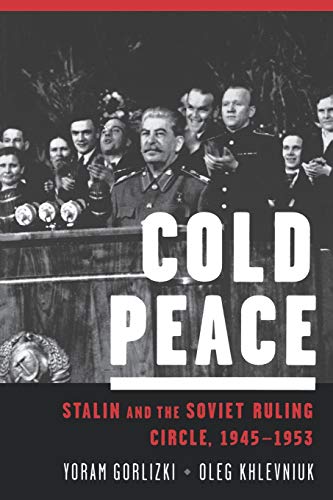
Ebook Info
- Published: 2005
- Number of pages: 272 pages
- Format: PDF
- File Size: 3.29 MB
- Authors: Yoram Gorlizki
Description
Following his country’s victory over Nazi Germany, Joseph Stalin was widely hailed as a great wartime leader and international statesman. Unchallenged on the domestic front, he headed one of the most powerful nations in the world. Yet, in the period from the end of World War II until his death, Stalin remained a man possessed by his fears. In order to reinforce his despotic rule in the face of old age and uncertain health, he habitually humiliated and terrorized members of his inner circle. He had their telephones bugged and even forced his deputy, Viacheslav Molotov, to betray his own spouse as a token of his allegiance. Often dismissed as paranoid and irrational, Stalin’s behavior followed a clear political logic, contend Yoram Gorlizki and Oleg Khlevniuk. Stalin’s consistent and overriding goal after the war was to consolidate the Soviet Union’s status as a superpower and, in the face of growing decrepitude, to maintain his own hold as leader of that power. To that end, he fashioned a system of leadership that was at once patrimonial-repressive and quite modern. While maintaining informal relations based on personal loyalty at the apex of the system, in the postwar period Stalin also vested authority in committees, elevated younger specialists, and initiated key institutional innovations with lasting consequences. Close scrutiny of Stalin’s relationships with his most intimate colleagues also shows how, in the teeth of periodic persecution, Stalin’s deputies cultivated informal norms and mutual understandings which provided the foundations for collective rule after his death. Based on newly released archival documents, including personal correspondence, drafts of Central Committee paperwork, new memoirs, and interviews with former functionaries and the families of Politburo members, this book will appeal to all those interested in Soviet history, political history, and the lives of dictators. Cold Peace was a CHOICE Outstanding Academic Title for 2005.
User’s Reviews
Editorial Reviews: Review “[W]ould be useful reading for those studying the regimes of Adolf Hitler, Francisco Franco, Fidel Castro, or Saddam Hussein.”–Eric Duskin, Christopher Newport University”[A] close-to-definitive reappraisal of the political history of late Soviet Stalinism, an accomplishment that had eluded so many scholars due to the lack of sufficient archival access…[A]n exhaustively researched and lucidly written volume…”–Slavic Review”A book of impeccable scholarship, which deserves to be read by all serious students of modern Russian history and politics.”–The Russian Review”Whereas earlier historians of this period have relied largely on newspaper articles, leaked reports and memoirs–many colored to show Khrushchev, Stalin’s eventual successor, in a positive light–Gorlizki and Khlevniuk have trawled through piles of newly available Central Committee paperwork and personal correspondence to create an admirably objective and balanced account of Stalin’s relationship with his ruling circle….For scholars seeking a hard-nosed analysis of high-level Soviet politics after the war, this book could hardly be bettered.”–Moscow Times”The authors’ impressive work with the archival sources makes for a convincing and gripping account of the dictator’s final months and days….[A] book of impeccable scholarship, which deserves to be read by all serious students of modern Russian history and politics….It may attract comparison with those two splendid blockbusters, William Taubman’s Khrushchev: The Man and His Era and Simon Sebag Montefiore’s Stalin: The Court of the Red Star. While the scope of their research is narrower, Gorlizki and Khlevniuk display no less skill in creating this definitive monograph.”–T.H. Rigby, Australian National University, Canberra”A highly valuable book. It adds significantly to our understanding of Stalinist dictatorship, presents new evidence for what happened in the Soviet Union, and analyzes it insightfully.”–H-Net”The most detailed account to date of Soviet high politics in the post-war Stalinist years. The analysis and revelations in this book are absolutely first-rate.”–CHOICE”Whereas earlier historians of this period have relied largely on newspaper articles, leaked reports, and memoirs–many colored to show Khrushchev, Stalin’s eventual sucessor, in a positive light–Gorlizki and Khlevniuk have trawled through piles of newly available Central Committee paperwork and personal correspondence to create an admirably objective and balanced account of Stalin’s relationship with his ruling circle….For scholars seeking a hard-nosed analysis of high-level Soviet politics after the war, this book could hardly be bettered.”–Moscow Times”Cold Peace is a masterful analysis of high politics around Stalin in the least known period of his autocracy. Dark, grim, subtle, crackling with the electricity of Stalin’s seething personality and constant manouvering, this brilliant book delivers readable narrative history, superb archival research and a splendid analysis of that terrifying character: it destroys myths with the same facility that it unveils new fascinations….as important and magisterial for the postwar period as the classic historical works of the Revolution and Terror.”–The Spectator”A tour de force by Russia’s most distinguished historian of Soviet politics and an outstanding young British scholar, based on voluminous new archival material, clearly presented and judiciously analyzed. All scholars and students of Soviet history need to buy this book, which for the first time gives us a reliable, detailed account of the internal politics of the late Stalin period in highly readable form. Indispensable for understanding both Stalin’s role and personal power and the surprisingly sophisticated mechanisms that functioned routinely without his direct intervention.”–Sheila Fitzpatrick, author of Everyday Stalinism”Cold Peace is magisterially researched, clearly written, and makes an important contribution to our knowledge of Stalin’s last eight years. A fascinating description of how Stalin systematically humiliated and persecuted precisely those on whom he was most dependent.”–Abbott Gleason, author of Totalitarianism”Using previously unavailable archives, Gorlizki and Khlevniuk have reconstructed the inner workings of the top Soviet leadership in the declining years of Stalin’s brutal reign. They take us into the inner sanctum of the Kremlin and weave for us an intricate tapestry of cold calculation and intrigue, jockeying for influence and caprice, with Stalin squarely in the center and in control. Rather than simply the tale of degenerating dictatorship, the years after World War II were marked by consolidation of the institutions and habits of authoritarianism.”–Ronald Grigor Suny, University of Chicago”[A] most readable, original, and stimulating study.”–Christopher Read, University of Warwick About the Author Yoram Gorlizki teaches Russian politics and history at the University of Manchester, where he is a Senior Lecturer in the Department of Government.Oleg Khlevniuk is a Senior Research Fellow at the State Archive of the Russian Federation.
Reviews from Amazon users which were colected at the time this book was published on the website:
⭐We have had several recent biographies of Stalin, as well as new histories of the Col War. There have been, however, few accounts of internal Soviet politics for the period 1945-53. Cold Peace fills this void. In a short, well research book, the authors explain Stalin’s style of rule. While not neglecting the victims of the seven plus yeas, the authors cogently explain Stalin patriomonial style. The book also explains how the senior leaders of the country and the Communist Party maneuver around Stalin, adroitly avoiding annoying the vozhd.
⭐In 1945, Russia stood alone among the continental European powers as the unquestioned victor of World War II, as a Superpower, at least in a military and political sense. The country had been devastated by four years of fighting and nearly 30 million dead, civilian and military. Much of its industry was in tatters. This book discusses how Stalin modified his ruling style after the war, as opposed to his pre-war methods with the Purges. It appears Stalin, cautious as ever, wanted to avoid the upheavals of the 1930s and made changes only incrementally. The book also discusses Stalin’s tolerance for differing opinions and his intolerance for lack of candor. Putting it another way, he wanted to hear it like it was and was not a sycophant lover. This was at the root of the “Leningrad Affair” in 1949 in which two key Party members were shot. The book gives insight into the functioning of the Politburo machinery and the alliances formed among Politburo members, most notably Malenkov and Beria. The book sets the stage for the events that happened in 1953 after Stalin’s death and why, with the exception of Beria, the transition of power was essentially bloodless. It also sets the stage for the de-Stalinization process implemented by Soviet leaders in the 1950s.
⭐In 1945 V.M. Molotov pleaded with Stalin to ease censorship of foreign correspondents, but sensing Stalin’s disapproval, assured him he would tighten censorship. This example of kowtowing is emblematic of Stalin’s interactions with his inner-circle, and the subject of Yoram Gorlizki and Oleg Khlevniuk’s Cold Peace: Stalin and the Soviet Ruling Circle, 1945-1953. The structure of Cold Peace progresses chronologically through late Stalinism, 1945-1953, which has traditionally been described as the calcification of the Soviet Union’s political, ideological, and economic institutions, and all under the dictatorship of an unstable leader. Gorlizki and Khlevniuk argue Stalin’s actions were not a result of an unstable mind; but of his relationship with his inner-circle followed an administrative and political logic, which their book seeks to unravel (3). Following the Great Patriotic War, coupled with Cold War tensions, the Soviet Union demanded a more effective administrative structure. Gorlizki and Khlevniuk use the international and internal problems as the underlying reasons that demanded changes to the Soviet state. Despite the necessity for a more effective state apparatus, Stalin preferred to rule informally. Gorlizki and Khlevniuk argue that Stalin wanted to restore the pre-war leadership balance, and be able to rule informally through the Politburo. Gorlizki and Khlevniuk describe the co-existence of the Politburo and the Council of Ministers (Sovmin) as neo-patrimonial. Stalin preferred to rule informally through the Politburo, but the formation of Sovmin served the purpose of making the administrative system more effective, hence neo-patrimonial. Sovmin was emblematic of the modern efficient state, which met regularly, contrary to the Politburo which met irregularly and undocumented (48). Stalin’s preference to rule informally was the basis for his methods of keeping his inner-circle in line. Gorlizki and Khlevniuk use the informal aspect of Stalin’s dictatorship to best describe the methods he used to manipulate the inner-circle. Stalin would denounce, demote and reshuffle the responsibilities of his inner-circle. The logic behind these attacks was to reinstate pre-World War II leadership norms, and to eliminate any autonomous action that had been fostered during the War (29). Stalin’s manipulation of his inner-circle did not end with denunciations, but also with periodic purges. Gorlizki and Khlevniuk use the Leningrad affair and the Doctor’s plot as examples of periodic purges that kept his colleagues in line. Although Gorlizki and Khlevniuk’s do acknowledge that Stalin was prone to fantasy, which would appear to be the antithesis to their main argument, our authors demonstrate Stalin’s need for convincing evidence, and the support of his inner-circle, so they would be jointly responsible (170). Gorlizki and Khlevniuk use these examples to demonstrate Stalin’s logical mind (163). Despite Stalin’s informal rule, the neo-patrimonial system not only made Stalin an effective dictator, it also created the opportunity for the inner-circle to understand the problems of Stalin’s leadership. As much as Cold Peace is about Stalin’s leadership, it is also about the buildup to reforms after 1953. After Stalin’s death the neo-patrimonial system dissolved in favor of the state apparatus, or Sovmin (166). According to Gorlizki and Khlevniuk, this shift of the “center of gravity” to the state apparatus was a continuation of the rise of Sovmin (166). Members of Stalin’s inner-circle held key positions in the party-state apparatus, and their positions within state agencies allowed them certain autonomy; this autonomy helped them realize the flawed and anachronistic nature of the neo-patrimonial system (106). The common understanding of problems, such as the lack of agrarian and labor camp system reforms, created a “collective membership,” which Gorlizki and Khlevniuk argue gave Stalin’s inner-circle a common understanding of the systematic reforms that would be necessary to enact (106). Stalin benefited from his inner-circle’s “balance of forces,” and would not upset it, because he always had the control of the “levers” of state security (113). Cold Peace is a book that should not only hold a place in the history of the Soviet Union, but also speaks to a larger audience interested in dictatorships of the twentieth-century. Gorlizki and Khlevniuk provide a unique description of a dictatorship not available from a study of Mussolini or Hitler (168). The fundamental difference between Stalin and his dictatorial counterparts was not that he survived World War II, but the fact he was a “machine politician” (168). Stalin was not an accomplished orator, but did not hesitate to involve himself in bureaucratic disagreements, which Hitler avoided. In the context of twentieth-century dictatorships, Cold Peace, provides a picture of a dictator without the trappings of intense oratory, but an instinct for the intricate details of bureaucratic administration. The collapse of the Soviet Union provided historians with a rich source of primary documents, which Cold Peace benefits from. Gorlizki and Khlevniuk admit the Russian archives do not allow them to “see into Stalin’s mind,” but it does allow them to understand his behavioral patterns in dealing with his inner-circle (165). Earlier works on Stalinism relied upon newspaper articles, and a small number of reports that escaped the clutches of the Soviet Union (11). One of the most famous memoirs is Nikita Khrushchev’s Khrushchev Remembers. Cold Peace uses memoirs, Central Committee resolutions, correspondence between Stalin and his entourage, Politburo, and other leaders that counter Khrushchev’s accounts (11). These sources help expose not only a complex political situation during Late Stalinism, but the logic of Stalin’s manipulation of his inner-circle. Gorlizki and Khlevniuk’s Cold Peace offers not only historians of the Soviet Union, but historians of twentieth-century Europe a unique glimpse into the functions of a dictatorship. The neo-patrimonial system was a result of Stalin’s affinity for informal rule, but was also influenced by the post-World War II situation, which necessitated a need for a more formal and efficient administration. Stalin’s manipulation of his inner-circle was a result of neither rampant paranoia, nor fatigue, but a calculated method to maintain his dictatorship, and the “balance of forces” among them to operate an efficient state. Interestingly, Cold Peace, shows that Stalin’s dictatorship fostered the leadership that would come after his death with an understanding that reforms were necessary. Gorlizki and Khlevniuk provide an excellent analysis of the behavior and logic of Stalin, neither as a deranged or paranoid leader, but a “machine politician.”
Keywords
Free Download Cold Peace: Stalin and the Soviet Ruling Circle, 1945-1953 60422nd Edition in PDF format
Cold Peace: Stalin and the Soviet Ruling Circle, 1945-1953 60422nd Edition PDF Free Download
Download Cold Peace: Stalin and the Soviet Ruling Circle, 1945-1953 60422nd Edition 2005 PDF Free
Cold Peace: Stalin and the Soviet Ruling Circle, 1945-1953 60422nd Edition 2005 PDF Free Download
Download Cold Peace: Stalin and the Soviet Ruling Circle, 1945-1953 60422nd Edition PDF
Free Download Ebook Cold Peace: Stalin and the Soviet Ruling Circle, 1945-1953 60422nd Edition