

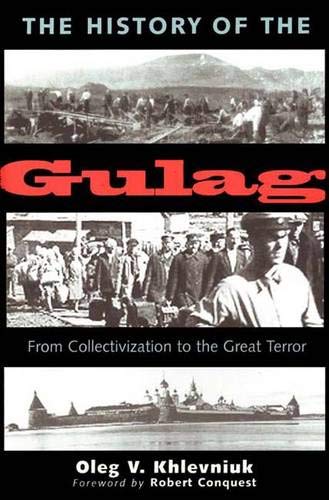
Ebook Info
- Published: 2004
- Number of pages: 464 pages
- Format: PDF
- File Size: 2.54 MB
- Authors: Oleg V. Khlevniuk
Description
The human cost of the Gulag, the Soviet labor camp system in which millions of people were imprisoned between 1920 and 1956, was staggering. Aleksandr Solzhenitsyn and others after him have written movingly about the Gulag, yet never has there been a thorough historical study of this unique and tragic episode in Soviet history. This groundbreaking book presents the first comprehensive, historically accurate account of the camp system. Russian historian Oleg Khlevniuk has mined the contents of extensive archives, including long-suppressed state and Communist Party documents, to uncover the secrets of the Gulag and how it became a central component of Soviet ideology and social policy.Khlevniuk argues persuasively that the Stalinist penal camps created in the 1930s were essentially different from previous camps. He shows that political motivations and paranoia about potential enemies contributed no more to the expansion of the Gulag than the economic incentive of slave labor did. And he offers powerful evidence that the Great Terror was planned centrally and targeted against particular categories of the population. Khlevniuk makes a signal contribution to Soviet history with this exceptionally informed and balanced view of the Gulag.
User’s Reviews
Editorial Reviews: From Publishers Weekly Starred Review. Annals of Communism, Yale’s acclaimed series, adds another major documentary history to its list. More than 100 documents from the Russian archives are translated, and interspersed with Russian historian Khlevniuk’s extensive analysis. The result is a fascinatingly detailed depiction of that horrific symbol of the 20th century, the Soviet prison camp system. Khlevniuk argues that the gulag as it developed from 1929 was a new creation, a specifically Stalinist invention. He weaves together personal accounts by victims with the far more numerous documents written by Soviet bureaucrats. The documents provide surprises and revelations. In the early years, prisoners petitioned and went on strike for improvements in their conditions, sometimes successfully. Officials wrote innumerable memoranda documenting the abysmal food supplies and sanitary conditions and the excessive brutalities of camp guards. At the same time, production derived from forced labor became a major element of the Soviet economy. Attempts to ameliorate the camp situation were thwarted by the ineptitude of the Soviet bureaucracy and the severe crises of the 1930s. Khlevniuk demonstrates how every tightening of the overall political situation, such as the onset of forced collectivization and then the Great Terror, led to a worsening of conditions within the camps. Ultimately, the camps were “almost [the] direct reflection” of the Soviet system and the outcome of decisions made by Stalin and a small group around him. This is an excellent companion to Anne Applebaum’s Pulitzer-winning Gulag: A History. 39 illus. Copyright © Reed Business Information, a division of Reed Elsevier Inc. All rights reserved. Review “Annals of Communism, Yale’s acclaimed series, adds another major documentary history to its list. More than 100 documents from the Russian archives are translated, and interspersed with Russian historian Khlevniuk’s extensive analysis. The result is a fascinatingly detailed depiction of that horrific symbol of the 20th century, the Soviet prison camp system.”—Publishers Weekly‘Precise and balanced in its use of sources, Stalin has many advantages over its competitors… if this book is a classic, it will be for it’s laconicism and lucidity, and it’s authoritative separation of the incontrovertible from the probable and possible in Stalin’s motivation.’—Donald Rayfield, TLS. (Donald Rayfield TLS 2015-08-14) About the Author Oleg V. Khlevniuk is senior researcher at the State Archive of the Russian Federation, Moscow. Read more
Reviews from Amazon users which were colected at the time this book was published on the website:
⭐This is one of the books in Yale University’ series “Annals of Communism.” So far I have read three of these works, and rated all of them with five stars. Their scholarship is impressive, and they bring the political situation under Stalin’s regime into the reader’s living room as no other series (or single volume) has done. Yale is to be praised for this series and this author, Oleg Khleevniuk, in particular for this fine work. Like others in this series, this work is based on documents made available to historians from archives of the Soviet Union since the fall of Communism. The author presents many of these documents organized chronologically, tying them all together with a narrative discussing the documents, their content and importance. There is simply so much to learn here that I don’t know where to begin. It was interesting that Robert Conquest wrote the Foreword (very objectively, I might point out) when he was literally the only scholar of note to address the GULAG and its liquidation of millions of people for so many years. Liberals like Walter Lippmann, Walter Cronkite and many others denied the GULAG’s existence for many years, and even if it did exist, it was supposedly more humane than the American prison system. Gee, how could so many in the American media and national political scene get it wrong? Well, for many it was an inconvenient truth that needed to be denied since they were cheering for the eventual victory of socialism and communism. But now the cat is out of the bag. So why are we still marching like a group of lemmings to a socialist state? Because people don’t read books like this. The only negative aspect of this work is that the reader is bombarded with numbers upon numbing numbers of people sent to camps, dying in transport, dying of maltreatment, dying of malnutrition, and dying of loneliness, hopelessness and every form of human depravity and degradation. Even upon release, the “repressed” individuals could at best look forward to a bleak life of hardship at a subsistance level and probably another long sentence at the government’s pleasure. There was no such thing as “the pursuit of happiness” — just the pursuit of another day to survive. All this wears the reader down, but that is as it should be. We should come to understand the inhumanity of the GULAG and the system that needed it for its own survival. This is a book that every student in high school should read, and it they do, the virtues of our free American society might have more meaning to our pampered youth. Repression is growing in America as national bureaucracies grow and increase their power to govern the lives and well-being of the population. After some tipping point physical repression will have to be used, and it is not difficult to imagine recalcitant individuals being sent to camps for political indoctrination. Is not “anger management” used on some individuals today? How about “sensitivity training?” This is all conditioning, and if the person fails to respond appropriately in the bureaucrat’s mind, what is next? I leave that to the reader’s imagination. Stalin opened his repressive measures with a campaign against the “Kulaks”, supposedly wealthy peasants, but readily expanded that term to an idea rather than a specific class. The system rapidly disregarded guilt or innocence and simply ordered certain quotas for deportations. If a region could only find 5,000 people they could classify as anti-soviet agents and the quota was 10,000, the additional 5,000 were simply swept up off the streets and sent to the GULAG. Their crimes could always be determined later at random. After all, the communist regime wasn’t functioning very well, and the fault had to be that of “wreckers”, Kulaks, and anti-soviet elements. If the police couldn’t find those actually guilty of such “crimes”, then transporting others would set the example than no one was immune from deportation and help drive the criminals into hiding where they couldn’t undermine government programs. Or so ran the logic. Author Khlevniuk had done a wonderful job with this subject in a most scholarly fashion. It is now impossible to deny the GULAG existed and the mechanisms and policies of the Soviet state that brought it into existence and managed it. Sorry, Virginia, there was no Santa Claus in the Soviet Union. Read this book to discover various party officials and bureaucrats fighting turf wars and various problems in managing the GULAG. And they thought they had it bad. What about the people in the camps? What about all those who died, by beatings, shootings, and all the other attendant ills of the system? We thought Hitler’s ovens were bad, but at least that was a quick end. So where are the monuments in Washington to the GULAG? Man’s inhumanity to man? Read and weep, read and weep. This is a monstrously important book.
⭐Oleg Khlevniuk’s Russian archive work on researching the true extent of the destruction of humans under Stalin is by far the best work in the field. By painstakingly analyzing secret reports, top secret letters between Commissars, censuses, official data, the Chrushchov era KGB research, etc. he is capable of giving an authoritative and absolutely fair analysis of exactly what went on in the GULAG system in particular and Stalinism as a whole, how many people were affected and how, and what this means for the accuracy of the ‘popular view’ of Stalin’s crimes.Contrary to Conquest, Malia, Montefiore etc. etc. he presents the facts and the documents as they are and lets them speak for themselves, instead of going on and on about the moral/sentimental issues without any thorough factual backing, as almost all such popular writers on the USSR do. Certainly no fan of Stalin either, he manages to present the simple facts in such a clear and well-evidenced way that he does justice to all involved. An impressive achievement considering the political meaning of the subject.
⭐Khlevniuk has done a valuable service by collecting and selecting key documents related to the development of the Soviet prison system. However, for someone just wanting to learn about the general history, Anne Applebaum’s book would be a far better bet.
⭐A must read.
⭐This is an excellent history of the Gulag.It is a collection of documents, letters, memos, reports, statistical tables, from the Soviet archives. These documents are interspersed with analysis and commentary. This format is both the book’s strength and weakness.The strength is that the reader gets to form his/her own opinion about the Gulag, collectivisation and Terror rather than being fed received opinion from authors many of whom, such as Robert Conquest, approach such matters from an intensely partisan position. The intervening commentary serves to guide understanding around some of the contentious issues of interpretation rather than tell the reader what to think. As such, I think that it’s a great book for students – especially as such an approach serves to undermine the thesis of continuity between the revolution of 1917 and the events of the 1930’s described here and reinforce the discontinuity instead. In this regard, the introduction from Conquest jars somewhat as the approach here serves to undermine the ideological school of which he has been such a major proponent.The weakness is that the book is a bit of a disjointed read for an interested general reader who may be looking for a smoother narrative.Criticism aside, this is an excellent book for understanding what happened in the Stalinist counter-revolution of the 1930’s. It’s not so strong on explaining why the events described happened.
Keywords
Free Download The History of the Gulag: From Collectivization to the Great Terror (Annals of Communism Series) in PDF format
The History of the Gulag: From Collectivization to the Great Terror (Annals of Communism Series) PDF Free Download
Download The History of the Gulag: From Collectivization to the Great Terror (Annals of Communism Series) 2004 PDF Free
The History of the Gulag: From Collectivization to the Great Terror (Annals of Communism Series) 2004 PDF Free Download
Download The History of the Gulag: From Collectivization to the Great Terror (Annals of Communism Series) PDF
Free Download Ebook The History of the Gulag: From Collectivization to the Great Terror (Annals of Communism Series)