

Ebook Info
- Published: 1997
- Number of pages: 292 pages
- Format: PDF
- File Size: 1.06 MB
- Authors: William R. Jones
Description
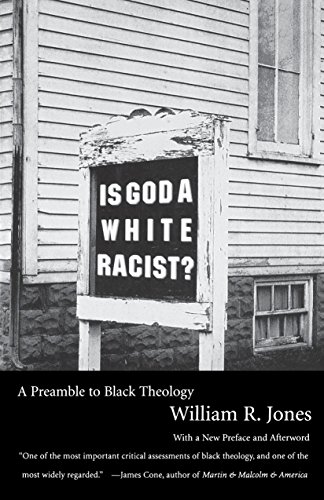
Published originally as part of C. Eric Lincoln’s series on the black religious experience, Is God a White Racist? is a landmark critique of the black church’s treatment of evil and the nature of suffering. In this powerful examination of the early liberation methodology of James Cone, J. Deotis Roberts, and Joseph Washington, among others, Jones questions whether their foundation for black Christian theism—the belief in an omnibenevolent God who has dominion over human history—can provide an adequate theological foundation to effectively dismantle the economic, social, and political framework of oppression.Seeing divine benevolence as part of oppression’s mechanism of disguise, Jones argues that black liberation theologians must adopt a new theism that is informed by humanism and its principle of the functional ultimacy of wo/man, where human choice and action determine whether our condition is slavery or freedom.
User’s Reviews
Editorial Reviews: Review One of the most important critical assessments of black theology, and one of the most widely regarded. —James Cone, author of Martin & Malcolm & America”Black religious humanism has no more articulate exponent than William R. Jones. No liberation theology, black or white, can afford to ignore his searing critique of the idea of God’s omnibenevolence, or the link he makes between natural evil and social oppression. For all that, he expounds not fatalism, but humanistic hope for us all.” —John A. Buehrens, president, Unitarian Universalist Association of Congregations About the Author William R. Jones (1933-2012) was a professor of religion and director of black studies at Florida State University. A well-known and respected African American theologian and scholar, he was the author of the groundbreaking book Is God A White Racist?, a deep and profound look at the connections between natural evil and social oppression.
Reviews from Amazon users which were colected at the time this book was published on the website:
⭐Bill Jones’ pointed critiques of traditional Black theologians’ rationalization of black suffering is arguably the most enlightening theological work of its kind ever written. Unless we are willing to acknowledge that God is a racist, then there is absolutely no reasonable way to arrive at any other conclusion than the discomforting reality that God is not physically involved in the affairs of humankind. Whether God is powerless and unable to intervene or powerful and unwilling to intervene is entirely irrelevant. The result is what is practically important.There is perhaps only one area where the book can be found lacking, and that is in its inconsideration of the faith-based possibility of divine involvement in human affairs on a spiritual or emotional level. While Jones picks apart anti-logical (a subset of illogical) arguments like a surgeon, he does not provide an “out” for the hard of heart by acknowledging that there are some realms of illogic that are not necessarily anti-logical and cannot be easily dismissed using conventional logic. This is a minor criticism, however, since the focus of the book is God’s physical activity (or lack thereof) in this world. Jones’ book is perhaps the most fascinating contemporary theological critique and treatise of the modern era.
⭐This book shocked me for the simple reason there has been a Black scholar who has grappled with the idea of there being an all-knowing all-powerful god, while there is continued suffering in the Black community. I would highly recommend this book for all persons of color who are questioning their faith.
⭐Good read!
⭐A must read for any seeking guidance on theology as applied to the African American experience.
⭐Is God a white racist critiques various Black Theologians as leaving this big question unanswered. Jones’ basic critique of Black Theologians is that they assume that God is actively at work for the liberation of Black people and yet have no examples or proof of such a claim. In fact Jones’ would argue that the assumptions of Black Theology that God is all powerful and actively invovled in humanity leaves God open up to the charge of divine racism which is a question that Jones believes the Black liberation Theologians must answer. Jones also beleives that the God of black theologians can also lead to passivity.In this work Jones looks at various major proponents of Black theology and seeks to show how each of their assumptions leave open the possibility of divine racism. Jones does have a proposal to get around the possibility of divine racism by seeking to replace the all-powerful God who is actively invovled in human events with a God that is not invovled and leaves humanity to work its own problems out. This position is what Jones has called Humanocentric Theism. God exists, but God ain’t inovled.Agree or disagree it is an important work that all of those interested in Black Liberation Theology should read.
⭐God, as being represented by any people that use the name of God to “manifest their destiny” by annihilating and enslaving millions of human beings like themselves as if they were animals, has made themselves into God. Therefore the answer to Williams’ question is YES! God is a white racist. Anyone can become “God” I have found, when they need to push their agenda that is so obscene and evil that it needs a divine mandate to give their plan credibility. Jones wins the award for book title of all time. He is on my top ten reading list along with “Black Theology, Black Power” by his counterpart, James Cone. JUST READ IT!
⭐This book is very well thought out. The author tries to give an argument about God. The title is a little misleading because of what he addresses. His argument is basically this: If God is omnibenevolent, omnipotent, and all loving, why do black people suffer? I don’t want to spoil this book, but if you are reading this review (no matter what race you are), you really should spend the money on this book. It is worth it, I assure you.
⭐At the time this book was published in 1973, William R. Jones was a professor of religion and director of black studies at Florida State University. In the Preface to this 1998 edition, he wrote that this book “personified my plan for black liberation and my uncommon religious conversion from black Christian fundamentalism to black religious humanism… IGWR’s argument comprised a constructive criticism of the black church and black theology that blended deconstruction and reconstruction.” (Pg. vii) Later, he added, “[The book] took the centrality of the black church and black Christianity in the community as its point of departure. But it took exception to other hypotheses that assigned positive value to the black church and black Christianity as instruments of liberation—arguing instead that black Christianity was a form of mis-religion that fulfilled a vital role in keeping blacks oppressed. In particular, it challenged as flawed the twin claims that ‘though blacks accepted the white man’s religions,’ they recreated and remolded it to fit their ‘own peculiar needs,’ and that ‘the black man’s pilgrimage in America was made less onerous because of his religion.’” (Pg. xv)He wrote in the Introduction of Rabbi Richard Rubenstein’s book
⭐. “His analysis of Jewish suffering forced me to pose a troublesome question that he does not explicitly consider: Is God an anti-Semite? The implications of his study for my own explorations in black theology were direct and immediate. In the light of black suffering, a suffering that may exceed that of the Jews, the unsettling question becomes: Is God a white racist?” (Pg. xxii) He continues, “The issue of divine racism surfaces whenever a specific type of suffering, which I identify as ‘ethnic suffering,’ is joined with particular interpretations of God’s sovereignty over human history… with the intent of establishing divine racism as not only a legitimate but an irreducible theological category.” (Pg. xxiii)He explains, “A former colleague responded to my claim about the centrality of theodicy with this criticism:… he concluded that I do not sufficiently honor the black perspective. This is an eminently fair challenge, and the bulk of this book is an implicit reply to it… Theodicy, I will show, is already at the heart of theology; I simply call attention to this fact.” (Pg. xxiii-xxiv)He concludes the Introduction, “a new model for treating black suffering must be sought. I suggest that what I term ‘humanocentric theism’ and ‘secular’ humanism are the best candidates. The essential feature of both is the advocacy of the ‘functional ultimacy of man.’ Man must act AS IF he were the ultimate valuator or the ultimate agent in human history or both. Thus God’s responsibility for the crimes and errors of human history is reduced if not effectively eliminated.” (Pg. xxviii) He adds, “features of black theologians … must be modified if humanocentric theism or secular humanism is accepted as normative. The belief, for instance, that blacks are God’s chosen people must be abandoned.” (Pg. xxviii)In the first chapter, he states, “To speak of divine racism is to raise questions about God’s equal love and concern for all men. It is to suggest that He is for some but not for others, or at least not for all equally. It asks whether there is a demonic streak in the divine nature. The charge of divine racism, in the final analysis, is a frontal challenge to the claim of God’s benevolence for all.” (Pg. 6) He adds, “in the face of human suffering, whatever its character, we must entertain the possibility that it is an expression of divine hostility… the particular category of black suffering… at least suggests the possibility of divine racism, a particular form of hostility.” (Pg. 9)He asserts, “Having shown that deserved punishment is a possible interpretation of suffering and that a theodicy of deserved punishment involves quietism, we have arrived at the position where we can demand the following: the Christian who wants to eliminate suffering or reduce it, the Christian who wants to heal the sick, must confirm that the suffering itself is not deserved punishment. Such a demonstration, I conclude, is exceedingly difficult to formulate.” (Pg. 56)He outlines, “[Chapter V] purports to show that the issue of divine racism has been illegitimately ignored by the current black theologians… the absence of an analysis and denial of the question ‘Is God a white racist?’ constitutes a curious inconsistency and removes the necessary support the superstructure of their respective systems requires. I will show specifically that the issue of divine racism is implicit in the following propositions affirmed by the black theologians: black theology is a theology of liberation; the politics of God and blacks as God’s chosen people are central themes in black theology; and black theology is committed to a total a comprehensive examination of the Christian tradition.” (Pg. 71)Commenting on James Cone’s book
⭐, he says, “Note the core of Cone’s argument here. It is by virtue of their status as the oppressed that blacks occupy the unique epistemological position that makes they sole judge of the character of their sin and its relation to their suffering. However, without a pervasive refutation of the theodicy of deserved punishment, the classification of blacks as oppressed clearly begs the question, and Cone’s theodicy is invalid until this flaw is determined.” (Pg. 105)He continues, “In point of fact, does not the continued suffering of blacks AFTER the Resurrection raise the essential question all over again: Is God for blacks? We must not forget that black misery, slavery, and oppression—the very facts that make black liberation necessary—are all POST-Resurrection events. Must not the fact of black oppression after the Resurrection raise the most serious questions about Cone’s designation of the Resurrection as the event of universal liberation? It is closer to the truth, it seems, to say that Cone is affirming liberation in an unliberated world!” (Pg. 119)He clarifies, “It is not my intention to eliminate the category of hope from black theology. Hope is necessary to motivate an oppressed people to undertake its liberation. What I insist upon is some clarity about the different types of hope. Must a black theology appeal primarily to an extrahuman or suprahuman ground? Is hope in God, as they interpret him, the only basis for black religion? If this is what black theologians affirm, then they are obliged to justify hope in this suprahuman factor in light of the intolerable surplus of black suffering, which is their own point of departure for theologizing. If they invoke God as their hope, they had better be certain that He is in fact on the side of black people. For my part, I would emphasize an ANTHROPOLOGY of hope rather than a THEOLOGY of hope. By this I express a conviction not to seek aid beyond the human level.” (Pg. 141-142)He articulates, “My own constructive enterprise, the formulation of a black theology rivaling those now available, lies in the immediate future. It will consummate in a statement utilizing the framework of ‘secular’ humanism. In fact, the purpose and content of this present book become clearer if it is seen as an attempt to make a place in the theological circle for a non-theistic model. The present work, in a real sense, is a prolegomenon to my own future statement in black theology, since the argument of this book explains why a humanistic model is necessary. “ (Pg. 171)He argues, “the claim of God’s support for black liberation lacks substance until the black theologians refute the charge of divine racism. Their failure to provide a convincing rebuttal, along with their question-begging argument for divine sanction of black freedom, eliminates any real ground for black hope. Until they provide a more effective theodicy, the choice is between (a) a black hope based on God as a white racist and (b) one based on God as functionally neutral relative to human affairs. If these are the alternatives, then the choice open to us seem clear-cut.” (Pg. 197)He concludes, “black theology … [must] move beyond the pain of Whiteanity’s precarious present and beyond the calamity of mis-religion’s problematic future to the realization of that promised that WE—theist and humanist—so desperately need, now.” (Pg. 214)This is a challenging book, and retains its vigor even today.
⭐I have a legal background so I approached this man’s thoughts with careful probing and critical evaluation. As my legal background has shown me; I explored with logic and a cold mind piece by piece the reasons for William’s arguments. As a Christian I even in my own mind attempted to conjurer up counter arguments… I failed miserably!I shared this book with a friend who happens to be white Christian and an academic on religious studies. His silence spoke volumes. But with this horrible evidence that, ‘God is a white racist’ where do we go from here? Do we go back to voodoo our ancestral religion assuming that the white racist God is not the creator of the universe otherwise we are doomed in this life and also the next where the job roles for black people would be no different. There are too many problems just to leave an empty space. What or why did God become a white racist? So because black people has suffered without divine intervention means that God is white? is it possible for spirit beings to adopt this racist attitude?
Keywords
Free Download Is God A White Racist?: A Preamble to Black Theology in PDF format
Is God A White Racist?: A Preamble to Black Theology PDF Free Download
Download Is God A White Racist?: A Preamble to Black Theology 1997 PDF Free
Is God A White Racist?: A Preamble to Black Theology 1997 PDF Free Download
Download Is God A White Racist?: A Preamble to Black Theology PDF
Free Download Ebook Is God A White Racist?: A Preamble to Black Theology