

Ebook Info
- Published: 2017
- Number of pages: 308 pages
- Format: PDF
- File Size: 4.61 MB
- Authors: Mike Duncan
Description
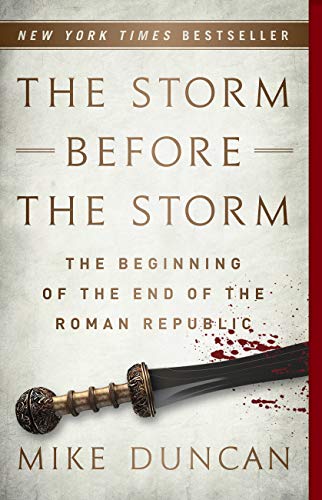
The creator of the award-winning podcast series The History of Rome and Revolutions brings to life the bloody battles, political machinations, and human drama that set the stage for the fall of the Roman Republic. The Roman Republic was one of the most remarkable achievements in the history of civilization. Beginning as a small city-state in central Italy, Rome gradually expanded into a wider world filled with petty tyrants, barbarian chieftains, and despotic kings. Through the centuries, Rome’s model of cooperative and participatory government remained remarkably durable and unmatched in the history of the ancient world. In 146 BC, Rome finally emerged as the strongest power in the Mediterranean. But the very success of the Republic proved to be its undoing. The republican system was unable to cope with the vast empire Rome now ruled: rising economic inequality disrupted traditional ways of life, endemic social and ethnic prejudice led to clashes over citizenship and voting rights, and rampant corruption and ruthless ambition sparked violent political clashes that cracked the once indestructible foundations of the Republic. Chronicling the years 146-78 BC, The Storm Before the Storm dives headlong into the first generation to face this treacherous new political environment. Abandoning the ancient principles of their forbearers, men like Marius, Sulla, and the Gracchi brothers set dangerous new precedents that would start the Republic on the road to destruction and provide a stark warning about what can happen to a civilization that has lost its way.
User’s Reviews
Reviews from Amazon users which were colected at the time this book was published on the website:
⭐The Storm Before The Storm is a well-written, entertaining, and thought-provoking book about a period of Roman history that doesn’t get much attention.Admittedly, before reading this book, my knowledge of Ancient Roman history was limited to vague knowledge of the wars against Carthage, the chronicles of Julius Caesar, and some of the better known Emperors. I picked this book up after visiting Rome for the first time in order to fill some of the gaps in my knowledge and anticipated a somewhat boring political history. But the scope of the book, the intrigue, drama, cowardice and heroism of this period of Roman legend had me captivated.In my opinion this book is a must-read for anyone interested in the history of Rome, and the story of how the proud Republic ultimately transformed into an empire.
⭐Duncan’s style is imminently readable, and sometimes even tongue-in-cheek in its appreciation for the nooks and crannies of human motivation; that is to say, how completely understandable yet disturbingly ludicrous human behavior can be. The ending is almost comically rushed after spending so much time on the ins and outs of Roman republican politics and history, and it would’ve been nice to revisit his note from the introduction regarding parallels to our own times. However, Duncan’s ability to turn potentially dry dates and facts into page-turning drama outweigh these fairly minor criticisms.
⭐The book, The Storm Before the Storm, by Mike Duncan was published in 2017. The impressively well-researched, concise, and scholarly work relates to the stone-throwing, sword-wielding history of Rome during the time period roughly four to seven generations before the birth of Jesus Christ. A stark sense of foreboding begins to dawn on you when you read between the lines. You find the inference “raising an army in Rome was not difficult” has far-reaching implications. In addition, the author provides readers with an excellent English translation of an esoteric Latin quotation attributed to a wise and prominent philosopher at the beginning of each chapter. Insightful, the quotation drives home a major point, gives greater meaning to, and offers a unique perspective for the topic in question in each chapter. If you are not already a well-versed lover of Latin linguistics, the author takes time to explain the meaning, usage, and function of certain obtuse, archaic, or technical terms, which have evolved or been incorporated into the daily lives of virtually every Roman citizen. You can’t help but gain a deeper appreciation of the Forum, the Senate, and the Assembly, as well as many of their principal members and arch-enemies. Who among us has ever heard of the dangerous exploits and grisly adventures of Gracchus, Marius, Jugurtha, Sulla, Mithridates, Drusus, or Cinna? I certainly haven’t, until I began to delve into this particularly interesting book of antiquity. If you haven’t heard of these several notable larger-than-life personalities either, and others, of whom the author mentions, you are in for a real treat. The author goes on to elaborate and elucidate, telling their individual stories, which are nothing short of incredible. The conflicted history of these terrible and terrific titans of Western Civilization turns out to be spectacular, overwhelming, and decimating. Yet, at the end of the day, the reader may pause and reflect that something good must have come out of all the strife and chaos they created after all. The possibility of peace, prosperity, and better government, for instance. Greater respect for humanity, human life in general, and personal dignity would only arrive a couple of thousand years later for some, the enlightened and fortunate ones. More drastic changes would be needed first. R. Royce watched a professional bull-riding event on television. The commentator’s advice for the average cowboy was, “You have to point your toes out and dig your heels in, if you want to stay on the bull.” Royce had to think about that one for a minute. The object of riding a bull for the cowboy is to stay on top for at least 8 seconds with one hand raised in the air and one hand grasping the leather harness tightly wrapped around the bull’s mightily muscular mid-section. Rodeo judges determine his score by how well he rides the bull. What the commentator neglected to mention is that a real cowboy wears silver spurs that jingle, jangle, and dangle on the heels of his boots. When he forcibly digs them into the haunches of the bull, the bull goes absolutely crazy, bonkers. The bull receives quite an unpleasant sensation, if not downright painful. He begins to jump high into the air repeatedly, writhing uncontrollably. He performs the most amazing contortions imaginable. He gyrates and spins around wildly, bucks, twists, and turns–anything to prevent the cowboy from digging the star-shaped metal spur points into the tender flesh of his flanks. So, technically speaking, digging his heels into the haunches of the bull, does not so much help the cowboy stay on the bull better, but it definitely helps him score more points with the judges, should he ride the bull for the required length of time. Along about that time his friend and cohort Cornelius Korn telephoned. Royce picked up a nearby cell-phone. He told Royce that the dental bridge in his mouth had come loose while he was biting into a casserole entree. “The bridge is rock solid. It lasted about thirty years and the dentist offered to glue it back in on the spot,” he said. But, Korn was more concerned about the strength of the teeth underneath. The dental assistant took some routine panoramic x-rays, and scheduled another appointment for the actual dental work to commence. “The initial shock of losing three teeth at the same time has worn off,” Korn continued. But he was still uncertain whether to have the dentist fabricate and install a new bridge, or get an implant and three crowns.” “I’d definitely get a second opinion from the dentist who does implants,” said Royce. “He should know if you are a suitable candidate for the delicate procedure.”
⭐Fascinating recount of history by a great storyteller
⭐Great book
⭐I’m usually not much into ancient Roman history, but Mike Duncan is an excellent storyteller. I couldn’t put the book down.I don’t know that there’s anything in this book apropos to today’s world but this book is well worth the read.I’m not sure that Ancient Rome ever had a real republic. I’m not sure that America ever had a real democracy either. This book brings clarity to this idea: governments work for the rich and powerful, everybody else is expendable.
⭐I have read many books about the Roman Empire. This book helped to clarify to me how the Roman Republic collapsed and became an empire. This a great read for those who like to study Roman history.
⭐This book covers a little known period of Roman history from the fall of Carthage to the death of Sulla the Dictator. In general the story develops in chronological order and allows the reader to follow the crisis that eventually would envelope the Republic. This is a well written account that maintains interest from the preface to the epilogue. This is not boring, or stuffy, history.The author has extensively trawled the works of the ancient writers and pieced together a fascinating narrative that is comprehensively cross-referenced. This was a period of massive change as the Roman Republic expanded into chaos and descended into civil war and eventually the formation of the Principate. This work records the facts that led to the fall of the Roman Republic, but offers very little insight apart from a brief comparison towards modern politics in the USA. The sources appear to have been taken at face value without questioning their motive, or accuracy. This does not distract from the flow of the story, or the ultimate outcome, but in my view reduces the work from five to four stars.Overall this is a very interesting book and anyone reading it without prior knowledge of the fall of the Roman Republic would understand the basic reasons why it fell. The parallels to political life in Britain today are staggering!
⭐Like most others I got introduced to Mike Duncan through his witty Rome podcast quite a few years ago. Although not my favourite ancient historical podcast it stands out because of the vast size, humour and completeness.Frankly what I was always looking for was a bit more depth to interesting elements of the expansive narrative.So here he covers it. He not only manages to pick an extremely fascinting and crucial period in the republic history – that is rarely dealt with in such detail – Duncan also demonstrates he is an accomplished, compelling writer of popular-history.And he passed my tube-nap-test!: I did not fall asleep once when reading his book on the way back home.Loved to go over the Gracci and Sina stories again but appreciated all the detail about other more-obscure actors even more.If my arm is twisted: its a book that stands firmly among Tom Holland and Goldsworthy but for that reason it lacks the fun and cynicism from the podcasts.Looking very much forward to his next work, hopefully again about ancient history.
⭐As a novice in Roman history and a fan of Mike Duncan’s podcasts this was an absolute joy to read. Mike Duncan has proven with his podcasts that he can tell an enjoyable story which educates the listener on the ins and outs of complex political, economical and social upheavels in history and he has done it again with The Storm Before The Storm. A vast roster of characters are introduced in his book, yet I never felt overwhelmed by all the names and information that are provided in these pages. Each chapter has a logical beginning and ending which allowed me to end a chapter and come back a few days later without having to reread the last 50 pages to understand what’s going on. The book was inspired by people asking for a comparison of the Roman civilization to our current, though Duncan does leave the reader to make his own conclusions and leaves it for us to decide if we are facing similar challenges. For that I am certainly grateful.I wholeheartedly recommend this to anyone who enjoys Mike Duncan’s podcasts and anyone who is interested in Rome’s history. It might not be for the experienced reader with vast knowledge of the Roman republic. I was however annoyed by several misprints in the book, hopefully these will be ironed out in future releases.
⭐Mike Duncan translates his accessible podcast style into a well-focussed historical narrative explanation of the deep structural problems that lurked within the Roman Republic, and gives us a thoroughly entertaining “prequel” to the Pompey/Caesar story. This book isn’t about Julius Caesar and Mark Anthony. Octavius doesn’t get a look in. This is about the Gracchi, Sullus, Marius and all those other political and military chancers who laid the foundation for the epic we already know is coming. Very enjoyable read.
⭐I have been following Mike’s work since being introduced to “The History of Rome” podcast in 2014. It took over a year for me to catch up with his episodes before moving on to “Revolutions”. This book is as good as his podcast.For those of you unfamiliar with his work; this book is an easy to read history of the events that lead to Julius Caesar’s rise to power. Rather than tell Caesar’s oft told story again, Mike tells us of the failing politics in Rome that enabled him.It is written as prose rather than a series of facts and dates, thereby engaging with the reader.
Keywords
Free Download The Storm Before the Storm: The Beginning of the End of the Roman Republic in PDF format
The Storm Before the Storm: The Beginning of the End of the Roman Republic PDF Free Download
Download The Storm Before the Storm: The Beginning of the End of the Roman Republic 2017 PDF Free
The Storm Before the Storm: The Beginning of the End of the Roman Republic 2017 PDF Free Download
Download The Storm Before the Storm: The Beginning of the End of the Roman Republic PDF
Free Download Ebook The Storm Before the Storm: The Beginning of the End of the Roman Republic