

Ebook Info
- Published: 2003
- Number of pages: 216 pages
- Format: PDF
- File Size: 27.51 MB
- Authors: Herbert G. Gutman
Description
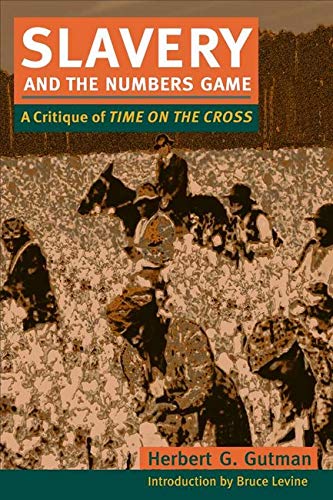
This detailed analysis of slavery in the antebellum South was written in 1975 in response to the prior year’s publication of Robert Fogel and Stanley Engerman’s controversial Time on the Cross, which argued that slavery was an efficient and dynamic engine for the southern economy and that its success was due largely to the willing cooperation of the slaves themselves. Noted labor historian Herbert G. Gutman was unconvinced, even outraged, by Fogel and Engerman’s arguments. In this book he offers a systematic dissection of Time on the Cross, drawing on a wealth of data to contest that book’s most fundamental assertions. A benchmark work of historical inquiry, Gutman’s critique sheds light on a range of crucial aspects of slavery and its economic effectiveness. Gutman emphasizes the slaves’ responses to their treatment at the hands of slaveowners. He shows that slaves labored, not because they shared values and goals with their masters, but because of the omnipresent threat of ‘negative incentives,’ primarily physical violence. In his introduction to this new edition, Bruce Levine provides a historical analysis of the debate over Time on the Cross. Levine reminds us of the continuing influence of the latter book, demonstrated by Robert W. Fogel’s 1993 Nobel Prize in Economic Sciences, and hence the importance and timeliness of Gutman’s critique.
User’s Reviews
Editorial Reviews: Review “Gutman has destroyed the mathematical mystique of time on the Cross, punctured its claims of novelty, accuracy, and understanding, examined the past reviews of the work, and begun a new tradition in his critique.” About the Author Herbert Gutman (1928-85) was distinguished professor of history in the Graduate College of the City University of New York and the author of The Black Family in Slavery and Freedom, 1750-1925,Work, Culture, and Society and Power and Culture.
Reviews from Amazon users which were colected at the time this book was published on the website:
⭐This ought to be considered a necessary third volume to Robert William Fogel’s and Stanley L. Engerman’s
⭐. Gutman takes a detailed look at the way they have used and misused sources, ignored potential sources, as well as sometimes dubious statistical methods. It is a devastating critique of a book that garnered a lot of positive press at its release, and which has remained in print up to the present time, even after the revision
⭐was released. That book, written by Fogel, retreats from almost every position that Gutman criticized, which would seem to validate Gutman’s contentions. The introduction to Without Consent or Contract says that it is a new book rather than a new edition because Time on the Cross generated so much discussion that it is a historical artifact. There is in fact so much discarded that it would have been a new book in any case.I give three examples of problems pointed out by Gutman; page numbers are from the 2003 reprinting by the University of Illinois press. Fogel and Engerman use an 1860 manuscript census of occupations in Nashville, Tennesee to argue that slaves were not used for prostitution, and to suggest, further, that most white men did not find black women attractive. The only prostitutes are 198 white women and 9 light-skinned free black women. One is forced to ask how light-skinned black women came to exist if white men were not attracted to black women, or white women to black men (the latter is likely to have ended badly.) However, the census explicitly does NOT list the occupations of slaves, so slave prostitutes would not be listed no matter how many may have existed. The census tells us nothing about slaves and prostitution. (p.157 ff)Fogel and Engerman also suggest that the slaves were generally chaste until marriage, which occurred around 20-years of age for women, based on assuming that the oldest child listed in inventories of slaves was the oldest child of his/her mother, born a year after marriage. Gutman points out that there are many weaknesses in these assumptions. Still births, miscarriages, infant and child mortality, fertility problems, and of course, the sale of children away from their mothers could all mean that either the assumption that the oldest child listed is the woman’s oldest child, or that the child was born approximately a year after the mother began her sex life, or both are false. (p.150 ff)Third, Fogel and Engerman argue, based on invoices for the sale of slaves in New Orleans, that it was rare for slaves to be separated by sales from their partner. They calculate this by assuming that women sold with a child are married women, and women sold without a child are unmarried women. They assert without proof that young children were “virtually always” sold with their mother. Gutman points out that a woman sold out of a childless marriage would be single in their view and a woman whose older children were sold separately would be considered to be single by Fogel and Engerman. He also casts doubt on the assertion that young children can be assumed to be sold with their mother. (p.113 ff)Gutman continues on with examples of sources cherry-picked for desired information, doubtful reasoning, and inappropriate evidence; a truly devastating critique.
⭐Numbers Facts My Study Your Study.. I am tired of those among us who come up with unsustainable numbers to get our point across.
⭐5*.
⭐Gutman’s analysis of T/C is marked by the same measure of excellence as T/C itself; Gutman’s successful venture into cliometrics is obviously indicative of his prowess and flexibility as a historian. Gutman’s greatest success in writing his criticism amounts to this: he beat Fogel and Engerman at their own game by demonstrating the lack of uniformity and impotence of the statistics used by the authors, as well as exposing many tenuous claims Fogel and Engerman drew from their data. His criticism, although at times annoyingly tenacious in its attempt to prove the cliometricians wrong, is thorough and a solid piece of scholarship. His persistence, though admirable, is also his biggest folly, for Gutman fails to refute the overarching implications made by T/C, most notably the implication that the antebellum south was capitalist in nature, and was managed by the planter elite, who were, like northern industrialists, driven by economic rationality and the profit motive. This oversight is significant for Genovese, and he quickly addressed the fallicy put forth. He draws directly from Marx (aptly) the distinction between capitalist and pre-capitalist being wholly contingent upon the social (labor) relation between the bourgeois and laboring classes. Because, as Marx deliniates, the social relation in capitalist society is characterized by the presence of wage labor, Genovese rightly rejects the classification of the southern economy as capitalist. Explaining why the Marxist interpretation is more fitting would require a lengthy and tedious review of the first volume of Capital, but if the reader is familiar with Marx, he can appriciate that the advantage the Marxist model offers over the Capitalist (chiefly Ricardian) interpretation (the emphasis here being placed upon the existence of labor markets). Furthermore, Genovese’s indictment of T/C places a necessary emphasis on the societal aspect of planter society, pointing out its unique, often contradictory place inbetween capitalist and pre-capitalist societies. He characterizes the south as being merchant capitalist, essentially societies that were heavily influenced by profit motive and raw commodity production, yet still retaining a feudalistic flavor in regards to social, and more importantly, labor relations. Fruits of Merchant Capital by Genovese and his wife offers a much more vivid and deep examination of T/C than the overview I’ve provided, and a more historically pervasive and satisfactory case for rejecting many of T/C’s arguments than Gutman’s statistical retaliation. I know, my adoration of Genovese is not well hidden, but the assessment of T/C in Fruits is undoubtedly a stronger and more thorough (while remaining less viturperative) socio-economic indictment than is Gutman’s Slavery and the Numbers Game. Read both if you have the time and judge for yourself.
⭐Great accurate book. Well written and researched.
⭐This book was written for a very specific purpose, as rebuttal to Time on the Cross, a cliometric investigation of American slavery:http://www.amazon.co.uk/Time-Cross-Economics-American-Slavery/dp/0393312186/ref=sr_1_1When it was published, Time on the Cross received wide public acclaim despite its severe flaws (see my separate review of that book). Therefore, a detailed critique was justified and this book by Gutman is it.It was written to do a job that needed to be done, made its point and (to my satisfaction), did a good job of settling the argument. This doesn’t make it a particularly useful or fascinating book for the general reader however; if you want to know about slavery in the American South, this isn’t really the right book for you …. maybe this would a better choice:http://www.amazon.co.uk/Roll-Jordan-World-Slaves-Vintage/dp/0394716523/ref=sr_1_1If you’re particularly interested in the development of cliometrics however, you might find it worthwhile to read in conjunction with Time on the Cross.If you’re doing a cliometric study yourself, then I think this book would be a very worthwhile warning of potential mistakes to avoid.
Keywords
Free Download Slavery and the Numbers Game: A Critique of Time on the Cross in PDF format
Slavery and the Numbers Game: A Critique of Time on the Cross PDF Free Download
Download Slavery and the Numbers Game: A Critique of Time on the Cross 2003 PDF Free
Slavery and the Numbers Game: A Critique of Time on the Cross 2003 PDF Free Download
Download Slavery and the Numbers Game: A Critique of Time on the Cross PDF
Free Download Ebook Slavery and the Numbers Game: A Critique of Time on the Cross