

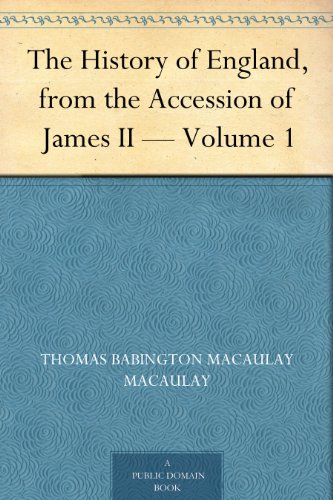
Ebook Info
- Published: 2011
- Number of pages: 424 pages
- Format: PDF
- File Size: 3.72 MB
- Authors: Thomas Babington Macaulay
Description
This book was converted from its physical edition to the digital format by a community of volunteers. You may find it for free on the web. Purchase of the Kindle edition includes wireless delivery.
User’s Reviews
Reviews from Amazon users which were colected at the time this book was published on the website:
⭐Thomas Babington Macaulay is a different kind of historian. He was an active politician, a devoted Whig, a brilliant scholar, and a man with a knack for making a point in entertaining prose. He wrote for generations that were just starting to receive monthly and quarterly periodicals and that had few other sources of intellectual stimulation outside London and one or two other great cities. Consequently, Macaulay’s original readers had nothing against elaborate and elegant embellishments of simple historical facts even if they stretched out the work to several times the minimal length needed for the same message.Additionally, Macaulay was fluent in classical Greek, Latin, and at least read French, Italian, and German. He taught himself Dutch to be able to follow the doings of his hero King William III of England in William’s native Netherlands. Macaulay’s knowledge of historic documents was encylopedic and his ability to recall what he read was summed up in the phrase “photographic memory.” His parliamentary oratory, when it was known in advance that he would speak, was guaranteed to fill the House because those gifts were on display.The bulk of volume I is properly labeled “introduction.” It is a crucial read for anyone who hasn’t thought of all the political evolution that had gone into the history of continental histories and that England had avoided in its island situation and security. E.g., when continental monarchies began building great standing armies, adjacent countries had to react with their own standing armies or become the pawns of powerful neighbors. England, in no danger of easy invasion, was spared both the intimidating presence of an army and need to pay high taxes to support a standing army under the command of a king who was glad for the chance to bully the rest of the population. The result: the Parliament of England maintained and expanded the privileges it started with whle the Estates Generals and Great Councils of other countries fell into disuse on the mainland. The English monarchy remained limited while the kings of France and Spain became absolute.Such backgrounds frame Macaulay’s narration. And as the “introduction” Volume I is a spectacular display of the resources at his command. If you want elegant writing and keen, if one-sided political analysis, I fully recommend this history. Without Gibbons’ gifted irony but with an abiding sense of humor, Macaulay can carry your interest from page to page.
⭐I’ve been meaning to read this book for decades. It is out of favor with the politically correct because it doesn’t have enough about gays, transgenders, Marxism and patriarchy, but it was written in 1848, so why would it? Unlike most histories written then, it is not just about battles and diplomacy. Macaulay makes a point of discussing art, culture, trade and other subjects that weren’t considered to be worthy of a serious historian. The chief pleasure of the work is the writing style, which has seldom been equalled in English. Some Amazon reviewers say that the language is antique and difficult, but I don’t think it is. Here’s a sample, so you can judge for yourself. Macaulay is discussing Oliver Cromwell– “While he lived his power stood firm, an object of mingled aversion, admiration, and dread to his subjects. Few indeed loved his government; but those who hated it most hated it less than they feared it. Had it been a worse government, it might perhaps have been overthrown in spite of all its strength. Had it been a weaker government, it would certainly have been overthrown in spite of all its merits. But it had moderation enough to abstain from those oppressions which drive men mad; and it had a force and energy which none but men driven mad by oppression would venture to encounter.” That requires that you pay attention, but it is not needlessly complicated. The prose style fits the intricacy of Macaulay’s ideas, unlike Gibbon, for example, who always used twice the number of words needed to express even the simplest thought. The ebook conversion is better than average. I’ve noticed about one typo every ten pages. And the price is right.
⭐Macaulay’s History of England was celebrated as a classic during the first century after its publication. For my generation, however, it was the paradigm of so called Whiggish history, which narrates the past –of mankind, of a nation, of a branch of science, etc– as a story of progress leading to the present dominated by the historian’s friends, fellow citizens and/or coreligionists. I have therefore allowed most of my life to pass without looking into it. Now, thanks to Kindle. I’ve started reading volume I –a little bit every night. I stand in awe of the author’s intelligent grasp of historical events and I am fascinated by his magnificent English prose. As a concise illustration of both, I shall quote a Macaulay’s very apposite remark concerning the pernicious effects that reading the Bible had on the behavior of 17th century Puritans: «…the Old Testament contained the history of a race selected by God to be witnesses of his unity and ministers of his vengeance, and specially commanded by him to do many things which, if done without his special command, would have been atrocious crimes». (Location 1151 of the Kindle edition). Macaulay’s remark throws light on some current political events too.
⭐This is simply one of the greatest works of history ever written, and one of the great works of English literature. Of course it is dated, of course he got much wrong, of course his prejudices distorted his judgment, but for sheer epic scope, fizzing style, and the ability to recreate a bygone age it is without parallel. This is a must read for anyone with a passing interest in English literature or History. Such interest would be inflamed once you start. No wonder it was an instant best seller, how shameful it has become an unread classic.
⭐I’m trying to fill in gaps in my historical knowledge, and this book was really useful. Although written in the Victorian era, it wasn’t a boring “schoolbook” list of battles and parliamentary acts. The author was quite good at explaining the views of puritans v cavaliers, without particular bias to either party, showing why people acted as they did at the time… Style of writing was easy to read, with enough human interest side-stories to keep it interesting.Free for Kindle… couple of typos, but better than some free books I’ve read… Can’t lose really.
⭐I used to go to a local library to borrow some books, but have recently begun to download free books from Amazon using my Kindle when I have time. I am very glad that a lot of books are available free of charge. Thank you.
⭐Had a hard copy of this which I was obliged to throw away when my wife re-organised the furniture. So glad to get it back. Nobody writes like Macaulay or Gibbon.
⭐LIGHT APPROACH EASY READING. BUT RESENTHAVING TO RESPOND W IT H A REQUIRED NUMBER OF WORDS TO REVEIW IT.THIS PUTS ONE OFF
Keywords
Free Download The History of England, from the Accession of James II — Volume 1 in PDF format
The History of England, from the Accession of James II — Volume 1 PDF Free Download
Download The History of England, from the Accession of James II — Volume 1 2011 PDF Free
The History of England, from the Accession of James II — Volume 1 2011 PDF Free Download
Download The History of England, from the Accession of James II — Volume 1 PDF
Free Download Ebook The History of England, from the Accession of James II — Volume 1