

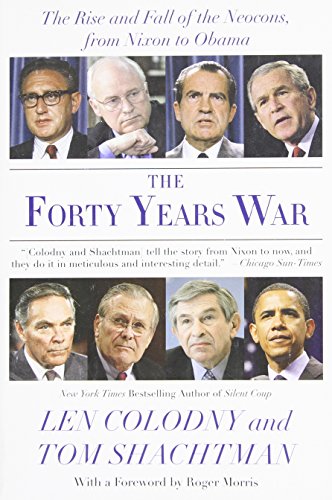
Ebook Info
- Published: 2010
- Number of pages: 512 pages
- Format: PDF
- File Size: 2.34 MB
- Authors: Len Colodny
Description
Both a work of courageous journalistic investigation and a revisionist history of U.S. foreign policy, The Forty Years War details the rise of an insurgent movement, inside and outside the White House, that contributed to Richard Nixon’s resignation —including an eye-opening account of Bob Woodward’s direct ties to the military and to high-level White House insiders who actively worked to force Nixon out. The result is a must-read for anyone interested in America’s standing in the world—yesterday, today, and tomorrow.
User’s Reviews
Editorial Reviews: Review “Absorbing…a must read….illuminating and deeply provocative….The Forty Years War is a book that deserves to have a much higher public profile as Colodny and Shachtman are marshalling new evidence to challenge conventional interpretations of late Cold War political history and foreign policy.” (Zenpundit.com )“[Colodny and Shachtman] tell the story from Nixon to now, and they do it in meticulous and interesting detail.” (Chicago Sun-Times )“A rigorous and critical examination of the neoconservative movement and the bureaucratic, ideological battles over American foreign policy from 1969 to 2009.…[A] captivating chronicle. Highly recommended.” (Library Journal )“A well-reported, fast-paced history lesson on the eternal conflict between ideologues and policymakers and the hubris that always accompanies success.” (Kirkus Reviews ) About the Author Len Colodny is the bestselling coauthor of Silent Coup: The Removal of a President, which spent thirteen weeks on the New York Times bestseller list. He lives in Florida.
Reviews from Amazon users which were colected at the time this book was published on the website:
⭐Len Colodny and Tom Shachtman’s “The Forty Years War” is a welcome addition to the growing literature of “neoconology”. Where some (see Justin Raimondo) have focused on the social democratic – and indeed Trotskyite roots of the “classic neocons”, others have focused on the Cheney – Rumsfeld “Vulcans” (see James Mann) – the hawks of the Bush cabinet. In the later case the “neocon” label is usually applied with loose fit. This book fills a gap by bringing the two streams together.Where others have focused on Irving Kristol or Leo Strauss as “the neocon godfather”, Colodny and Shachtman find another contender, Fritz Kraemer, a German American defense policy wonk. As portrayed, Kraemer emerges as a kind of old school Prussian militarist, who came to give his fealty to Democracy (with a capital D) not the Kaiser. He was an in house Pentagon guru and a mentor to Kissinger before they fell out. Numerous Washington hawks fell under Kraemer’s spell, including Alexander Haig, Ford’s Secretary of Defense- James Schelsinger and most of the later day neocons. Kraemer wanted Democracy to pursue aggressive military superiority versus totalitarian foreign enemies, and saw diplomacy, loss of focus and ‘weakness’ as the domestic enemy. You get the impression Kraemer loved Democracy in abstracto, it was just real world democratic politics he couldn’t understand.Although subtitled the rise and fall of the neocons, “The Forty Years War” really focuses on the Nixon-Ford era. This comproses at least two thirds of a book that is more Nixon history than neocon history. I was surprised to learn that it was Nixon, not Kissinger, who was the real father of detente. He nurtured the idea prior to his 1968 election and had to convert Kissinger, his new Kraemerite recruit to the need for a very non-Kraemerite diplomatic road to Moscow. Nixon really had left his ice cold warrior phase behind, even if his liberal critics, perhaps still smarting over Hiss, never quite got the memo.Nixon’s detente ultimately left his right wing exposed. Many Conservatives were unwilling to defend him when he most needed their help. Cullodny, who authored “Silent Coup”, a Watergate revisionist book, saw the right exercising a more active role in his demise. He sees Alexander Haig as wanting Nixon out of the White House before any detailed Senate impeachment trial could get near the Moorer / Radford spy case. This is a little known, if somewhat amateurish, case where the Joint Chiefs of Staff conducted an illegal operation to spy on Kissinger and his secret diplomacy. Nixon discovered the plot and let the plotters know he knew. Rather than sack JCS Chairman Admiral Moorer, Nixon left him in place, presumably to increase his leverage over the Pentagon whilst he redirected US foreign policy. During the Frost Nixon interviews Nixon maintained that “the plumbers” were necessary to ensure security for his foreign policy reformation. At the time, this was seen as self serving, but presumably this affair was on Nixon’s mind.When Colodny’s “Silent Coup” first proposed Nixon was removed to serve military interests, it was thrown into the ‘conspiracy theory’ bin. Subsequent revelation that Mark Felt (head of the FBI’s “Cointelpro” dirty tricksdepartment boss) was “Deep Throat”, should have convinced serious historians that another look is required. Perhaps Felt was more a player than a whistleblower. Cullodny also discusses the Haig and Bob Woodward links. Woodward, no Robert Redford, was Haig and Moorer’s ex briefing officer before he quit the navy to turn reporter. At that time young officers rarely obtained early release from their stints. Woodward was out a year early. Woodward’s string of later books, according to Cullodny, share a common theme. All boost the credentials of the uniformed military and manage to direct all criticism back to the civilians. Woodward’s employer “The Washington Post” had CIA connections going back through Philip Graham to “Operation Mockingbird”, a program to influence the domestic and international media.It was also during the Nixon era that the original alliance between the GOP hawks and the “classic” neocons was forged. Nixon needed the “Scoop Jackson” Democrats to get his program through Congress where the GOP lacked the numbers. Kissinger and Nixon saw the ABM program as a useful diplomatic bargaining chip, so they were happy to let the Scoop squad manage ABM in Congress. The Wolfowitzes and co learned their craft on ABM. When Kissinger cashed this chip on the diplomatic table, the neocons saw it as a sell out. ABM was revived under Reagan as Star Wars, although the neocons would turn on Reagan too, although some would label themselves “neo-Reaganites”, but only after airbrushing Reykjavik from memory.There are some other sidelights that stand out from his narrative. Remember the “Huston Plan”? This was a proposal from the dark recesses of the Nixon administration to severely restrict civil liberties, allow covert interception, black bag operations etc. In reality Attorney General Mitchell, horrified by the plan and ordered it “deep sixed” once he got wind of it. Colodny makes the ironic observation that compared the PATRIOT ACT, Huston actually looks mild. Then there is the “unitary executive theory” – promoted by Cheney and the ill named ‘Federalist Society’. Nixon (“when the President does it , it isn’t illegal”) was perhaps a practitioner rather than a theorist of “UET”. This is what ultimately did him in.”The Forty Years War” is large and detailed rich. The writing style is workman-like but the historical analysis is superior.
⭐I originally planned on giving this book a 4-star rating but there are three nit-picking subjects that bothered me about the authors’ analysis making we wonder if this is simply a biased attack. First, they go into great detail laying the blame for the Iraq war on the hawks within the Bush administration and their sole misleading claim of WMDs. But the authors failed to mention, as has been reported, that KGB, Mossad, MI6, CIA, and Saddam’s own generals all insisted Iraq possessed WMDs. Second, the authors went to great lengths to frame Scooter Libby as the leaker of Valerie Plame’s CIA identity while they should have known that the true leaker was Richard Armitage. Finally, I thought their reporting of what really happened at Abu Ghraib was completely overblown. Making a bunch of Arab prisoners of war parade naked in front of a female guard is not torture.On the plus side of the book I was impressed with the detail the authors went into to describe the Neocons. They reveal just how hawkish these people truly were and are. They also reveal the soaring egos these people possess to the point that they feel they are the ones running this nation and not our elected officials. I know this book was written 10 years ago so I’ll cut the authors some slack when they stated that the election of Barack Obama put the nail in the coffin of the Neocon movement. The Deep State is so firmly embedded in all facets of our government that the Neocons will probably not disappear during our lifetimes.
⭐I love reading about Richard Nixon and Gen. Alexander Haig so I enjoyed the book. In the 1968 election, Richard Nixon wanted to change foreign policy by creating détente with the Soviets, opening the door to Red China and he envisioned himself as a peacemaker through negotiation. He appointed Henry Kissinger to his National Security Council. Kissinger never liked Nixon. Kissinger’s military assistant was. then Col. Alexander M. Haig, Jr. Nixon was super secretive and insisted on secrecy to implement his new foreign policies. Out of his administration evolved the conservative movement up to the Bush years and the failings with Obama’s election as president, a Democrat. The conservative movement has always been among the Republicans.This book is a wealth of information from declassified documents, scores of interviews and tapes and follows the careers of political figures who still fascinate us to this day. It introduces us to Fritz Kraemer a cryptic individual in the pentagon who was a German expatriate whose beliefs influenced the neocons making him the godfather of the neocon movement. It is a fascinating read as the information was not declassified until recently about the players in politics who from the ascent of the conservative movement fought for forty years to seize the reins of American foreign policy and undermine Richard Nixon.
⭐
Keywords
Free Download The Forty Years War: The Rise and Fall of the Neocons, from Nixon to Obama in PDF format
The Forty Years War: The Rise and Fall of the Neocons, from Nixon to Obama PDF Free Download
Download The Forty Years War: The Rise and Fall of the Neocons, from Nixon to Obama 2010 PDF Free
The Forty Years War: The Rise and Fall of the Neocons, from Nixon to Obama 2010 PDF Free Download
Download The Forty Years War: The Rise and Fall of the Neocons, from Nixon to Obama PDF
Free Download Ebook The Forty Years War: The Rise and Fall of the Neocons, from Nixon to Obama