Ebook Info
- Published: 2015
- Number of pages: 1097 pages
- Format: PDF
- File Size: 10.31 MB
- Authors: Thomas Pakenham
Description
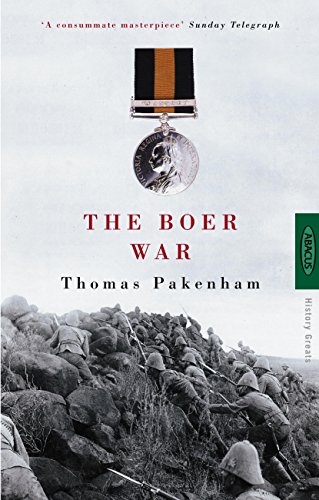
Featuring previously unpublished sources, this ‘enjoyable as well as massively impressive’ bestseller is a definitive account of the Boer War (Financial Times)The war declared by the Boers on 11 October 1899 gave the British, as Kipling said, ‘no end of a lesson’. It proved to be the longest, the costliest, the bloodiest and the most humiliating campaign that Britain fought between 1815 and 1914.Thomas Pakenham’s narrative is based on first-hand and largely unpublished sources ranging from the private papers of the leading protagonists to the recollections of survivors from both sides. Mammoth in scope and scholarship, as vivid, fast-moving and breathtakingly compelling as the finest fiction. The Boer War is the definitive account of this extraordinary conflict – a war precipitated by greed and marked by almost inconceivable blundering and brutalities…and whose shattering repercussions can be felt to this very day.’Not only a magnum opus, it is a conclusive work … Enjoyable as well as massively impressive’ -Financial Times’This is a wonderful book: brilliantly written … the reader turns each page with increasing fascination and admiration’ -A.J.P. Taylor
User’s Reviews
Reviews from Amazon users which were colected at the time this book was published on the website:
⭐The author uncovered a huge amount of contemporary accounts of events, many of which had been top secret. He put these together into an exciting account that reads like a good novel.
⭐Atr the outset, it should be noted that this book could be usefully supplemented by reading COMMANDO by Deneys Reitz – A Boer journal ,of the Boer War.Much of the horror of 20th century warfare – trench warfare, concentration camps, shooting or otherwise mistreating prisoners – was carried out in the Boer war. Some readers, and I am a general reader not an historian, will have been aware of elements of the Boer War such as the shooting of prisoners by Lt “Breaker Morant” which was and is something of a cause celebre in Australia retold in books, plays and a fine contemporary film. But the one feeling I have after reading this fine book by Mr Pakenham is a far greater sympathy for the Boers and a much better appreciation of the contribution and sacrifice that black Africans made in what was touted as a “white man’s” war. In fact it was a black man’s war too with c100,000 black riflemen seeing duty, and fighting in effect for the right to vote. Mr Pakenham provides evidence to suggest that the successful survival by the British at the siege of Mafeking was made possible by the sacrifice of black Africans.Item: 3500 horses perished in one day in one cavalry charge.Item: 400,000 horses, mules, donkeys died in totalItem: Lord Kitchener invented the concentration camp using a Spanish model re CubansItem: The British military and politicians did not care about the thousands of women and children in concentration camps and as the result of disgusting conditions many many died as a result.Item: It was not superior marksmanship or courage that won, but the application of the knowledge that defence was superior to attack with the new, smokeless, high velocity, weapons.The book is very well written, with a reliance on much primary source material, especially diaries and letters of the major British protagonistsincluding Sir Alfred Milner, High Commissioner for South Africa and Lt Governor of Cape Colony who is revealed in his own words as a thoroughly despicable character. The reader also gets a very real feeling for the exigencies of the landscape, the boredom of routine for the military, the clash of battle where the stones on the ground or the mud on the banks of a river become as frighteningly real as the whizz and splat of dum dum bullets. Clearly the writer has experienced the landscape firsthand. The reader also gets a very real picture of the characters involved, their weaknesses and strengths, including some ordinary and very likeable soldiers or “Tommy’s”.The likely causes and consequences of the war are made clear to the reader. The usual suspects – imperial supremacy of the British; greed for gold, diamonds; denial of franchise; nationalism – are covered and a re-evaluation of the protaganists undertaken. It is a fair and balanced re-assessment of the task faced by General Sir Redvers Buller and his inability to overcome it whilst appreciating his intelligent appraisal of the situation he found himself in. On the other hand it reveals Lord Kitchener as arrogant and hard working but overrated and over-compensated for his role. The book also emphasises the CRITICAL role of transport and supply.We are still living with the consequences of it today but one redeeming reality is that democracy and a free press are likely to inhibit a repetition. What was that? Guantanomo Bay? Oil? Imperialism? Franchise? Prisons?
⭐After many books on the American Civil War I chose this one with a view towards seeing if any lessons from it had been learned. Alas not. America’s failure to learn from Britain’s efforts in the Crimea was repaid by the Brit’s failure to anticipate the spadework of the Boers in their trenching both here and of course in the Great War to come. My father-in-law was wont to say, “some folks learn faster than others” and if the overall outcome is never in doubt – the cover has a Kipling quote “they taught us no end of a lesson” – the length and breadth of the teaching makes for exciting reading. Pakenham’s style is erudite without being cumbersome and though one could wish for a few more maps and end notes more expansive than mere citations (the reason for four rather than five stars) the work as a whole was well structured and never got bogged down in minutiae. The author spends considerable time developing the back story of the politicians, generals, and financiers – the usual suspects – who promulgated the conflict. Many of them, French, Hamilton, Churchill, Milner, Kitchener, would go on to similarly influence for better or, more frequently worse, WWI. Battle details are given as needed to support the tactics employed by each side with numerous diary and interview quotes from the participants. Neither side survives Pakenham’s examination wart-free. Boy Scout founder Baden-Powell comes off particularly blemished. Although this book focuses on the third Boer War the preface gives a good precis of the first and second one. I found the book to be weighty in scholarship yet easy to read as an adventure story. Pakenham’s Boer War was a stimulating and satisfying study of the continent’s impending colonial calamities. As a follow up, the Boer War redux, i would recommend Edward Paige’s World War I the African front.
⭐This three inch book of 650 pages is printed in what – to my tired old eyes – seems to be an eight point font, or less, and I struggled to read the closely packed history at first. But I persevered, gradually focusing on the facts and not the font, and found the extra effort well rewarded. In fact, by the second day, I could not put this impressive magnum opus down. The Boer War (1899 – 1902) was to be the most costly, in terms of blood and treasure, in the hundred years of Queen Victoria’s “little wars” period, and was a true forecast of the butchery that smokeless rifles fired from trenches would effect in the slaughter of WWI.Thomas Pakenham is in fact the 8th Earl of Longford, and his grandfather fought the Boers in South Africa, and was seriously wounded in a typical `last stand’ affair where 80 of his fellow troops were killed. The author, besides being a respected and prize winning historian (perhaps best known for his The Scramble for Africa is also a noted arborist.The book offers great insights – several of which are detailed here for the first time- into the politics of the war, both in Cape Town and the government parliaments and leaders, that were behind the campaigns and battles. A drum roll of famous characters thunders through this work, Kitchener, Roberts (“Bobs”), Kipling, Botha, Jan Smuts, Chamberlain … names that echo still.I thoroughly recommend this book for history lovers and for those seeking the widest picture of a complicated, tortuous and very political war – A.J.P. Taylor added to his recommend that “…the reader turns each page with increasing fascination and admiration”. I certainly did.
⭐A good history book. I recommend it.
⭐Thomas Packenham has written a very concise account of the second Boer War. I was deeply frustrated throughout the read by the sheer incompetence of the British military officer class from the Field Marshals and Generals at the top to the junior officers at the bottom. The rag tag Boer guerilla army ran circles around the might of the British Empire soldiers of over 200,000 men and had the Boers been better equipped and their folk better treated they might not have sought peace after three years of fighting. Did the British military learn any lessons from the Boer War. In a word no. They made the same mistakes, with some of the same officers in charge, in WWI seeing fighting men and equipment as expendable. Written in the 1970s Packenham’s Boer War should be seen not just as educational good read, but as a text book on how not to pit trained troops against a tag tag army of volunteers.
⭐This was an area of history that I had never considered and shamefully new little about. The author has written an excellent and very readable account which was thoroughly enjoyed. In fact it became something of a page turner even though the end was already known.Mr Pakenham has produced a balanced account and given both sides of the war a very even handed treatment.I suppose we need to ask why we and more importantly our Generals should adopt the same approach as Wellington even though military technology had so improved and the consequences of this were already known after the Crimean War, the American Civil War, the war of 1864 between Denmark and Prussia, and the Franco-Prussian War, and yet the same tactics which were to lead so many losses in South Africa were used again. And, of course they would be used again at greater cost of lives post 1914. Perhaps it is to no little surprise that some of the Generals who were in position in 1914 had also fought a difficult and bloody campaign in South Africa.
⭐As far as I’m aware there is no better or more thorough account of the Boer War than this volume. It reads beautifully, almost like a novel and is easy to follow and understand throughout, even for a non-historian like myself. Fully recommended.I hope you find my review helpful.
⭐This is the greatest book ever written on the Boer War. It is extremely well researched and gives great insight from a balanced and unbiased viewpoint. After reading this book, you will be able to give balanced arguments from a military and political perspective and will understand the war from both a British or Boer viewpoint – he also covers: the black population, the ‘gold bugs’, the concentration camps and the generals, amongst many other topics. As a WW1 enthusiast it was good to be introduced to the inadequacies of Gough, Haig, Kitchener, Rawlinson, French etc; very interesting to see that they had already experienced trench warfare prior to WW1; artillery bombardment, failed cavalry charges and creeping barrages and yet they failed to adapt to them in WW1. The political decisions, publicity, ‘spin’, ‘old boy’ networks and lobbying resonate deeply with the modern day reader, especially concerning casus belli and the resultant modern wars. One of the best history books that I have read; the amount of effort and research is an inspiration.
⭐I wanted to learn more about the Boer War and all research pointed to this book. It is well illustrated with maps and photographs which helps set the context. Unfortunately, as the author states, to create the large book three quarters of the text have been left out. The author says the cuts have been made seamlessly and this may be true, but I felt that too often the reader is moved along the story too swiftly and important parts seem to be missing.I shall keep this book but buy the fuller, paperback version to get the full text.
Keywords
Free Download The Boer War in PDF format
The Boer War PDF Free Download
Download The Boer War 2015 PDF Free
The Boer War 2015 PDF Free Download
Download The Boer War PDF
Free Download Ebook The Boer War