Ebook Info
- Published: 2007
- Number of pages: 400 pages
- Format: PDF
- File Size: 22.68 MB
- Authors: Pat Southern
Description
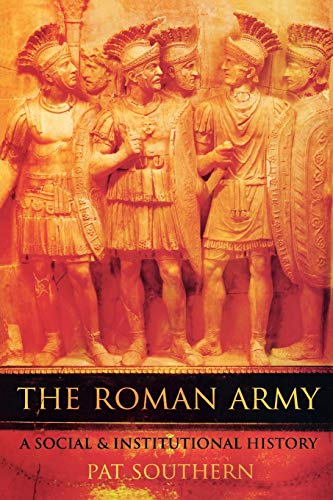
Written by a leading authority on Roman military history, this fascinating volume spans over a thousand years as it offers a memorable picture of one of the world’s most noted fighting forces, paying special attention to the life of the common soldier. Southern here illuminates the Roman army’s history, culture, and organization, providing fascinating details on topics such as military music, holidays, strategy, the construction of Roman fortresses and forts, the most common battle formations, and the many tools of war, from spears, bows and arrows, swords, and slingshots, to the large catapulta (which fired giant arrows and bolts) and the ballista (which hurled huge stones). Perhaps most interesting are the details Southern provides about everyday life in the Roman army, everything from the soldiers pay (they were paid three times per year, but money was deducted for such items as food, clothing, weapons, the burial club, the pension scheme, and so on) to their often brutal life–if whole units turned and ran, about one-tenth of the men concerned were chosen by lot and clubbed to death and the rest were put on barley rations instead of wheat. Moreover, soldiers who lost weapons or their shields would fight savagely to get themback or would die in the process, rather than suffer the shame that attached to throwing weapons away or running from the battle. Attractively illustrated, this book offers a fascinating look at the life of the Roman soldier, drawing on everything from Rome’s rich historical and archaeological record to soldier’s personal correspondence to depictions of military subjects in literature and art.
User’s Reviews
Editorial Reviews: About the Author Pat Southern has published nine books on the Roman army and on Roman history, including The Roman Cavalry (with Karen R. Dixon) and The Roman Empire from Severus to Constantine. She has also written biographies of Mark Antony, Pompey the Great, Julius Caesar, Augustus, and Cleopatra. She lives in the UK.
Reviews from Amazon users which were colected at the time this book was published on the website:
⭐I did not enjoy this book as much as her book on the Roman Empire. I never really felt I learned very much after a lot of reading. I appreciate that there are not many sources, does it have to be repeated 1000 times. Make the book shorter if you don’t have much to say.
⭐Although this is a better-than-average review of the Roman army, once again, an author who is a supposed expert on ancient Rome perpetuates the (long disproven) contention that Caesar burned the Alexandrian Library. This kind of error lessens the overall worth of the book.
⭐This is an interesting and at times fascinating book on the Roman army, although it also has limits, some of which are acknowledged by the author herself.To begin with these, and irrespective of the author’s considerable knowledge and efforts, it is quite impossible to write the definitive history about the Roman army, not even in four hundred pages. Patricia Southern gives a number of reasons for this throughout her book. The main one relates to the shortcomings of our sources which are largely incomplete. Many written sources no longer exist and many sites where archaeology might make major finds cannot be accessed. Moreover, what has survived and what is now lost owes a good deal to chance. One illustration of this is that Caesar would probably not have acquired quite the same the standing he has if his “war diaries” on the Gallic and Civil wars had not been preserved. Other generals or emperors, such as Corbulo or Trajan, who also wrote such diaries, now lost, would have been much better known to us had these been preserved in some form.Another limitation of this book, which may also be a quality depending on your perspective, is that it is a bit of a “jack of all trades”. It is a social and institutional history of the Roman army, its organisation and its culture. It is also a bit of an overview, meaning that it contains a bit of everything and does not always devote enough space in discussing the issues in depth. To illustrate, you have the last but one section which is titled “Great soldiers and Battles” and which is a collection of vignettes briefly presenting a selection of outstanding Roman generals, summarising their careers and sketching some of the most important battles fought by the Roman Army. There is no indication whatsoever explaining how these were selected while a great many others did not.Another section which I found slightly disappointing was the one on the Late Roman Army, although I may be a little unfair since most of the main points are made. I was probably expecting more on the Late Roman Army precisely because the author had already written another book about it some years ago (with Karen Dixon). I was also expecting an assessment of the Late Roman Army’s effectiveness during the reign of Diocletian, throughout the fourth century and even the first half of the fifth century but this is essentially absent from this book. What is included, however, is a broad-brush picture of how the Army was re-organised and evolved during the reigns of Diocletian and Constantine, with the author stressing that it is essentially impossible to be categorical in attributing various changes and reforms.Something else that you will not find in this book is a chronological history of the Roman Army, but then this was not its purpose. Instead, the author has come up with a thematic presentation of the army, its culture (with a strong chapter on its morale, discipline and values), the soldiers’ living conditions and equipment, their forts and road building, the various types of units and how they adapted to evolving needs, their evolving recruitment, pay, command structures and their relationships with civilians. While each of these components may be found elsewhere and in more detail in more specialised works, this book brings them all together in a single comprehensive volume. This is what the author intended to do and this is exactly what she has achieved since, to quote her, it is “quite impossible to conceptualise the Roman Empire without the army.”The book’s last section is also of particular interest when discussing the current debates about the Roman Army and its frontiers (a debate that has been going on for more than twenty years) and the areas of current research, including the ethnicity of soldiers. Here again, the section is valuable and I can only agree with the author that “the fascination of investigating the Roman army will never die and the definitive study will never be written.” However, after finishing this book, I was left wanting for more. Although I certainly recommend this book to anyone interested in the Roman army, I could not help finding that it certainly was good, sometimes fascinating but perhaps not great. Maybe I was expecting too much. Four stars.
⭐This is an excellent survey, covering a broad range of topics that extend somewhat beyond what the subtitle might suggest, such as weaponry. Southern takes into account recent archaeological finds, which continue to modify our view of Roman military history. It’s a shame, though, to see what is essentially a scholarly book marred by that bane of sociology texts: inline references rather than footnotes. Don’t writers and editors understand that these clutter the text and detract from readability?Query: what is the relationship between this book and the author’s later
⭐?
⭐This is an interesting and at times fascinating book on the Roman army, although it also has limits, some of which are acknowledged by the author herself.To begin with these, and irrespective of the author’s considerable knowledge and efforts, it is quite impossible to write the definitive history about the Roman army, not even in four hundred pages. Patricia Southern gives a number of reasons for this throughout her book. The main one relates to the shortcomings of our sources which are largely incomplete. Many written sources no longer exist and many sites where archaeology might make major finds cannot be accessed. Moreover, what has survived and what is now lost owes a good deal to chance. One illustration of this is that Caesar would probably not have acquired quite the same the standing he has if his “war diaries” on the Gallic and Civil wars had not been preserved. Other generals or emperors, such as Corbulo or Trajan, who also wrote such diaries, now lost, would have been much better known to us had these been preserved in some form.Another limitation of this book, which may also be a quality depending on your perspective, is that it is a bit of a “jack of all trades”. It is a social and institutional history of the Roman army, its organisation and its culture. It is also a bit of an overview, meaning that it contains a bit of everything and does not always devote enough space in discussing the issues in depth. To illustrate, you have the last but one section which is titled “Great soldiers and Battles” and which is a collection of vignettes briefly presenting a selection of outstanding Roman generals, summarising their careers and sketching some of the most important battles fought by the Roman Army. There is no indication whatsoever explaining how these were selected while a great many others did not.Another section which I found slightly disappointing was the one on the Late Roman Army, although I may be a little unfair since most of the main points are made. I was probably expecting more on the Late Roman Army precisely because the author had already written another book about it some years ago (with Karen Dixon). I was also expecting an assessment of the Late Roman Army’s effectiveness during the reign of Diocletian, throughout the fourth century and even the first half of the fifth century but this is essentially absent from this book. What is included, however, is a broad-brush picture of how the Army was re-organised and evolved during the reigns of Diocletian and Constantine, with the author stressing that it is essentially impossible to be categorical in attributing various changes and reforms.Something else that you will not find in this book is a chronological history of the Roman Army, but then this was not its purpose. Instead, the author has come up with a thematic presentation of the army, its culture (with a strong chapter on its morale, discipline and values), the soldiers’ living conditions and equipment, their forts and road building, the various types of units and how they adapted to evolving needs, their evolving recruitment, pay, command structures and their relationships with civilians. While each of these components may be found elsewhere and in more detail in more specialised works, this book brings them all together in a single comprehensive volume. This is what the author intended to do and this is exactly what she has achieved since, to quote her, it is “quite impossible to conceptualise the Roman Empire without the army.”The book’s last section is also of particular interest when discussing the current debates about the Roman Army and its frontiers (a debate that has been going on for more than twenty years) and the areas of current research, including the ethnicity of soldiers. Here again, the section is valuable and I can only agree with the author that “the fascination of investigating the Roman army will never die and the definitive study will never be written.” However, after finishing this book, I was left wanting for more. Although I certainly recommend this book to anyone interested in the Roman army, I could not help finding that it certainly was good, sometimes fascinating but perhaps not great. Maybe I was expecting too much. Four stars.
⭐Good book, good price but if I was picky it is just a little disappointing that the bottom right corner of the front of the book came out of the package creased. Not a big issue but it was supposedly new and that was why I did not award 4 stars.
⭐I write historical fiction and have found all of Pat Southern’s texts to be lucid, fascinating and very, very useful. Her book on Zenobia was also excellent. Many thanks!
⭐As expected very good and nice price
Keywords
Free Download The Roman Army: A Social and Institutional History 1st Edition in PDF format
The Roman Army: A Social and Institutional History 1st Edition PDF Free Download
Download The Roman Army: A Social and Institutional History 1st Edition 2007 PDF Free
The Roman Army: A Social and Institutional History 1st Edition 2007 PDF Free Download
Download The Roman Army: A Social and Institutional History 1st Edition PDF
Free Download Ebook The Roman Army: A Social and Institutional History 1st Edition