

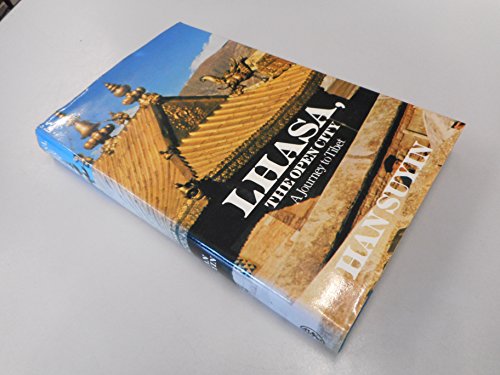
Ebook Info
- Published: 1977
- Number of pages:
- Format: PDF
- File Size: 19.60 MB
- Authors: Han Suyin
Description
User’s Reviews
Reviews from Amazon users which were colected at the time this book was published on the website:
⭐An eye opener to how the populous of Tibet were treated by the lamaists, royals, and landlords before the communist takeover.They had very little food, clothing or shelter. Almost like the serfs in Europe, but this was in the early 1900. By 1974, when Han Suyin finally got the okay to go to Tibet, she saw the beginning of change. Have read three other books by Han Suyin, a half white and half Chinese, who finally became a doctor and came back to China. Her first husband was a soldier for Chiang Kai Shek. Her husband and the Nationalist did very little to help the working populous. The communist under Mao Tse Tung did so much more and that is why they are still ruling in China.
⭐Right from the beginning the book goes on and on to say that (1) Tibet was a part of China since thirteenth century. (2) It was always waiting for liberation by China from its tyrannical theocracy. (3) Had it not been liberated extinction of its population was imminent, due to poverty and the epidemics. Which occurred as a result of the failure of its theocratic system to bring social changes.(4) Theocracy took hold of Tibet when its warriors were on an expansion spree in the medieval times. (%) Many Dalai Lamas were assassinated in Potala, who displyed reformist and liberal bent. (6) Where ever Lamaism rules, the results were the same, like in Mongolia.I can also go on and on numbering the books formation on such jaundiced premises. But a reader might have understood what I mean.Then it goes further on and on, on how things have improved after PLA marched into Lhasa. Had it not done so, modernity might have never reached Tibet.I am in the middle of the book. I may not read it fully. This author should be regarded as a person with very limited insight into how civilization progresses; someone highly indoctrinated to become unable see the out of the box possibilities. She also is a representative of the educated elite of China of the time. Hope her type is no more there in China. Else it doesn’t portend well for the second biggest economy of the world–mainly on account of a cheap labour. Imagine the tyranny of it among the Chinese people, those who work in subhuman conditions. A total lack of innovation and making fakes won’t take it far. A regimented mindset is the problem of one party system of China.
⭐A very well written book, but the propoganda machine is in full force. So much of what we know about human civil rights, and the atrocities of China are never mentioned. The book is sterile of any cultural value, but an excellent resource for those wishing to study how propaganda works. This book, written in the 1970’s, when China was trying it’s dangdest to be an open country, and fails miserably to show the cultural and human violations.
⭐The author was allowed to visit Tibet for two months in 1975. In her preface she thanks the Chinese Government for looking after her and making material available to her. It is unclear to what extent the book may have been an officially sponsored publication.The book contains much praise for the development, “modernisation” and secularisation of Tibet. Much of this praise now seems dated, e.g. for the now defunct communist “cooperative” labour systems that were introduced, or the unqualified praise for new roads and railways without any sense of environmental or cultural conservation values.Heinrich Harrer’s book “Return to Tibet” (1984) is more valuable as a first hand account of the changes in Lhasa as the author had lived in Tibet for several years before the Chinese invasion, as well as revisiting afterwards.For an account of the same period by a Tibetan, Dawa Norbu’s book “Tibet: The Road Ahead” (1997) is good, although it has less on Lhasa and more on rural Tibet.Suyin has several chapters on Tibet’s earlier history. These have been compiled in a sometimes nebulous fashion from sources listed in the bibliography. There are far better introductions to Tibet’s history e.g. “Tibet: Past and Present” by Sir Charles Bell (1924), “Tibet: A Political History” by Tsepon W. D. Shakabpa (1967), and “A Cultural History of Tibet” by David Snellgrove and Hugh Richardson (1968).
⭐I read this book because I am hoping to visit Tibet. I had earlier read Love is a Many Splendoured Thing by Han Suyin. I found “Lhasa: An Open City” to be a very pro-China account of Tibet. So in that sense it was disappointing. The language was uninspiring. However, if you retain your objectivity, there is a lot of useful information about Tibet and it is definitely worth a read on that account.
⭐Good
Keywords
Free Download Lhasa, the open city: A journey to Tibet in PDF format
Lhasa, the open city: A journey to Tibet PDF Free Download
Download Lhasa, the open city: A journey to Tibet 1977 PDF Free
Lhasa, the open city: A journey to Tibet 1977 PDF Free Download
Download Lhasa, the open city: A journey to Tibet PDF
Free Download Ebook Lhasa, the open city: A journey to Tibet