Ebook Info
- Published: 2013
- Number of pages: 464 pages
- Format: PDF
- File Size: 5.22 MB
- Authors: Michael Dobbs
Description
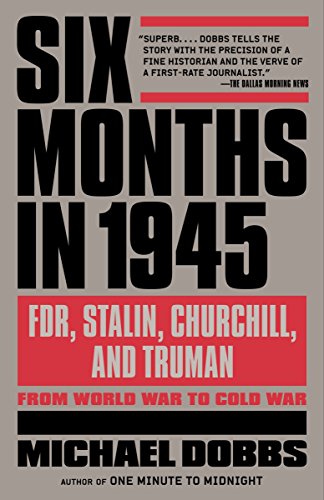
When Franklin Roosevelt, Winston Churchill, and Joseph Stalin met in Yalta in February 1945, Hitler’s armies were on the run, and victory was imminent. The Big Three wanted to draft a blueprint for a lasting peace—but instead they set the stage for a forty-four year division of Europe into Soviet and Western spheres of influence. After fighting side by side for nearly four years, their political alliance was beginning to fracture. Although the most dramatic Cold War confrontations such as the Berlin airlift were still to come, a new struggle for global hegemony had got underway by August 1945 when Truman used the atomic bomb on Hiroshima. Six Months in 1945 brilliantly captures this momentous historical turning point while illuminating the aims and personalities of larger-than-life political giants.
User’s Reviews
Editorial Reviews: Review Praise for Michael Dobbs’ Six Months in 1945“Superb . . . Dobbs tells the story with the precision of a fine historian and the verve of a first-rate journalist.” —The Dallas Morning News “Elegant and convincing. . . . Dobbs’s description of the fledgling relationship between the two superpowers is unerringly fascinating.” —The Washington Post “[S]uperbly evocative . . . So vivid is the writing that you can practically feel the shuddering vibration and turbulence in what was then the state-of-the-art aircraft carrying Roosevelt on the first visit by an American president to the Soviet Union.” —San Francisco Chronicle “A gifted storyteller and thorough researcher with an eye for detail . . . tension and suspense aplenty.” —Washington Times“This extraordinary and well-documented account of a short period in history illustrates how just a few men in a closed room can influence history in a monumental and sometimes devastating way. Six Months in 1945 is an important book to read to better understand how such negotiations influence us for decades. It illustrates that events and decisions made on the world stage affect us all, without most of us being aware of the decisions.” —Free Lance-Star“Elegantly written . . . Dobbs delivers engaging portraits of the national leaders . . . . A confident and rewarding survey of a hinge point in 20th century history.” —Kirkus Reviews “Dobbs brings these ‘six months in 1945’ to life better than anyone before him. In brisk, engrossing chapters, he weaves between the Big Three decision-makers . . . and sketches their stratagems, illusions, strengths and weaknesses.”—Military Book Club“Dobbs is a gifted writer. His characterizations of powerful men are well judged and rounded, as are his evaluations of the fateful choices they faced.” —Foreign Affairs“Dobbs lends the subject an immediacy that will engage history readers. . . . a readily accessible presentation of the onset of the Cold War.” —Booklist“An astute narrative of the six months that changed the world.” —Publishers Weekly About the Author Now a U.S. citizen, Michael Dobbs was born and educated in Britain, with fellowships at Princeton and Harvard. He spent much of his career as a reporter for The Washington Post, for which he covered the collapse of communism. His previous books include One Minute to Midnight, and Down with Big Brother: The Fall of the Soviet Empire, a finalist for the 1997 PEN award for nonfiction. Excerpt. © Reprinted by permission. All rights reserved. 1RooseveltFebruary 3 The big four-engine airplane with the gleaming white star stood on the tarmac of the little airfield in Malta, ready to take Franklin Delano Roosevelt on a final mission. The new Douglas C-54 Skymaster had been specially fitted with all the latest conveniences, including an elevator that could lift the president and his wheelchair off the ground and deposit him in the belly of the plane. FDR voiced his displeasure to the Secret Service agents who wheeled him up to the tiny elevator cage. “I never authorized that,” he muttered. “It’s quite unnecessary.” The embarrassed agents insisted that the device was required for security reasons. The alternative was a long ramp, a signal to enemy spies that the polio-stricken president of the United States was about to arrive or depart. Roosevelt, who disliked needless fuss and expense, was unconvinced. The departure schedule had been planned with choreographic precision. Thirty military planes were lined up next to the small control tower, waiting for permission to take off. At ten-minute intervals, the lead plane moved to the head of the darkened runway, shades drawn, exterior lights extinguished. As each plane roared into the Mediterranean sky, the next plane moved into position behind. The night was filled with the roar of Skymaster and York transports warming their engines for takeoff and the high-pitched whine of fighter planes circling the airfield. Few people were aware of the existence of a presidential aircraft. Code-named Project 51, its construction was such a closely guarded secret that those in the know referred to the plane as the Sacred Cow. Roosevelt had become the first U.S. president to travel by airplane two years earlier, in February 1943, when he took a Pan American flying boat to Casablanca for a conference with Winston Churchill. But commercial air travel was obviously impractical for a wartime president—particularly one paralyzed from the waist down. The flying White House was ready for its inaugural trip. Roosevelt boarded the Sacred Cow at 11:15 on the evening of February 2, 1945. The plane was not scheduled to depart until 3:30 a.m., but his doctors had decided this was the best way for him to get a decent night’s rest. He was rolled straight to his stateroom, just aft of the wing. His black valet, Arthur Prettyman, helped him off with his clothes and made sure that he was lying comfortably on the plush three-seat couch emblazoned with the presidential seal. Other amenities included a swivel chair, a conference table, several closets, a private toilet, and a panoramic bulletproof window twice the width of regular portholes that was framed by blue curtains. A console next to the window provided communication with the cockpit and other parts of the plane. The interior wall opposite contained a set of maps on rollers that could be pulled down for in-flight briefings. A painting of a nineteenth-century clipper tossing in the waves filled the wall above the couch, evoking Roosevelt’s love of the sea. The president was chronically tired. He had whiled away the twelve-day crossing of the Atlantic on a U.S. Navy cruiser with endless rounds of gin rummy, deck games, and movies in the evening. He frequently slept twelve hours a night—but however much rest he got, it never seemed enough. Much of his remaining energy had been spent on his last election campaign, riding in open limousines and braving a torrential downpour in New York in a desperate attempt to show he was fit enough to serve a fourth term. The campaign appearances were designed to remind the voters of the FDR of popular imagination—strong, indomitable, optimistic—but they concealed his rapidly deteriorating state of health. He had lost some forty pounds over the last few months and looked like a skeleton. His blood pressure was out of control, sometimes as high as 260 over 150. The man he had chosen as vice president, Harry S. Truman, was alarmed when they met for a symbolic photo-taking session at the White House. “I had no idea he was in such a feeble condition,” Truman confided to an aide. “In pouring cream in his tea, he got more cream in the saucer than he did in the cup. There doesn’t seem to be any mental lapse, but physically he is going to pieces.” Roosevelt’s heart specialist, Howard Bruenn, slipped into the cabin shortly before takeoff. The president was already snoozing. The young navy lieutenant commander wanted to make sure his patient did not roll off the couch as the Sacred Cow accelerated down the runway. Knowing that Roosevelt would not have the strength to prevent himself from falling deadweight to the floor, Bruenn positioned himself on the swivel chair, its back against the couch. He would sleep sitting down, alert to the noises behind him. Bruenn was worried about FDR. When he first examined the president, at Bethesda Naval Hospital in March 1944, he knew at once there was something “terribly wrong” and gave him no more than a year to live. He was having trouble breathing, and suffering from bronchitis. His heart was greatly enlarged, no longer able to pump blood efficiently. The cardiologist prescribed a regimen of digitalis to control the heartbeat, an easily digestible diet, greatly increased rest, and a sharp cutback in the number of official visitors and duties. Roosevelt’s chief physician, Vice Admiral Ross McIntire, had resisted Bruenn’s recommendations because he did not want to disrupt the president’s routine, but eventually agreed to a scaled-down version. On McIntire’s insistence, nobody outside a small circle of trusted White House doctors would know the facts about the boss’s medical condition. Even Roosevelt was kept in the dark. Averse to unpleasant news, he displayed little interest in finding out the truth. The roar of the engines and the shuddering of the aircraft frame as the Sacred Cow rose from the ground awoke the president from his fitful sleep. His nose and throat were stuffed up. Bruenn could hear FDR toss around on the couch behind him. His clinical notes recorded that Roosevelt “slept rather poorly” on the plane because of “noise and vibration” and was frequently woken by “a paroxysmal cough which was moderately productive.” Apart from that, “the patient” was doing better than expected. He had “thoroughly enjoyed” his two weeks of travel away from the United States—“via train, ship, aeroplane and motor car”—and had “rested beautifully” on the trip across the Atlantic, “sleeping late in the morning, resting in the afternoon, and retiring fairly early at night despite fairly rough seas.” After taking off from Malta, in the center of the Mediterranean, the Sacred Cow headed due east, cruising at a speed of two hundred miles per hour. The doctors had insisted that the unpressurized plane stick to an altitude of six thousand feet to minimize the president’s breathing problems. The plane danced in and out of the clouds. About an hour out of Malta, it hit bumpy weather. The head of the Secret Service contingent heard a noise in the president’s bedroom and went to investigate, but it was just a door slamming back and forth. The pilots shifted course northeast to avoid Crete, parts of which were still held by the Germans. Dawn broke as the Sacred Cow passed over Athens, clearly visible on the port side of the aircraft. Six P-38 fighter planes appeared out of the clouds to escort the president’s plane onward across the Aegean Sea to the snow-covered plains of northern Greece and Turkey, and finally the Black Sea. Roosevelt’s daughter, Anna, was already up to watch the “beautiful sunrise” and the “outlines of tiny villages” in the otherwise barren Greek islands. Everyone had been instructed to put their watches and clocks forward two hours overnight. The president was dressed and served his usual breakfast of ham and eggs an hour before landing. The Allied planes had been instructed to execute a ninety-degree turn as they entered Soviet airspace, to identify themselves as friendly and avoid being shot down by antiaircraft defenses. The Sacred Cow followed the agreed routing along the railway track from the town of Eupatoria on the western edge of the Crimean Peninsula to the airfield at Saki. The landscape was flat and uninteresting, a seemingly endless expanse of snow. The president’s plane, now accompanied by five fighters (one had turned back because of engine trouble), circled the airstrip once and landed on schedule at 12:10 Moscow time, “bumping the full length of the short concrete-block runway.” During twelve years as president, Franklin Roosevelt had helped rescue the United States from the depths of the Great Depression, persuaded a reluctant nation to support Great Britain in its hour of need, and assembled the mightiest military coalition in history to resist the assaults of Nazi Germany and imperial Japan. Victory in both wars was within sight. Allied troops had reached the frontiers of Germany and were rolling back Japanese gains in Asia. The dying commander in chief had decided to make a dangerous, potentially suicidal, voyage across the ocean just two days after his fourth inaugural because he was obsessed by two final goals. He wanted to make sure that victory was secured at the lowest possible cost in American lives. And he had promised Americans, exhausted by more than three years of war, “a lasting peace.” Prior to FDR’s arrival in the Crimea on Saturday, February 3, 1945, no serving U.S. president had set foot in Russia, much less the Soviet Union. None would do so again for nearly three decades. American attitudes toward Russia had veered wildly since the 1917 Bolshevik Revolution. U.S. troops had intervened on the side of the Whites in the Russian civil war, battling the Reds in the snows of northern Russia before eventually retreating in disarray from Arkhangelsk with more than two thousand casualties. Americans were shocked by Stalin’s agreement with Hitler in 1939, the carving up of Poland, and the Soviet invasions of Finland and the Baltic states. But the pendulum swung back sharply when the German armies invaded the Soviet Union on June 22, 1941, reaching the gates of Leningrad and Moscow within a few months. When the United States entered the war after the Japanese attack on Pearl Harbor on December 7, Communist Russia became its most important military ally. Hollywood movies began portraying the Soviet Union as a land of brave soldiers, contented workers, and smiling commissars, a one-hundred-eighty-degree turnaround from the thuggish buffoons depicted in the 1939 smash hit Ninotchka. The image of a mighty, trustworthy nation, under a strong yet benevolent leader, grew with every Red Army victory, with the active encouragement of the Roosevelt administration. There were some dissenting voices, particularly among the handful of American diplomats with firsthand experience of life in Russia. The U.S. ambassador to Moscow, Averell Harriman, complained that the Russian bear was turning into the “world bully.” He feared that Stalin would use “strong-arm methods” to establish a “sphere of influence” in eastern Europe under his exclusive control. Harriman’s deputy, George Kennan, agreed that a division of Europe was inevitable. America and Russia had little in common—other than a shared enemy. In a letter to his friend Charles E. Bohlen on the eve of the Yalta conference, Kennan urged the U.S. government to make the best of geopolitical realities: “Why should we not make a decent and definite compromise with [Moscow]—divide Europe frankly into spheres of influence—keep ourselves out of the Russian sphere and keep the Russians out of ours”? Dividing Europe with Russia was not at all what FDR had in mind when he risked his life to meet with Joseph Stalin and Winston Churchill in the Crimea in the waning days of World War II. Like most Americans, he was repulsed by anything that smacked of “empires,” “balance of power,” and “spheres of influence.” In the grand Rooseveltian scheme, a new world organization would assume primary responsibility for ensuring the “lasting peace” under the benign supervision of the victorious allies. The president wanted American soldiers to come home from Europe and Asia as quickly as possible. Stalin was not at Saki airport to greet Roosevelt. Instead, he had sent his foreign minister, Vyacheslav Molotov, who was pacing up and down on the tarmac in a heavy overcoat and fur hat, surrounded by Allied officials. Through the window of the president’s cabin, FDR and Anna could see knots of Russian women sweeping snow from the runway with brooms made out of birch twigs. They waited inside the warm plane until Churchill’s C-54 Skymaster, a gift from the United States, landed twenty minutes later, accompanied by its own escort of six P-38 fighters. Originally, Roosevelt and Churchill had planned to take only modest entourages with them to Yalta, consisting of thirty to thirty-five key aides. But the delegations grew in size as more and more officials deemed themselves “indispensable” to either the president or the prime minister, until they reached a combined total of some seven hundred people, support staff included. The Russians had erected large army tents, heated with wood-fired stoves, to provide hospitality to the throng of field marshals, ministers, generals, ambassadors, and assorted aides-de-camp. New arrivals were invited inside for their first Russian breakfast, consisting of giant dollops of caviar, assorted garlic-heavy cold cuts, smoked salmon, eggs, curd cake with a sour cream sauce, sweet champagne, Georgian white wine, vodka, and Crimean brandy, all washed down by tumblers of boiling tea.Eventually, everybody shuffled into place for the arrival ceremony. After lowering the president to the ground in his elevator, Secret Service agents lifted him into an open lend-lease jeep covered with rugs. A Red Army band played “The Star-Spangled Banner,” “God Save the King,” and the new Soviet national anthem (“The Great Lenin lit our way / Stalin brought us up to serve the people”). Seated in the jeep in his dark navy cape, Roosevelt reviewed a goose-stepping honor guard, flanked by Churchill and Molotov on foot. FDR seemed “frail and ill” to the prime minister. “He was a tragic figure.” His face was the color of parchment, waxlike and drained of energy. His right arm rested on the side of the jeep, the hand hanging limply downward. Churchill’s doctor, Lord Moran, described the scene: The PM walked by the side of the President, as in her old age an Indian attendant accompanied Queen Victoria’s phaeton. They were preceded by a crowd of camera-men, walking backwards as they took snapshots. The President looked old and thin and drawn; he had a cape or shawl over his shoulders and appeared shrunken; he sat looking straight ahead with his mouth open, as if he were not taking things in. Everyone was shocked by his appearance and gabbed about it afterwards. Read more
Reviews from Amazon users which were colected at the time this book was published on the website:
⭐In his book “One Minute to Midnight”, Michael Dobbs brought us a thrilling, minute-by-minute account of the Cuban Missile Crisis. Now he attempts to do the same with six crucial months in 1945, from February – August 1945, and largely succeeds. In this book Dobbs gives us a fly-on-the-wall treatment of political deliberations between the major Soviet, American and British players during the war, most prominently FDR, Churchill, Truman and Stalin. While this is a highly readable account, it lacks the urgency and minute-by-minute detail of Dobbs’s book on the Cuban Missile Crisis and has few revelations.Dobbs begins with a vivid account of the February conference at Yalta that sets the tone for the rest of the book. Churchill, Stalin and FDR met at a time when the war had decidedly turned in favor of the Allies but the future of postwar Europe had not been decided. The great strength of the book is in giving us compelling character sketches through the words of the prime participants as well as those of their colleagues. Not just the main players but also minor ones like valets, diplomats and colonels come to life in several places. Dobbs shines in describing minor details like the menu or the woeful bathroom situation at Yalta that nonetheless give us a sense of being there. Maps and even reprints of handwritten notes from the deliberations further enrich the narrative. The author does an excellent job sketching out the character and motivations of the major players. Each one had his own agenda; FDR was the charmer who thought he could easily manipulate Stalin, Churchill was the imperialist who was desperate to hold on to his empire, and Stalin was the poker player who already had made plans for the occupation of Eastern Europe. Churchill especially comes to life under Dobbs’s pen as a shrewd man with a heart of steel and superlative linguistic gifts who could occasionally act childish, even comical. As other accounts have made clear, both he and FDR needed Stalin – the Soviet Union had paid most of the price during the war in terms of bloodshed – and so it was Stalin who really carried the best cards. He was much more mistrustful of Churchill than of FDR and Dobbs does a very good job laying out his thoughts and his conversations with his subordinates; many memorable quotes surface in this book, including one by Stalin to the effect that Churchill will extend his hand into every pocket even for a kopeck, while FDR is only interested in the bigger coins. What’s also clear is that by this time FDR was a dying man, and while he made every effort to stay in the game, his health prohibited him from doing so.The book then proceeds with a discussion of how Stalin used all his cunning to make sure he could gain control over much of Eastern Europe. A chapter on his deputy Andrey Vyshinsky tells us how Vyshinsky used his diplomatic guile to institute Communist governments in Latvia and Romania. Stalin also used his guile to extract significant concessions on Poland. The Allies had no chance but to agree, effectively sidelining the free Polish government and signing over Poland to communist tyranny. Stalin’s crony Molotov played a significant role in these negotiations. Dobbs’s portrait of Molotov as a cold, shrewd manipulator whose love letters revealed a sentimental man is memorable. Ultimately Dobbs makes it evident that Churchill’s famous “iron curtain” (which he proclaimed much later in a March 1946 speech) was being drawn right then during the early months of 1945; in fact Churchill issued explicit orders to his commanders to keep their forces on alert and to retain German equipment so that it could come in handy in case of a potential confrontation with the Soviets. In general compared to FDR or Truman, Churchill was always more attuned to Stalin’s scheming. The political manipulations of the Soviets and the straitjacket that the necessities of the war imposed on the Allies set the stage for the Cold War.Further on there is a poignant chapter on FDR’s death and the shock waves this sent throughout the world. The new president Truman was not from FDR’s inside circle so he retained much of FDR’s staff while making it clear that the buck stopped with him. Dobbs describes how the fate of the world unexpectedly fell on Truman’s shoulders. While lacking FDR’s capacity for intellectual sophistication and ability to manipulate men, Truman showcased solid commonsense and a sprightly confidence. Unfortunately he could not manipulate Stalin much and he also had to be consistent with his predecessor’s concessions to the dictator, as became evident at the Potsdam conference. Dobbs’s narrative of the linkup between the Allies and Soviets and the way the Allies had to grudgingly cede Berlin to the Soviets is especially readable. The atomic bomb was the ultimate card which Truman thought he could play to manipulate the Soviet dictator, but as we now know, Stalin already knew about it through spies. Dobbs also describes relatively minor but still important events like the race to locate Germany’s atomic bomb program (which was far from producing a weapon) and how the Allies had to turn a blind eye to the looting and pillaging by the Soviets during their march on Berlin. However Dobbs also makes it abundantly clear that both sides committed acts which in hindsight look immoral and gratuitous. Such is the nature of war.All this still keeps me from giving the book five stars since as I mentioned above, this account lacks the fast pace and minute-by-minute snapshots of “One Minute to Midnight”. More importantly, I was disappointed by the relative lack of detail on ongoing military conflicts and some key events; for instance the important bombing of Dresden is quickly dispatched and there is very little discussion on the Japanese theater of war. An account of Hitler’s last days is almost entirely absent; even a few pages on the fascinating deliberations in his bunker would have complemented the narrative. There is also little consideration of the important Interim Committee that met in May and June and had a soul-searching and fascinating debate on the impending atomic bombings of Japan. I think that the addition of fifty or so pages expounding on these events would have produced a more comprehensive account. Overall then, this is an excellent account of the crucial first six months of 1945 and would be a first-rate introduction to those unfamiliar with this history. But for those already steeped in the story of this era, the book would be entertaining but would bring little that’s new to the table.
⭐”Six Months in 1945″ is the new history book by Michael Dobbs. Dobbs is British born though he is now a United States Citizeen. “Six Months in 1945” is the third in the author’s trilogy on the Cold War. The other two books in the series are”One Minute to Midnight about the Cuban Missle Crisis and “Down With Big Brother: “The Fall of the Soviet Empire.” “Six Months in 1945” begins in February, 1945. The scene is Yalta where the big three: Stalin, FDR and Churchill were meeting for a late war summit. The purpose of the meeting was to see if the big powers could amicably:a. Devise a blueprint for the new Europe following the imminient defeat of Nazi Germany.b. Reconcile the political differences over Poland. Stalin would renege on giving concessions to the non-Communist exile government based in London. The Communist Lublin government would have power in postwar Europe. Churchill using a phrase first enunciated by Nazi Joseph Goebbels described an IRON CURTAIN dividing the Soviet controlled Eastern European nations from the free nations of Western Europe.c. Final plans for the defeat of Nazi Germany were outlined. 5.5 million German troops were killed during the war. 3.5 died at the hand of the Soviets. The Soviets would take Berlin as the Allies deferred to Stalin’s wishes on this strategic decision. Over 2 million German women would be raped by the Soviet troops.d. Over 20 million Euopeans would be forced into refugee status as national boundaries were drawn. After his excellent graphic description of the Yalta Conference Dobbs goes on to disucss the Potsdam Conference in Berlin.During this meeting:a. Truman infomed Stalin of the development of the Atomic Bomb.b. The Soviets announced they were going to declare war on Japan. Stalin’s Red Army would invade Manchuria and defeat Japanese forces a few days before the bomb was dropped on Hiroshima and Nagasaki ending the Asian war.c. The wartime Alliance of Britain, the US and Soviet Russia began to break up as the Cold War began. During the crucial six months of 1945:a.. The German and Japanese were forced to surrender. Hitler committed suicide.b. The Atomic Bomb was dropped on Japan by the Americans.c. Franklin Roosevelt died to be replaced by Harry Truman the Vice-President. Truman proved to be a good representative of the United States at Postdam. He would provide aid to Greece and Turkey in their fight against Communism.d. Churchill’s Conservative Party was defeated by Attlee and the Labor Party. WSC was no longer Prime Minister of Great Britain. Attlee replaced WSC at the later meetings convened at Postsdam.e.Huge arguments were held over the issue of German reparations and the division of the zones of occupation in German and Berlin. Dobbs is great as portraying the major players in the last drama of World War II and the opening scenes in the Cold War.a. Winston Churchill-The wartime British Prime Minister was upset over Britain’s waning power and shrinking empire. he was the little British donkey who sat between the two behemoths of the United States and the Soviet Union.b. Franklin Delano Roosevelt was near death at the Yalta Conference. He was hoodwinked and seduced by the cruel and crafty Stalin in agreeing to Soviet territorial demands in Eastern Europe. He would die at Warm Springs Georgia in April, 1945.c. Stalin was at the apex of his dictatorial powers. He hated democracy and was a tough negotiator for Soviet interests at both Yalta and Potsdam. He was ably assisted by Molotov at both conferences.d. Harry Truman was a neophyte in foreign policy. He relied heavily on Secretary of State Jimmy Byrnes. George Kennan’s containment policy in Europe would win favor as the Cold War strategy of the United States became operative. Most Americans have a very murky understanding of the political and military events which ensued immediately following World War II. Dobbs book is an excellent corrective to this blind spot. A fine book well written and perceptive. The book includes helpful maps and includes excellent notes to aid understanding. Highly recommended!
⭐In ‘Six Months in 1945′, Michael Dobbs has delivered an exciting and easy to read analysis of how the world moved rapidly from World War to Cold War. Its content is summarised well by the author when he writes in the final chapter: “virtually all of the watershed moments of the early Cold War can be traced back to the six-month period between February and August 1945 that spanned the death of FDR, the end of World War II, the disintegration of the anti-Hitler alliance, and the division of Europe into rival political blocs”. I particularly enjoyed Mr Dobbs’ summary of the Yalta conference, at which the ailing Roosevelt was no match for Stalin – and whose diplomatic triumph was no doubt helped by the fact that the Soviets had bugged the rooms of the British and American representatives.The rapid pace at which events moved during these momentous times, with the re-drawing of national borders and major changes to the political map of Europe, must have felt astonishing to the people who lived through them. Ironically, some 40 years later, the Soviet empire collapsed almost as rapidly – and that too, felt astonishing at the time. That’s the topic of another instalment of Michael Dobbs’ Cold War trilogy, which I look froward to reading soon.
⭐easy to read pop history. generally it’s fascinating and hugely enjoyable – all the old cliches about the truth is stranger than fiction apply here. occasionally there seems to be a bit too mich of an effort to inject ‘thrill’ into the duller aspects of the story. but that’s a quibble. yiouy could see any number of dramas being made form these characters and these events
⭐In 6 months time the allies turned against each other. The book explains how the main characters contributed to the cold war and that a different relationship between the former allies had been possible. I grew up during the cold war and found it fascinating to read about the origins of the conflict that defined the political context of my youth.
⭐Sart by not confusing authors! I did. However for once history outpaces fiction. Not material for house of cardsbut good background reading for John le Carre
⭐Very dull and plodding.
Keywords
Free Download Six Months in 1945: FDR, Stalin, Churchill, and Truman–from World War to Cold War in PDF format
Six Months in 1945: FDR, Stalin, Churchill, and Truman–from World War to Cold War PDF Free Download
Download Six Months in 1945: FDR, Stalin, Churchill, and Truman–from World War to Cold War 2013 PDF Free
Six Months in 1945: FDR, Stalin, Churchill, and Truman–from World War to Cold War 2013 PDF Free Download
Download Six Months in 1945: FDR, Stalin, Churchill, and Truman–from World War to Cold War PDF
Free Download Ebook Six Months in 1945: FDR, Stalin, Churchill, and Truman–from World War to Cold War