

Ebook Info
- Published: 2002
- Number of pages: 332 pages
- Format: PDF
- File Size: 3.82 MB
- Authors: David Ramsay
Description
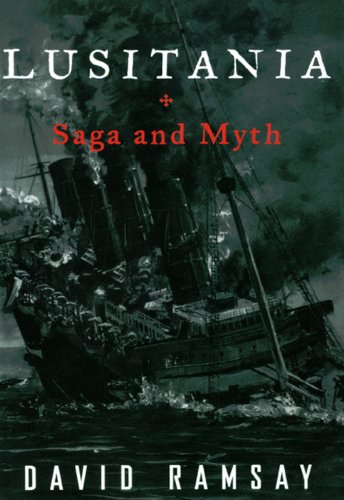
An objective and enthralling account of the sinking of the Lusitania, which unravels many of the myths and, for the first time, explains the true significance of that terrible disaster.The saga of the Lusitania is one of the most remarkable in the annals of maritime history. State-of-the-art when she went into service and the first express liner to be equipped with steam turbines, she outclassed all her rivals. She triumphantly restored British supremacy on the North Atlantic passenger routes and became an acknowledged commercial success; she was highly popular with her regular passengers. Her sinking in May 1915 by a German U-boat, with heavy loss of life, was at that time the most savage attack on civilians in the course of war, and was widely denounced in allied and neutral countries. From that day her loss has become encrusted with legends (including conspiracy theories), many of them created by German propaganda. In this new book David Ramsay has unraveled those myths and legends and tells a clear and compelling saga of terrible maritime disaster and clashes among three powerful nations. It is a story of potentates and presidents, ambassadors and ministers of state, bankers, shipping magnates, spies, and, not least, Captain William Turner, who had to defend himself against charges of incompetence and fight for his reputation. Based on detailed research, this new book almost certainly contains the most objective account of the history of the liner and the circumstances surrounding her sinking. The sinking of Lusitania, which took a mere eighteen minutes, led to a loss of life comparable with the Titanic disaster, and the ramifications were felt across Europe and America; this masterly telling of the story will intrigue the general reader as much as it does the historian and enthusiast.
User’s Reviews
Reviews from Amazon users which were colected at the time this book was published on the website:
⭐This book was excellent. It will be a wxcellent addition to my ww1 collection1
⭐I don’t know why Ramsay’s book has not had a greater readership. Ramsay attempts to tell the story of the Lusitania with the facts. One fact, the German Embassy posted the Warning note for an earlier edition of the New York papers, only to have it appear on the same page as the announcement of the Lusitania sailing. When the sinking actually occured, many thought it was revenge by the Germans, when it was a coincidence. Another was the conspiracy theory of Churchill actually letting the liner be sunk. Churchill was in Paris trying to bring the Italians into the war. The final one was the storage of ammunition in the holds, which was a fact. However, this ammunition did not blow up when the topedo struck. The boiler(s) probably blew causing the second explosion.This is a nice book that explains what happened to the Lusitania. The author did a good job of dispelling the myths of the loss of this great liner
⭐There is a myth that the Lusitania was the reason America entered World War One and it is a false one. Borrowing on this idea, authors mostly assume that the reader wants to read about the war. This work is not a book so much about the Lusitania, but more of a behind-the-scenes view of what went on during “The Great War”. Unfortunately, this has been covered time and time again making books indistinguishable from one another. Anyone reading Ramsay’s “Lusitania” that has read other books about the ship will be saying, ‘Don’t tell me what I do know; tell me what I don’t know’ Unfortunately, there is hardly anything in this book that a basic student of history will not know. There is only marginal new info on the ship, the rest is just a retread of what can be found in other works. In the previous edition of this book, he claims that Aileen Harris was a survivor, yet she was not aboard at all; she was not even Aileen Harris. She was not married to Dwight Harris at the time. He writes that a relative of victim Mrs. Stephens claims that her body went down with the Arabic, when in fact, it went down with the Hesperian. Cross-checking and fact-checking with a passenger list would have been the least Ramsay could have done. One would think the New York Times was the only paper to publish survivor accounts. Like most authors, Ramsay depends on the more easily obtainable sources. Again, tell me what I don’t know, not what I do know. The author gets points for actually tracking down a relative of someone aboard the liner, which other authors like Preston and Butler didn’t do, but this is clearly not the definitive book on the ship. It’s just barely about the ship! Just another WW1 over view.Mike Poirier is co-author of “Into the Danger Zone: Sea Crossings of the First World War”.
⭐There is a myth that the Lusitania was the reason America entered World War One and it is a false one. Borrowing on this idea, authors mostly assume that the reader wants to read about the war. This work is not a book so much about the Lusitania, but more of a behind-the-scenes view of what went on during “The Great War”. Unfortunately, this has been covered time and time again making books indistinguishable from one another. Anyone reading Ramsay’s “Lusitania” that has read other books about the ship will be saying, ‘Don’t tell me what I do know; tell me what I don’t know’ Unfortunately, there is hardly anything in this book that a basic student of history will not know. There is only marginal new info on the ship, the rest is just a retread of what can be found in other works. He claims that Aileen Harris was a survivor, yet she was not aboard at all; she was not even Aileen Harris. She was not married to Dwight Harris at the time. He writes that a relative of victim Mrs. Stephens claims that her body went down with the Arabic, when in fact, it went down with the Hesperian. Cross-checking and fact-checking with a passenger list would have been the least Ramsay could have done. One would think the New York Times was the only paper to publish survivor accounts. Like most authors, Ramsay depends on the more easily obtainable sources. Again, tell me what I don’t know, not what I do know. The author gets points for actually tracking down a relative of someone aboard the liner, which other authors like Preston and Butler didn’t do, but this is clearly not the definitive book on the ship. It’s just barely about the ship! Just another WW1 over view.Mike Poirier is co-author of “Into the Danger Zone: Sea Crossings of the First World War”.
⭐Author David Ramsay’s account of the sinking of The Lusitania is one of a glut of maritime disaster books to appear in recent years (and, indeed, was released almost simulateously with Diana Preston’s book on this particular disaster). Obviously, this is a hot publishing trend. Alas, it is also one that could stand better editing. Ramsay gamely provides the full sweep of The Lusitania tragedy, including detailed accounts of the political intrigue that surrounded it. Unfortunately, his prose is so, uh, lifeless, that the book is barely readable. Ramsay’s approach might be fine for historians, but readers who are looking for the kind of lively narrative history that has become so popular recently should look elsewhere.
⭐Many new information come to light, in this book, which correlates myths to facts and serves as a guide to all RMS Lusitania fans.
⭐A brilliantly researched and brilliantly written book.Five stars !!!
Keywords
Free Download Lusitania: Saga and Myth in PDF format
Lusitania: Saga and Myth PDF Free Download
Download Lusitania: Saga and Myth 2002 PDF Free
Lusitania: Saga and Myth 2002 PDF Free Download
Download Lusitania: Saga and Myth PDF
Free Download Ebook Lusitania: Saga and Myth