Ebook Info
- Published: 2009
- Number of pages: 592 pages
- Format: PDF
- File Size: 4.56 MB
- Authors: John Darwin
Description
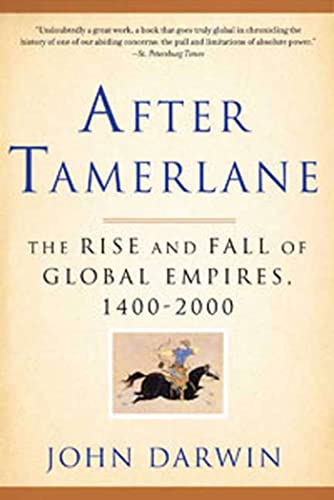
Tamerlane, the Ottomans, the Mughals, the Manchus, the British, the Japanese, the Nazis, and the Soviets: All built empires meant to last forever; all were to fail. But, as John Darwin shows in this magisterial book, their empire-building created the world we know today. From the death of Tamerlane in 1405, to America’s rise to world “hyperpower,” to the resurgence of China and India as global economic powers, After Tamerlane is a grand historical narrative that offers a new perspective on the past, present, and future of empires.
User’s Reviews
Editorial Reviews: Review “Marvellously illuminating…Darwin sustains an intricate thesis with enormous panache.” ―Independent (UK )“Elegant and brilliant….wonderful and imaginative…a deeply significant book.” ―Sunday Times (UK )“Undoubtedly a great work, a book that goes truly global in chronicling the history of one of our abiding concerns: the pull and limitations of absolute power.” ―St. Petersburg Times About the Author John Darwin is a University Lecturer and a Fellow of Nuffield College, Oxford. His books include Britain and Decolonization and The End of the British Empire.
Reviews from Amazon users which were colected at the time this book was published on the website:
⭐Trade and Empire Building are two intrinsic aspects to human organization. They are both absolutely unavoidable, are completely unpredicable, and are neither good nor bad inherently. They are what we as humans require at a minimum for human civilization to be anything other than a mass of self-sufficient individuals, which is ultimately an impossibility.States are nothing more than embryonic empires currently hemmed in by more powerful neighbors or geographical and economic constraints. Just as life dies when growth ends or corporations fail when profit shrinks, so do empires. Again – this is neither good nor bad – it is the essence of existence. Yet growth can happen too quickly, corporations can get too greedy, and unexpected geopolitical or technical change can shock the system in unexpected ways, often quite suddenly. We live in an Hegelian world, where every ideology, every religion, every culture, every empire is challenged by an opposing kind. Conflict is invevitable but a necessary prerequisite for resolution; only to resume in a new conflict. To what ultimate end however? To a one-world government of sorts? Perhaps but still – unpredicable – because there will be factors as of yet nobody can predict and even a one-world government/empire will face conflict from within.Every empire that has ever existed is still with us today in some vestigial form; they never truly disappear and in some ways recur again but in unexpected places and in unexpected forms. The power of the Roman Empire still exists but has been incarnated in the United States, which even names its legislative body after the Senate and uses the very same eagle as its symbol; many other similarities exist. One can find to this day some incarnated form of the old Tsarist Russia, Ottoman, Persian, British, and Spanish empires, among others. Communist China today has roughly the same borders it had under the Qing dynasty, which formed it and kept it together under the horrors of civil war and foreign bullying from Britian. Empires lose cohesion and collapse but they never truly disappear. History is not about the past but about the present for all that was is with us still and all that will be is here already in some embryonic form.The above are my thoughts after reading After Tamerlane, which is an outstanding book that will make you think and see connections. Books that focus on single eras, events, or regions can easily lose sight of the forest in which all things are ultimately connected and in which history is a series of patterns that repeat themselves endlessly, though always in some unique form, and typically in unexpected ways.Author John Darwin refers to Tamerlane as the last of the great attempts to unifiy all of “Eurasia” under one empire. We may never see another Steppe Horde attempt to subjugate through the sword a large swathe of territory but without doubt we will see more attempts at empire. Though it may not be via the sword it could be by the purse or it could be via AI or some form of technological subjugation. We seem not far from this already.There are essentially 2 predominant views of the period of European colonialism in Asia and Africa from roughly 1757 (after the Battle of Plassey) to 1961 (the Indian Annexation of Goa). The first is essentially pessimistic and increasingly views the Europeans as perpetrating evil or having some form of moral failing. The second is optimistic and sees the colonialism as a net positive that brought about accelarated progress, excesses and shortcomings notwithstanding.Should conditions have been otherwise, it could have been the Chinese or some other regional power or culture that was actually doing the colonizing, and in any case eventually it may very well be (for history is still happening) that some day the tables are completely reversed. Did not Muslims attempt to conquer much of the world? Did not Asian Mongols?Did not the Japanese carve out a large Pacific empire? Therefore, the idea that Europeans are somehow morally inferior or intrinsically more imperialistic is not based on sufficient evidence and in fact can be countered by examples of the opposite. It is not European nature that is the problem but human nature and it is the nature of power that it seeks more power.The idea of progress itself is debateable. Is there truly progress if human nature does not change? Does it really matter that we can light our streets, air condition our homes, refrigerate our food, and hold in the palm of our hands more knowledge than entire libraries yet live in perpetual fear of being killed by our leaders, or worse – enslaved?
⭐Professor Darwin has one hell of a mind. He writes with subtlety and grace while consistently giving the reader a thoroughly organized line of thought that is enhanced by a rich mass of detail, data, and anecdotes. He is one of the best historian-writers I have come across in decades of reading in the field. I found my mind skipping lightly from page to page and from chapter to chapter. Pure joy for any serious reader.I was less happy about the way he structured his analysis and presented his conclusions. Making sense of six centuries worth of data covering much of the Eurasian heartland would probably take a dozen volumes of narrative history and there would still be social historians complaining that their people had been left out. And deciding to go with “Imperialism since 1400” gives him a story he can tell in one volume. Who won and who lost has been pretty much the heart of the human drama since the Greeks invented history.Most of history’s winners are now deemed by the post-Vietnam academic mainstream to be the villains behind everything bad that has happened, particularly since the Soviet Union expired (with neither whimper nor bang) in 1989. Millions of lost academic sheep were left without, like the emperor, naked and feeling foolish. Perhaps the utopias promised by Rousseau, Marx, and Lenin would have reversed the west-east tide with better management from the East. Perhaps not. And perhaps all that romantic theorizing was in some part responsible for the disastrous misrule of Stalin, Mao, the Khmer Rouge, and the North Korean oligarchy. Sadly, much of academe and the mass media seem in thrall to post-modern theories of history that hold that the Enlightenment was the first false step taken by the West.To my mind, Darwin seems to believe that Western imperialism could do no right and those who lost out to it could do no wrong . With the exception of Japanese exploitation of China, aggressions by non-western imperialists from Tamerlane to Lenin are pretty much treated as “that’s the way people like that do things”. The Mughal Empire in India is one example. Mongolian domination of Han China is another.Also, he doesn’t appear to give much thought to the way western imperial powers disposed of their possessions after the Second World War. For example, one wonders if there are lessons to be learned by contrasting the way the U.K. eased out of their empire with the stubborn determination by the French to hang on to their possessions in North Africa and Indo-China and all that went with it. And while he rightly describes the slave trade to the west as a barbarous holocaust, he barely mentions the slave trade that sent just as many Africans north to Arab countries as were sent west to the Americas. He mentions enslaved European children brainwashed into Janissary servitude as the chief weapon and chief problem of the Ottoman sultans but with little moral reflection. By the end of the book Darwin seems to be going into overdrive as he tries to get his narrative up to speed with post-modern (read Marx lives) interpretations of history. He considers the popularity of Western films and consumer lifestyles now part of the imperialist tide. Stuff that was getting old in the 80’s. A good case can be made for the fact American politicians did the world a huge service by rejecting nativist isolationism and opting instead to shoulder the burdens of world leadership.I suppose it all comes down to perspective. Was there a monolithic colonialist West or were there qualitative differences between the way the various European powers expanded? Isn’t it entirely possible that the different developmental levels of North and South America is related to the way Britain and Spain themselves developed? Would the world be a better place if Shakespeare, Locke, Hume, Newton, Darwin, Blackstone, Mill, Wilberforce, and the hundreds of Parliamentary workhorses of representative government not been able to do their work?By all means read this book. Darwin has more right to offer opinions than I have to offer criticisms. He did, after all, do all the work of writing it. But also consider reading Francis Fukuyama’s, “The Origins of Political Order” for a more measured analysis of the way things happen in the real world. First volume takes us to the French Revolution and the second, out not long ago, finishes his analysis.Looking for a little optimism? Try Steven Pinker’s, “The Better Angel’s of Our Nature”. He writes as least as well as Darwin, displays a lighter touch at times, and lays out literally dozens of empirical studies that collectively suggest that humankind has reached a plateau of progress and that we might even have reason to hope for better days ahead. Need I add, in spite of all those Western sins.
⭐I originally wish-listed this book because I thought it was about Tamerlane, but then it would have been called “During Tamerlane” I guess. Darwin lays out the narrative and causes for why the West/Europe did not really start to dominate or overpower other cultures until 200-300 years until after Columbus/De Gama. For centuries after 1492 the Chinese,Indian and pan-Asian Islamic civilizations equaled or surpassed Europe in terms of development and it was only the period from 1750-130 that saw the West surge past everyone. The industrial revolution was the impetus. once Europe recovered from the 1/4 century of Napoleonic war they all kind of worked together to carve up the world into colonies with only a few tensions–Franco-Prussian war and the Fashoda incident being exceptions. Then WWI happens and European empires start imploding left and right. Sure England and France held onto theirs for a few more decades, but the writing was on the walls. Ironically Lenin who saw empire as the last stage of capitalism decided early on that the Czars empire would suit the new Soviet one just fine. Darwin also makes case that although US was late to empire game,its development was a key factor in its rise and at the end of the 20th century was the last empire left. Really good exploration of the subject that pursues angles i never thought of
⭐I read this as one of the recommended “background” books for the Open University course “Empires” and I thought it was excellent. It’s not an easy read because it is long, over 500 pages, and detailed. It is however very well written and if you keep at it you will discover a great many things and gain a good background knowledge of this subject.As another reviewer has said it doesn’t have a central “thesis”; it is much more a survey than an argument. If you want a “thesis” then Niall Ferguson’s
⭐Empire: How Britain Made the Modern World
⭐and David Day’s
⭐Conquest: How Societies Overwhelm Others
⭐, the other background books for the aforementioned OU course, are excellent. However if you want a survey then this is first class and an easy 5 star recommendation.
⭐This is the best book that gives an over view of Empires,without the vice or virtues and of the antagonistic debate which is now destroying any legitimate balanced debate on the subject. Reading this book will inform the reader that the colonial project was blind and unpredictable,good and bad things were done.Reading this book will give you a good grounding in historical facts,and give you a better understanding of global events,as you will be able to put them in a historical context. I am surprised at the poor star ratings from other reviewers,as some one who has studied international politics and history,this book is required reading on my course,as it gives a good grounding on the subject.John Darwin has done a excellent job.
⭐This book is a tour-de-force. Unlike ‘Empire’ by Niall Ferguson it does not put the British Empire centre-stage but rather looks at all examples of empire building including ones that are still happening under the radar today. It gives the reader a complete understanding of the role of empires in forging the world we live in today and how past empires have formed the historical basis of the events we witness every day in news broadcasts. It’s not always an easy read but it is an essential one.
⭐Great book from an amazing academic, which tackles globalisation in a very interesting way.
⭐Haven’t read the book yet.
Keywords
Free Download After Tamerlane: The Rise and Fall of Global Empires, 1400-2000 in PDF format
After Tamerlane: The Rise and Fall of Global Empires, 1400-2000 PDF Free Download
Download After Tamerlane: The Rise and Fall of Global Empires, 1400-2000 2009 PDF Free
After Tamerlane: The Rise and Fall of Global Empires, 1400-2000 2009 PDF Free Download
Download After Tamerlane: The Rise and Fall of Global Empires, 1400-2000 PDF
Free Download Ebook After Tamerlane: The Rise and Fall of Global Empires, 1400-2000