Ebook Info
- Published: 2013
- Number of pages: 496 pages
- Format: PDF
- File Size: 4.66 MB
- Authors: John Darwin
Description
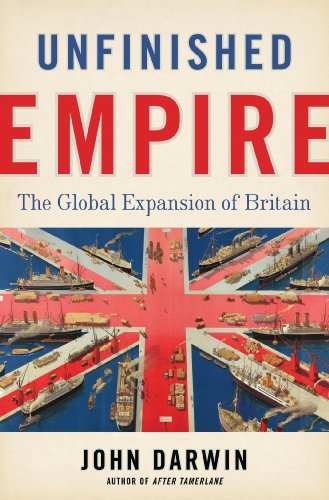
John Darwin’s After Tamerlane, a sweeping six-hundred-year history of empires around the globe, marked him as a historian of “massive erudition” and narrative mastery. In Unfinished Empire, he marshals his gifts to deliver a monumental one-volume history of Britain’s imperium-a work that is sure to stand as the most authoritative, most compelling treatment of the subject for a generation.Darwin unfurls the British Empire’s beginnings and decline and its extraordinary range of forms of rule, from settler colonies to island enclaves, from the princely states of India to ramshackle trading posts. His penetrating analysis offers a corrective to those who portray the empire as either naked exploitation or a grand “civilizing mission.” Far from ever having a “master plan,” the British Empire was controlled by a range of interests often at loggerheads with one another and was as much driven on by others’ weaknesses as by its own strength. It shows, too, that the empire was never stable: to govern was a violent process, inevitably creating wars and rebellions.Unfinished Empire is a remarkable, nuanced history of the most complex polity the world has ever known, and a serious attempt to describe the diverse, contradictory ways-from the military to the cultural-in which empires really function. This is essential reading for any lover of sweeping history, or anyone wishing to understand how the modern world came into being.
User’s Reviews
Editorial Reviews: From Booklist Founded in a fit of absentmindedness, as the saying goes, the British Empire was never a monolithic polity but had different circumstances surrounding the establishment, growth, and rule of its colonies. Combine the variations in its parts and the range of historical opinion about it, from praise to condemnation, and one wonders whether a single-volume history of it is even possible. Darwin confidently forges one, however, that accentuates the decentralized character of the centuries of its expansion, which proceeded in tension with the links of trade, law, and military power between an outpost and London. If imperial control varied from colony to colony, it waxed and waned in a general sequence everywhere. British contact with a foreign land was followed by growth of a colonial society, assertions of autonomy or rebellion, and eventual independence. To contemporaries at all times, the worth and justice of the empire provoked debate that Darwin quotes amid his accounts of empire building in America, Africa, India, Asia, Australia, and New Zealand. Vast and controversial though his subject, Darwin raises all key historical issues in this solid survey of British imperialism. –Gilbert Taylor Review “The depth of Darwin’s learning is impressive…. [his] tone throughout is admirably detached and scholarly, though his dry wit keeps it well away from being boring…. [a] sharp, thoughtful, enjoyable and levelheaded book.” ―The New York Times Book Review“Mr. Darwin’s informative and intelligent book is ably written, and it is brimming with interesting statistics and acute observations.” ―The Wall Street Journal“[A] remarkable history of the empire…. immensely important and useful. As an Englishman, Darwin declines to be either boastful or self-lacerating about the empire his country presided over, but simply examines it with a clear eye. This he has achieved to a laudable and indeed remarkable degree.” ―Jonathan Yardley, The Washington Post“John Darwin has crafted a brilliant historical account of what the British empire was, stripped of the ideological fog that usually clouds the subject, and how we still live in its shadow.” ―Timothy Brook, author of Vermeer’s Hat: The Seventeenth Century and the Dawn of the Global World“In his sweeping new book Unfinished Empire: the Global Expansion of Britain, John Darwin reminds us that empires are created by people. This is the story of the British Empire from the perspective of the men and women who built and ran it. As such it provides a new and sober look at the complex workings of one of the longest lived and most influential empires in world history from a preeminent authority on imperial history. Those interested in an accessible, comprehensive, and up-to-date survey of the British Empire need look no further.” ―Timothy Parsons, Washington University in St. Louis, author of The Rule of Empires“Temporally and geographically sprawling, Darwin’s study is as expansive as his subject, yet his lucidly rendered project holds together remarkably well.” ―Publishers Weekly“A brilliantly perceptive analysis of the forces and ideas that drove the creation of an extraordinary enterprise … Bringing together his huge erudition, scrupulous fairness and elegant prose, Mr Darwin has produced a wonderfully stimulating account of something that today seems almost incredibly yet was, in historical terms, only yesterday.” ―Economist“Engrossing … What Darwin adds to this [subject] is a rare, wonderful capacity for comparison …. It raises the historical writing on empire to another level.” ―BBC History Magazine“Balanced, original and impressive … Subtle … intelligent.” ―Literary Review (UK)“Comprehensive … Darwin’s erudition allows him to skirt around the narrow orthodoxies of apologist v critic and provide an insightful account of Britain’s unlikely period of global hegemony.” ―Sunday Times (UK)“A breadth of perspective few other imperial historians can boast … Breadth of vision, fizzing ideas and a brilliant style as well as superb scholarship … It deserves to supplant every other book on this topic.” ―History Today (UK)“A sweeping, nondogmatic study of the gradual and not always secure development of the British Empire…. The author does an excellent job delineating the remarkable British rule in India…. An evenhanded, erudite book that finds the work of empire building more nuanced than catastrophic.” ―Kirkus Reviews“Clever analysis, poignant argument, accessibility of the text, and inviting prose make this work a must read for those interested in the British Empire. Summing Up: Essential.” ―CHOICE Reviews About the Author John Darwin has written extensively on the decline of Britain’s empire and teaches imperial and global history at Oxford, where he is a Fellow of Nuffield College. His books include After Tamerlane, Britain and Decolonization, and The Empire Project. Read more
Reviews from Amazon users which were colected at the time this book was published on the website:
⭐The British Empire existed for hundreds of years and encompassed a large number of peoples, cultures, and religions. To do it full justice you would need to read all 5 volumes of the Oxford History of the British Empire. Darwin does an excellent job of not just laying out the facts, but helps put a narrative while still remaining scholarly. He also doesn’t pick and chose sides. After reading his passages on the Boer war, you could easily argue for or against it. I also like that he doesn’t cover everything in a chronological order, but instead a “theme” order. For example, you will said African Colonization spread out throughout the book when discussing slave trade, missionaries, humanitarianism, war, and “informal empire”. This better allows you to view the evolution of the British Empire instead of siloed perspectives. It’s also good to supplement this book with the penguin atlas of the British Empire and Ashley Jackson’s short introduction to the British empire.
⭐I read a lot of history, and it is not often that I come across a book that repeatedly makes me stop and say “Geez, I never thought of that before”. John Darwin’s book does just that. It is a fantastic analysis of how the British put together, and held on to, an empire that spanned centuries and continents.=== The Good Stuff ===* Darwin does a great job at analyzing the way in which Britain grew, managed and especially financed their empire. He is willing to offer an opinion on how it was done, and provide examples and data to back his positions. For example, one of the main tenets of the book is that the British were pragmatic businessmen, whose colonizations were related to business expansions and mergers than any need to spread religion, forms of government or seeking official tribute.* Rather than getting carried away with the military side of conquest, the book takes a much closer look at the commercial side of colonization, which was important because much of Britain’s empire building was actually done by “private” enterprise-although in cooperation with the government. Darwin also points out the British habits of using whatever government was already in place, and building an empire while watching the “overhead” costs.* I found Darwin to be especially insightful, both in his overall analysis and in various small points that I had just never considered. As a trivial example, early Europeans had always thought that North America was just a thin strip of land, not more than 100 miles across, and that the Pacific Ocean (and China) were just over the next set of hills. This always puzzled me, until Darwin pointed out that Europeans’ first experience with the New World was Central America…which just happens to have those characteristics. I found many of these Aha moments in the book.=== The Not-So-Good Stuff ===* This really should have been a “business” book rather than a history book. Darwin almost makes a number of great points, but can’t quite bring himself to pull the trigger. For example, he discusses how Britain’s Asia colonies were managed in the 18th and early 19th century. Britain hired strong managers and supplied them with basic guidelines- simply because asking and getting an answer from London could easily be a 12-month undertaking. Further, it was not even clear who in London to ask, because the decision making was scattered across multiple government and private groups. Contrast that to the later years, when the telegraph and its successors made communications instant. But you could easily argue that Britain was more successful at managing colonies in the earlier years. A valuable lesson that modern business (e.g. Mercedes/Chrysler) seems to keep relearning.*The book is not an easy read. The sentences and paragraphs can get a bit long, and Darwin is prone to be wordy and obtuse. Some sections are much better than others. But my biggest complaint is the organization of the book. The author had set up the narrative more by topic (e.g. warfare, colonial resistance, local leaders)than by country or time period. As a result, the narrative constantly jumps from one continent and century to another, often in the same paragraph. I found this frustrating, especially in areas such as Africa and India where my knowledge was sketchy. It took a lot of work to read and organize this material in my mind.=== Summary ===A professor in college had once remarked that areas colonized by the British (Hong Kong, Singapore, Australia, US) tended to be commercially successful, probably more than those of any other colonizing power. I had always been intrigued by that, and this book provided an excellent look at why that might be so. Darwin does a masterful job at capturing how the British ran colonies, why there were so successful at it, and what we can learn from this.I would have loved to see his arguments expanded into modern business, but respect his position. I found the book tough to read, but the reward for working through it was more than sufficient to justify the time and effort. If you are at all interested in the pragmatic “business and economics” side of history, this is a great book.
⭐John Darwin has presented a good work concerning the creation and demise of the British Empire.This very readable account shows that this creation of an empire was certainly not a national scheme, but rather a result of the entrepot doctrine of trade, and kleptocracy in some parts of the world attracted those who looked for personal gain at the expense of the governed.The German imperialist Frederick Nauman noted the unsystematic character of English Imperalism, especially their preference for working methods rather than rigid principles, along with an instinctive calm among their leading men, combined with an unshakable self-confidence.There was success and failure along the way, most notably the loss of the American colonies over the reasonable need of England to generate some revenue through taxes to help pay for the long and expensive French and Indian War.One observation was made that the most troublesome colonies were the ones occupied by white settlers. The British learned from the American experience and were successful in their efforts in Canada, even after resistance by both English and French speaking citizens. While the author did discuss both Boer Wars, it was in the second South African war that the British struggled against mobile Boer commandoes, where every farm could be used as a base. He goes on to state that only the ruthless clearing and concentration of the civilian community secured an ambigious victory in May 1902. What he does not elaborate on is the fact that the British, in this campaign, set up the first concentration camps, where women, children, and old men, died by the thousands through lack of nutrition and medical care. It is estimated that as many as 40,000 perished. There were even relief agencies set up in England in an attempt to stem the deaths of so many. The reader can also see
⭐although this author goes very much over the top in comparing Britain’s colonial experiences the equivalent of the Nazi terror, which is, essentially, rubbish.While there was no single pattern of rule, and most of this was based on free trade and capitalism, it contributed to the growth of the empire as British “policy” was to accept wide local variations and leave much to the discretion of the men on the spot.All of this was nurtured by the British navy and merchant marine, and it was all based on bringing wealth back to the island nation.A large part of this story involves India. From 1757-1857, the British in India were a conquering force and the East India Compnay a garrison state, organized mainly for war. They were able to annex or defeat every significant regional power in the sub-continent, having more than 300,000 soldiers at the peak of their army. The British were successful in India because they inherited the method of taxing the land from the previous rulers, and the establishment of the Raj brought a certain order into their society.I am a bit surprised that there was no mention of Afghanistan in the book. While this region offered little in the way of trade, it became an obsession with the British in the 1830s because of their fear of Russian movement into the area to threaten India. It was through the British East India Company that Shah Shuja, after three failed attempts to reclaim his throne as King of Afghanistan, was finally reinstated with the backing of an army that placed him back in Kabul in 1839. It was classic blunder by the British as they backed an unpopular man and eventually the tribes united and decimated the entire force with the exception of one man when they unwisely tried to leave during the winter, 1842. For more information on this, see
⭐as well as the more recent
⭐.By 1913, there were more than one hundred separate political units that owed allegiance to the British Crown.By the end of the Great War, many of these alliances were no longer profitable and England could ill afford to maintain an army to keep order. This was especially true in the Middle East. See
⭐for more information of this very expensive and unsuccessful venture by Britain into the area.By the end of the second world war, the thing imploded and it was gone in a few years what had taken hundreds of years to build.The author makes good points in this work, and I felt was fair to all in his rendering of this story.
⭐There may well be better, more objective, studies of the British Empire, but I’ve never heard of one : he shows superbly how the reason why the different parts of the Empire developed, and were run, in very different ways, is because the Empire was not really a master-plan of any Government, until it actually existed, at which time people started to realise the responsibility that running an Empire of different types of government can make life for the ‘Mother’ country quite difficult. Very informative, without becoming bogged down in statistics.
⭐John Darwin’s book is very well written. Its 455 pages (excluding index) cover the whole range of colonies. It offers a professorial macro view of Britain’s imperial history. It is a finely balanced book and maintains balance which in such books is often difficult. I thoroughly recommend to all.
⭐Darwin is a leading historian of “empire” and his “After Tamerlane” is widely regarded as being the best modern book on the subject. This book looks in more detail at Britain’s empire and is excellent. Darwin can write really well and he explains his ideas really clearly.if you are interested in the history of empire then this is a book you should own.
⭐very good – i like authors style – ranks alongside Niall Ferguson in quality
⭐Accurately shows how the British Empire was always a work in progress. Particularly liked the chapter on “Ending Empire.”Strongly recommend it .
Keywords
Free Download Unfinished Empire: The Global Expansion of Britain in PDF format
Unfinished Empire: The Global Expansion of Britain PDF Free Download
Download Unfinished Empire: The Global Expansion of Britain 2013 PDF Free
Unfinished Empire: The Global Expansion of Britain 2013 PDF Free Download
Download Unfinished Empire: The Global Expansion of Britain PDF
Free Download Ebook Unfinished Empire: The Global Expansion of Britain