

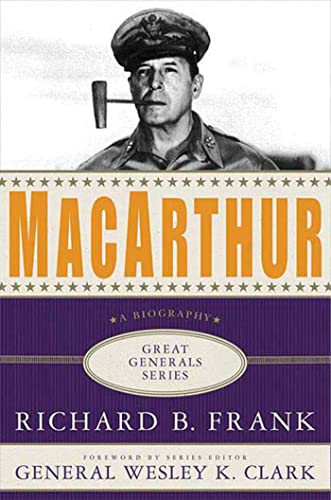
Ebook Info
- Published: 2009
- Number of pages: 226 pages
- Format: PDF
- File Size: 2.14 MB
- Authors: Richard B. Frank
Description
Douglas MacArthur is best remembered for his ability to adapt, a quality that catalyzed his greatest accomplishments. Adaptability has become an indispensable trait for military leadership in an era of technological leaps that guarantee the nature of war will radically change during the span of an ordinary career. One of the first proponents of a new dimension in warfare–the Air Force–MacArthur was also unmatched historically for his management of peace during the U.S. occupation of Japan. For generations to come, MacArthur’s legacy will yield profitable–and entertaining–examples to Americans in and out of uniform.
User’s Reviews
Editorial Reviews: Review “A vivid, compelling portrait of our most enigmatic battlefield commander. Richard B. Frank strips away both myth and malarkey to reveal both Douglas MacArthur the general and Douglas MacArthur the man.” ―Rick Atkinson, Pulitzer prize-winning author of An Army at Dawn: The War In North Africa, 1942-1943“Richard B. Frank’s incisive biography of General Douglas MacArthur offers not only a great read, but a timely and useful study both of the dilemmas of civil-military relations and the challenges facing American military leaders thrust onto a global stage. The writing is always clear, the history always accurate, and the analysis consistently stimulating. For all his faults, MacArthur was indisputably a great man among great contemporaries–this book will make the reader ponder the disappearance of such greatness among our nation’s leaders, military or civilian.” ―Ralph Peters, author of New Glory and Never Quit The Fight“Douglas MacArthur was either the greatest American military commander of the 20th century–or a dangerous meglomaniac. In this shrewd, fair, but unblinking biogaphy, MacArthur is both- at once-brilliant and deeply flawed and, in Frank’s skillful telling, an endlessly fascinating character. Rich Frank has long been a premier historian of the Pacific War. Now he has shown that he is first rank biographer as well.” ―Evan Thomas, Newsweek editor-at-large and author of Sea of Thunder“A classic example of good things in small packages, this addition to the Great Generals Series owes much to its author, an expert on the Pacific War and a particularly accomplished writer. Those attainments allow him to do a remarkable degree of justice to his subject, one of the most controversial leaders in American history. From early on, MacArthur, scion of a military family, exhibited great talents and a colossal ego that made it difficult for him to cooperate with either his fellow commanders or his civilian superiors, leading one of the latter, President Truman, to terminate his career during the Korean War. MacArthur’s insensitivity to politics didn’t, however, prevent him from practicing a high level of statesmanship as military governor of occupied Japan. Frank’s portrait of him is that of a man clearly related to the little girl who had a little curl in the middle of her forehead. When he was good, he was indispensable; when he was bad, he made colleagues and superiors think of firing squads. A good addition for any and all twentieth-century American history collections.” ―Booklist“Frank (Guardalcanal) presents the reader with a fair assessment of both the man and the soldier, covering the failures and triumphs in an assured and dispassionate tone.” ―David Lee Poremba, Haines City P.L., FL“His own unique take on this historic figure.” ―NewsMax“No general in American uniform during World War II was more controversial or more idolized than Douglas MacArthur. It takes a rigidly objective historian and painstakingly careful research to produce a biography of him that is both balanced and accurate. Richard B. Frank has succeeded brilliantly.” ―Brian John Murphy, America in WWII“America is hard on its politicians and generals. Whereas writers and composers are remembered for their creative peaks, and their lesser works are forgiven, politicians are often remembered for their failures, generals for their blunders. Gen. Douglas MacArthur was long an exception to this rule, for he spent a lifetime burnishing his image and training a staff to do likewise. But history is catching up, and we now have a readable and objective biography by respected World War II historian Richard B. Frank, who is immune to the general’s considerable charisma.” ―John M. Taylor, The Washington Times About the Author RICHARD B. FRANK is the author of Guadalcanal and Downfall and winner of the General William Greene Award and the Harry S. Truman Book Award. He lives in Annandale, Virginia.
Reviews from Amazon users which were colected at the time this book was published on the website:
⭐Richard Frank is one of the ablest historians writing on the Pacific War. His “Guadalcanal” is a classic military narrative that will serve as a kind of official history for decades. His book “Downfall” about the end of the Pacific War is another splendid effort that cannot be ignored if one wishes to understand the horrible events between Okinawa and war’s end. I believe he is presently working on a larger scale work on WII in Asia (including China) and I’ll be one of the first to read it. The one thing that has marked Frank’s major works is extremely thorough and extensive research.The MacArthur book is a real let down. It’s part of the “Great Generals” series edited by Wesley Clark. This was not intended to be a definitive military biography of MacArthur. The sources show it too – a lot of secondary stuff and I would guess nothing original. (I apologize in advance if that’s wrong.) Frank says that it’s “OK to hate MacArthur, you just have to know why.” It is not easy to tell what there is to hate by reading Frank’s book. Frank is critical of the defense of the PI in 1941-42. I’d be careful there. There were a lot of cooks ruining that broth including Marshall and FDR who decided in a heartbeat (after the oil embargo was declared) that they had been wrong in refusing to arm the soon to be independent PI, and couldn’t face the consequences of simply abandoning the American garrison there as was implicit in the last of the Orange Plans. I don’t know why MacArthur or Marshall believed war was not likely before April 42, but the American defense plans were based on the assumptions. So when the war came, Mac had to do with what he had which was grossly inadequate. (Might note he was let down by a still hard to explain failure of 23 modern US subs to do anything against Japanese merchant ships which arrived at exactly the place everyone on both sides expected.) The PI forces couldn’t stand against the Japanese, but they were able to get to Bataan in a well guided retreat. Unfortunately for the US, the supplies intended to keep a military garrison in operation for six months were grossly inadequate to the task of supplying a group of civilians and PI soldiers four times that size. As it was, the allied garrison in the PI held out for nearly six months – exactly as foreseen in Orange.It was the decision to send MacArthur to Australia that gets the general in hot water with Frank. While there MacArthur bombarded the Pentagon with an endless string of messages giving advice on every subject concerning WWII (many of them not so unreasonable – others a little nutty) and irritated Marshall and infuriated Stimson. Why FDR didn’t tell Stimson to shut MacArthur up is a toughie. Neither men liked MacArthur but seemed to think MacArthur’s status as “hero of Bataan” made him beyond discipline. A dubious conclusion in my eyes that says nothing good about our top leaders. Frank doesn’t nitpick every move made by MacArthur during the Kokoda-Buna campaign but misses something that should be fundamental starting point for understanding that campaign – the battle was run by the Aussies. Only one regiment plus of the 32d Division was under direct US command and its movements were to coordinate with the larger campaign run by the AIF. MacArthur always manipulated the press (nothing rare for a general) but when the smoke is cleared the Kokoda-Buna campaign was a huge allied victory that, given the extraordinary logistic difficulties faced, could not have been won quicker or with fewer losses.Frank gives MacArthur credit for the “island hopping” campaign that despite paltry forces led back to the road back to Leyte in October 44. As Frank notes it was these campaigns that won for MacArthur the admiration of AlanBrooke and Montgomery. Was the war in the PI needed? We’ll never know, but the SWPAC advance caused a complete dislocation of Japan’s strategic reserve when the tide turned – nearly a million IJA troops and thousands of aircraft were moved first to New Guinea and later to the PI. If the campaign had not taken place, is it unreasonable to think that the Japanese would have choked the Central Pacific bases with men and supplies while it was still possible to do so? Given the nature of the battles there, GIs and Marines were probably fortunate that there were about 10,000 men on Iwo instead of three times that. Ditto with Saipan and Okinawa.Oddly Frank doesn’t clobber MacArthur in Korea where I think it probably should have been done. Despite the spectacular nature of Inchon, it’s not at all clear that a reinforcement at Pusan would not have led to crushing breakout. If MacArthur wanted to continue to the Yalu – a no doubt blunder – he did so with the cheers and support of the Truman administration across the board. (I suppose it’s possible that had MacArthur not reacted as quickly as he did in mid 1950 that the North Koreans would have taken all of Korea. Let’s not forget that war in Korea proved to be a tremendous strategic victory for the US.)If you want to longer and more detailed trashings of MacArthur, they’re out there. William Manchester wrote a adulatory biography that borders on silly. But if any reader wants to examine in detail the extraordinary life of Douglas MacArthur I strongly urge reading “Old Soldiers Never Die” a brilliant and insightful book by the splendid military and political historian Geoffrey Perret. And if you haven’t read Frank at his best, I urge you to do so.
⭐This is really a humorous book, when you get right down to it. This guy, who I find otherwise to be a verycompetent scholar, is supposed to write a book here about “great generals”, yet he is so anti-MacArthur that the cadence of his book is like a piece of music with a “get-MacArthur” downbeat about every fourth sentence. This is most noticeable in his coverage of MacArthur’s return to the Philippines. Dr. Frank seems to have had a grandfather who was a Marine on Guadalcanal, if you get my drift. The best section I have found in the book is his treatment of MacArthur’s political “aspirations.” MacArthur, Dr. Frank feels, was this grasping maniac whose strongest character trait was his desire to be the Star of the Show. Therefore he does that section of his book justice, since doing it justice will not detract from this thesis. I have heard Dr. Frank on Youtube take what I consider to be a healthy appraisal of Chiang Kai-shek vis a vis Stilwell. Therefore I am surprised to find that Dr. Frank does not like MacArthur. Usually those who are pro-Chiang seem to be pro-MacArthur. I join those who feel that Dr. Frank’s book on MacArthur is disappointing. You cannot be this biased against someone and write an interesting, objective book.
⭐A man as controversial as Douglas MacArthur is a difficult subject for any author, and the relatively brief “Great Generals” series makes it an especially challenging one. Richard Frank does an excellent job of covering the main details of MacArthur’s career, and manages to condense a fair amount of analysis into a few brief lines. In particular, he manages to clearly convey the problem of MacArthur’s singular stature in the Army; by his frequent comparison of the general’s seniority and experience with those of his colleagues (Marshall, Eisenhower, etc.), the enormousness of the gulf between them is made very clear. For such a small book, it does a good job of giving a good feel for the man and his career.This is however the most flawed book of the series so far. Frank’s projection of MacArthur’s views forward to the present times lacks context; he does not adequately ‘ground’ his postdictions with references or justification, and it comes off sounding more like a caricature than is the case in the other books. Furthermore, the editing work on the book is shockingly subpar; each chapter is riddled with typographical and formatting errors (which reveals either that Wesley Clark’s title as series editor is purely honorific, or that he is a magnificently incompetent editor).Overall, it is worth reading, particularly if one desires a brief introduction to MacArthur’s career and his significance as a general. Seeing that this is more or less the point of the series, one might well declare that it has accomplished its mission, despite its rather glaring flaws.Not unlike MacArthur himself, as it happens.
⭐”MacArthur” looks at one of the most contravariant American generals of the 20th Century. The author’s analysis points out the strengths and weaknesses of the his leadership during his long tenure a the American Caesar of the Far East. This book is not a introductory biography, and is recommended for readers have read extensively on MacArthur and the Asia/Pacific wars of the 20th Century.
⭐Very good book well written and the delivery was on time and in good condition.
⭐Interesting, short biography.
⭐Gave me a new perspective that got me past the gigantic ego of MacAthur.
⭐Easy read; very informative. He captured the man and the legend. Jack
⭐The author is fair to a fault, with this very centrist biography and evaluation of MacArthur. While not rich in detail, the prose is lucid and very readable. The author is particularly talented in describing battle sequences clearly – not an easy thing to do. The “what if MacArthur was alive today” section at the end was unenlightening and unnecessary.
Keywords
Free Download Macarthur (Great Generals) in PDF format
Macarthur (Great Generals) PDF Free Download
Download Macarthur (Great Generals) 2009 PDF Free
Macarthur (Great Generals) 2009 PDF Free Download
Download Macarthur (Great Generals) PDF
Free Download Ebook Macarthur (Great Generals)