Ebook Info
- Published: 1962
- Number of pages:
- Format: PDF
- File Size: 17.50 MB
- Authors: Paul A.M. Dirac
Description
User’s Reviews
Reviews from Amazon users which were colected at the time this book was published on the website:
⭐Review of “The Principles of Quantum Mechanics” by P.A.M. Dirac. Oxford University Press (1958).The book is just over 300 pages including the Index. It is of historical interest, mainly. There are better treatments of the subject, but this is an original work and stands monumental in that regard, historically. The originality and its place in history is this works strength and it stands on its own as a classic in modern theoretical physics, unmatched in many ways in that sense.This book was first published in 1930. In 1928, Dirac’s application of the relativistic treatment of spin-1/2 particles leads to both positive- and negative-energy solutions to the electron. This book was made new in paperback in 1981. It has been reprinted 9 times since. The last reprinting was in 1993. It has a Preface to the first edition, which you should read using the Amazon “Look Inside!” feature. You can view the Contents of the book there, too. There you will find that the book’s contents are made up of twelve Chapters and a small Index.Quantum reality places the subject back into the study of the objective world. Listen to the author in his own words:”This state of affairs is very satisfactory from a philosophical point of view, as implying an increasing recognition of the part played by the observer in himself introducing the regularities that appear in his observations, and a lack of arbitrariness in the ways of nature, but it makes things less easy for the learner of physics.”If, in your enquiry into quantum mechanics, you have read about these philosophical changes brought about from the discovery of quantum reality, then reading the words of one of its legends will reinforce why many modern physicist’s sound more like philosophers than physicists. Here is the author, again, in his own words:”The methods of progress in theoretical physics have undergone a vast change during the present century. The classical tradition has been to consider the world to be an association of observable objects (particles, fluids, fields, etc.) moving about according to definite laws of force, so that one could form a mental picture in space and time of the whole scheme. This led to a physics whose aim was to make assumptions about the mechanism and forces connecting these observable objects, to account for their behaviour in the simplest possible way. It has become increasingly evident in recent times, however, that nature works on a different plan. Her fundamental laws do not govern the world as it appears in our mental picture in any very direct way, but instead they control a substratum of which we cannot form a mental picture without introducing irrelevancies.”In Chapter X “Theory of Radiation” Dirac derives his theory of radiation in which he connects bosons to oscillators. Relating a system “S (say a quantizied atom)to its Hermitian operator Ho,” he was able to identify the states of an assembly of bosons with the states of a set of oscillators. “This means that *the dynamical system consisting of an assembly of similar bosons is equivalent to the dynamical system consisting of a set of scillators–the two systems are just the same system looked at from two different points of view.*” (Dirac pg 228-229). Von Neumann, probably the greatest mathematician of the 20th century, in his book “Mathematical Foundations of Quantum Mechanics”, called Dirac’s radiation theory “one of the most beautiful achievements in the quantum mechanical field.” (Von Neumann, pg. 255)In the last chapter, the author solves both a positive-energy and a negative-energy solution for an equation (now called the “Dirac equation”) that applies relativistic solutions to the problem of particle physics, specifically, that of elementary spin-1/2 particles like the electron. The positive-energy solution is the electron. The author doesn’t ignore the negative-energy solution, though! This is one of the philosophical differences between quantum mechanics and classical mechanics. Dirac simply allows the mathematical result of a negative-energy solution to suggest that another particle actually exists in reality, every way equal to that of the electron, but opposite in sign. This would be like an antimatter particle to the electron! This would be unheard of but perhaps for science fiction writers. Here is the author in his own words:”In this way we are lead to infer that the negative-energy solutions of (56) refer to the motion of’ a new kind of particle having the mass of an electron and the opposite charge. Such particles have been observed experimentally and are called *positrons*. We cannot, however, simply assert that the negative-energy solutions represent positrons, as this would make the dynamical relations all wrong. For instance, it is certainly not true that a positron has a negative kinetic energy. We must therefore establish the theory of the positrons on a somewhat different footing. We assume that *nearly all the negative-energy states are occupied*, with one electron in each state in accordance with the exclusion principle of Pauli. An unoccupied negative-energy state will now appear as something with a positive energy, since to make it disappear, i.e. to fill it up, we should have to add to it an electron with negative energy. We assume that *these unoccupied negative-energy states are the. positrons*”The positron was confirmed by Carl Anderson just two short years later in 1932.P.A.M. Dirac was an Englishman. Since he is one of the early founders and contributors to Quantum Mechanics, I suggest that you read up on him if you haven’t learned that much about him in the past. I always appreciate a book more if I know a little bit about the author. In the Wiki on him I just learned that he married Eugene Wigner’s sister. Cool. It is a small world.I hope I have peaked your interest enough to make a purchase today.
⭐This is almost a must-have (if not a must-read) for those seriously interested in quantum matters. It was last updated by Dirac in 1967, so there are many more modern textbooks for those of the “shut up and calculate” persuasion. Aside from the cultural literacy aspect, the clarity of Dirac’s writing is remarkable, and his exposition of topics such as superposition is unsurpassed. Philosophically, he believed that physics should only concern itself with observable and measurable quantities, and that the only satisfactory “picture” of what goes on at the atomic level is the mathematical formalism itself. But he delves more deeply than most authors into the basis and motivation for aspects of the formalism such as the Dirac delta, difference between the Schrodinger and Heisenberg approaches to equations of motion, etc.
⭐My boy’s at it again.
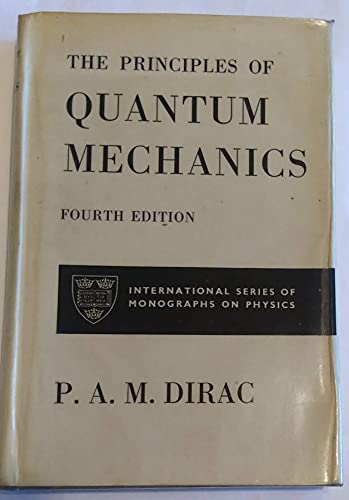
⭐This book is the basis of Quantum Mech any physicist that respect him or herself should read Dirac because it resembles the origins and gives the best description of QM there can be in this book you can feel the real possibilities of QM I say possibilities because at the time QM wasn’t fully developed, or at least as thought through as it is now.Either way this is a basic book for anyone intending to study physics I really recommend it.One thing you should know is that the image given here is the not the real one, you should look at th one given by me, is one taken from the look inside, that has the real cover. But as it is always said you should never judge a book by its cover, even more so if the one who wrote it was the best physicist in the last century.
⭐Anything can be added commenting a book made by one of the fathers of quantum Mechanics and many other fields of knowledge. A must for those who want to explore how to arrive to the deepest conclusions in physics. An insight on their amazing way of looking to the world…What should be best to guide through this matter than one of its creators?
⭐His insight into the physical interpretation of the formalism of Quantum Mechanics has no precedent. Almost every physicist around the world agrees that HE IS MASTER DIRAC, so an insight into his vision of the theory is invaluable.This is not a didactic book, in fact, in my opinion, it is not even to be considered a text book. Its value concerns the rigorous development of the formalism of QM, as well as a firm base for the understanding of the very principles of it. I’d say it’s better for people who have struggling qith the ideas of QM for a while already, that for who are just starting with them.
⭐A classical text book, although the tone is pretty dry. I would not use this as a primary undergraduate book, but appreciate its historical importance.
⭐The book was delivered in a very good condition! The price is also really reasonable.
⭐The Dirac formalism is not an easy to read, requires a lot of practice, but a very efficient framework of the topic. Dirac did a really great job with this book to give the formal definition for the algebra of quantum mechanics with its application to several problems. It is a book for those who are familiar with the topic and related mathematics and would like to put it onto a concise formal theoretical next level.
⭐From the early introduction of his famous bra and ket vectors, an emphasis on the crucial importance of the Uncertainty Principle, and later the Poisson Bracket, he gradually incorporates all the standard quantum mechanics models, particularly the Heisenberg and Schrodinger forms. Then he applies the theory to a sequence model problems, starting with a simple harmonic oscillator and leading to his famous hypothesis on the existence of the positron. The concluding chapters introduce relativistic treatments and his final, and subsequently updated, chapter is on the difficult area of quantum electrodynamics. It’s a breathtaking exposition – but not for the faint hearted!
⭐Goooooood!!
⭐Il grande classico (da acquistare in inglese) dell’eccelso fisico Dirac noto per la sua equazione in Teoria dei Campi Quantistici è il modo decisamente migliore per approcciare alla MQ per studenti ma anche appassionati di fisica. Le spiegazioni lunghissime dei fondamenti della meccanica dei quanti unite all’introduzione al formalismo braket e alla quantizzazione delle coordinate canoniche chiariscono effettivamente moltissimi dubbi, costruendo una impalcatura a posteriori (1930) della teoria sviluppata negli anni ’20.Per approcciarlo sono utili buone basi di fisica in quanto il libro in sé non ritorna sui concetti classici, così come sul formalismo hamiltoniano, per cui non è pensabile approcciare il libro da zero per chi fosse un amatore. Non è ovviamente molto aggiornato rispetto alla didattica contemporanea e può quindi essere utile integrarlo con qualche altro testo più aggiornato come il Sakurai o altri testi di una didattica più recente.Senza dubbio uno dei libri della mia biblioteca di fisica più affascinanti e ben congegnati, come del resto ci si poteva aspettare da Dirac.Ho acquistato questo libro, un classico del suo genere, come una sfida per vedere quanto riuscivo a capirne. Mia figlia, laureata in fisica teorica, mi ha detto che neanche lei è in grado di comprenderlo tutto. Temo che abbia ragione.Ci sono libri molto più comprensibili anche se meno classici, soprattutto per un ingegnere (elettronico) come me.Se non avete la testa molto dura e una solidissima preparazione in matematica, lasciate stare Dirac.
Keywords
Free Download The Principles of Quantum Mechanics, Fourth Edition in PDF format
The Principles of Quantum Mechanics, Fourth Edition PDF Free Download
Download The Principles of Quantum Mechanics, Fourth Edition 1962 PDF Free
The Principles of Quantum Mechanics, Fourth Edition 1962 PDF Free Download
Download The Principles of Quantum Mechanics, Fourth Edition PDF
Free Download Ebook The Principles of Quantum Mechanics, Fourth Edition