

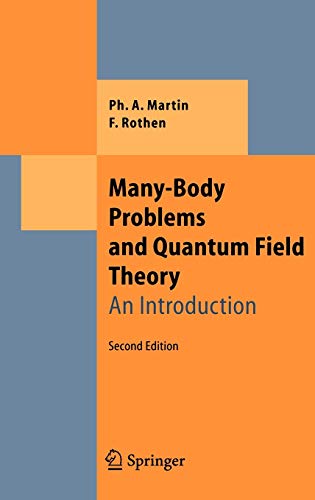
Ebook Info
- Published: 2004
- Number of pages: 454 pages
- Format: PDF
- File Size: 10.43 MB
- Authors: Philippe Andre Martin
Description
Emphasis is placed on analogies between the various systems rather than on advanced or specialized aspects, with the purpose of illustrating common ideas within different domains of physics.Starting from a basic knowledge of quantum mechanics and classical electromagnetism, the exposition is self-contained and explicitly details all steps of the derivations.The new edition features a substantially new treatment of nucleon pairing.
User’s Reviews
Editorial Reviews: Review “The book is aimed to provide a reasonably broad and nevertheless high level of knowledge to Ph.D. students. I think that this challenge is truly reached. The authors achieve a good balance between formal developments and physical applications. The former are limited to the essential, and the connection between the mathematical representations and the physical concepts and paradigms is pedagogically presented. The latter are well chosen and belong, I believe, to the basic culture of every Ph.D. student, too often driven to specialization. […] In conclusion, this book provides an excellent introduction to quantum field theory and its applications. It should be considered as one of the favourite books for any Ph.D. student and as a good reference book for more advanced physicists.” (Joseph Cugnon, Physicalia, 25/3, 2003)”[…] came out of a graduate course that presented a unified treatment of condensed-matter, nuclear, and particle theory. The course emphasized the similarities, sometimes even the identity, of the methods used in those fields – a wonderful idea, because students are often led to believe that the fields are disparate and never meet.” (Physics Today, April 2003)”Very well written and has a strong pedagogical style: mathematical steps in the explanations are complete and timely examples worked out in detail… I applaud the authors attempt to bring together the threads of many-body theory, which forms the cornerstone of traditionally distinct problems, into a readable textbook for students… and reference for the practitioner.” (The Physicist)From the reviews of the second edition:”The book provides a nice unified approach to the quantum field theory of the solid state and the nucleon. … The book applies the same, consistent language for the different and broad fields of physics. This approach makes the book attractive to beginners who want to learn some more advanced methods and … need to see a range of applications … . The book can be used as an introduction for beginners in the field, advanced researchers can use it as a look up reference.” (Andreas Knorr, Zentralblatt MATH, Vol. 1065, 2005) From the Back Cover “Many-Body Problems and Quantum Field Theory” introduces the concepts and methods of the topics on a level suitable for graduate students and researchers. The formalism is developed in close conjunction with the description of a number of physical systems: cohesion and dielectric properties of the electron gas, superconductivity, superfluidity, nuclear matter and nucleon pairing, matter and radiation, interaction of fields by particle exchange and mass generation. Emphasis is placed on analogies between the various systems rather than on advanced or specialized aspects, with the purpose of illustrating common ideas within different domains of physics. Starting from a basic knowledge of quantum mechanics and classical electromagnetism, the exposition is self-contained and explicitly details all steps of the derivations.
Reviews from Amazon users which were colected at the time this book was published on the website:
⭐Subtitled, “An Introduction,” a phrase that aptly conveys the goal of this outstanding text. Now, Zagoskin’s collateral book “Quantum Theory of Many-Body Systems” is slimmer and more advanced, whereas this book is thicker and more elementary. They complement each other nicely. Read the Foreword: “…not aimed at specialists ” and “…will discover a unity of thinking among different domains of physics.” Encounter ten informative chapters. Let us begin at the beginning: harmonic oscillators, photons, phonons. Onward to the concluding chapter– perturbative methods: Normal ordering, normal products, contractions…. all are carefully explained. Helicity of the photon is lucidly described. Problems conclude each chapter (hints provided to assist the student in that endeavor). Nuggets abound: “The stability of matter demands that the Hamiltonian have a lower bound which is proportional to the number of particles.” (page 80). Problem two, chapter two: “Dimensional Analysis” is a delight to see in a text at this level. Read: “The conceptual framework of the second quantization is thus that of the usual quantum mechanics.” And (once again) the reader advances to normal ordering, normal products and contractions in light of Fock space (an excellent spiral approach). I like the… “simple test used to recognize conservation of particle number…a monomial comprising the same number of creators and annihilators is invariant.” (page 108). The qualitative discussion of “concept of perfect gas and polarized Helium-three gas” concludes third chapter.The third problem in this third chapter introduces Hubbard model. Then continue: Hartree-Fock approximation provides detail (note: explicit evaluation of integral 4.58, page 141–that detail is helpful to students). That same helpful assistance is found in the discussion on electron gas–explicit evaluation of an integral 4.139, page 156). Students are well-served by the explicit mathematical derivations. In following chapter, students are presented with details on “How to calculate with a BCS State.” Bogolioubov transformation is utilized (comparison of this superconductivity chapter to that found in the monograph of Zagoskin makes for interesting rumination).Lucid comments on ‘analogy with statistical physics’ segues to the next chapter: there find discussion of nuclear systems concluding with qualitative survey of Moment of Inertia of deformed nuclei ! Superfluidity of liquid Helium begins with experiment progressing to modeling, read: “the analogy between liquid Helium-three and a perfect quasi-particle is thus justified for certain temperatures.” Feynman variational function is introduced in the chapter-end problem (hints and commentary provided ! ). We arrive to quantum fields. You will not find path integrals, but you will find a first-rate introduction to canonical procedures: Hamilton and Lagrange. Also, gauge invariance, broken symmetry, Higgs boson (“…the Higgs particle is likely to be observed”). Read: “….the Higgs field and the gravitational field share the common property that both of them do not just propagate through space-time, but, also deeply modify its structure.” (page 319). The final chapter provides ample detail in perturbative calculations utilizing Green’s functions. Feynman diagrams are introduced. The entire textbook is demonstrative of pedagogic artistry. That is: interplay between analogy and modeling, a mixture of the qualitative (descriptive) and quantitative (mathematical). Thus, an enriching introductory text intended for the beginner, replete with detailed intermediate steps in mathematical derivations. The text excels in its execution and pedagogic efficacy. Highly recommended.
Keywords
Free Download Many-Body Problems and Quantum Field Theory: An Introduction (Theoretical and Mathematical Physics) 2nd Edition in PDF format
Many-Body Problems and Quantum Field Theory: An Introduction (Theoretical and Mathematical Physics) 2nd Edition PDF Free Download
Download Many-Body Problems and Quantum Field Theory: An Introduction (Theoretical and Mathematical Physics) 2nd Edition 2004 PDF Free
Many-Body Problems and Quantum Field Theory: An Introduction (Theoretical and Mathematical Physics) 2nd Edition 2004 PDF Free Download
Download Many-Body Problems and Quantum Field Theory: An Introduction (Theoretical and Mathematical Physics) 2nd Edition PDF
Free Download Ebook Many-Body Problems and Quantum Field Theory: An Introduction (Theoretical and Mathematical Physics) 2nd Edition