

Ebook Info
- Published: 2007
- Number of pages: 253 pages
- Format: PDF
- File Size: 2.27 MB
- Authors: Voja Radovanovic
Description
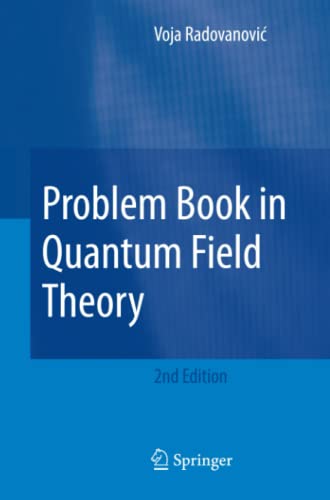
The Problem Book in Quantum Field Theory contains about 200 problems with solutions or hints that help students to improve their understanding and develop skills necessary for pursuing the subject. It deals with the Klein-Gordon and Dirac equations, classical field theory, canonical quantization of scalar, Dirac and electromagnetic fields, the processes in the lowest order of perturbation theory, renormalization and regularization. The solutions are presented in a systematic and complete manner. The material covered and the level of exposition make the book appropriate for graduate and undergraduate students in physics, as well as for teachers and researchers.
User’s Reviews
Editorial Reviews: Review From the reviews:”There is, as the author of this book points out, a shortage of books of problems on quantum field theory. This one is based on exercises set to undergraduate and graduate students of the University of Belgrade. There are 64 pages of problems and the solutions occupy a further 171 pages. There is a bibliography and an index. … The book would serve well to accompany an introductory course on QFT.” (Lewis H. Ryder, Mathematical Reviews, Issue 2007 c)”The book provides the reader with about 200 problems on different topics in quantum field theory … . The material covered and the level of exposition make the book typically appropriate for graduate and undergraduate students in physics. It is actually one of the first problem books in quantum field theory, and can be very useful students both following a course and studying on their own.” (Bassano Vacchini, Zentralblatt MATH, Vol. 1102 (4), 2007) From the Back Cover The Problem Book in Quantum Field Theory contains about 200 problems with solutions or hints that help students to improve their understanding and develop skills necessary for pursuing the subject. It deals with the Klein-Gordon and Dirac equations, classical field theory, canonical quantization of scalar, Dirac and electromagnetic fields, the processes in the lowest order of perturbation theory, renormalization and regularization. The solutions are presented in a systematic and complete manner. The material covered and the level of exposition make the book appropriate for graduate and undergraduate students in physics, as well as for teachers and researchers. The new edition is a corrected paperback edition for students.
Reviews from Amazon users which were colected at the time this book was published on the website:
⭐Many great textbooks have been written on Quantum field theory; however, there was a gap in the market which had to do with a problems book. This book fills this gap in a very successful manner.Each chapter starts off with a very brief overview/review of the knowledge one needs to start doing the problems. Do not expect this to help you learn the material presented there; this is definitely not the job for this section. It serves to remind you of the material you have already studied and also to have it as reference while you are going through the exercises. This is very convenient.As for the problems, they start off easy and gradually build up to some tough and/or more creative problems. This way of gradually increasing the difficulty is what every problems sections in every textbook should follow: it eases the reader into the more difficult exercises and guarantees that any failure of the reader/solver to solve a difficult exercise originates purely from his/her own possible lack of ability to do so and not from just being thrown into deep waters very early on.The nature of the problems varies from problem to problem. There are problems whose goal is to just familiarize the reader with some standard calculations that are often found in field theories. Some of these, for example, might have to do with boringly -but necessarily- using commutation (or anti-commutation) relations to play with the creation and annihilation operators to compute something relatively trivial and/or standard. Some of these problems include long (and, often, tedious) calculations that are nonetheless very much needed; otherwise, one cannot be or feel confident enough tackling difficult and long calculations on, say, scattering amplitudes.Other problems are much more interesting and possibly non-trivial. For example, the last problem of chapter 3(which is on the Dirac γ-matrices) has to do with finding the Dirac matrices in 2 spacetime dimensions. [SPOILER ALERT!] It all comes down to the Pauli matrices, of course, but the problem actually shows you that γ^(5) is in this case only the third Pauli matrix rather than something fancier. It was a nice surprise for me to see such a problem here since I have an extensive condensed matter physics background and I have thus studied the properties of 2D spaces and spacetimes and I have (sadly, but unsurprisingly) found that nearly nobody mentions anything about the chiral representation for less than four spacetime dimensions.The solutions are very detailed and thorough. Although there are examples of a problem skipping some very small steps, at the end, this is for the better as it never skips hard steps but never gives the full details, something which poses the risk of “inviting” the reader to just check the solutions out when he/she is stuck. All in all, I am very satisfied with the solutions.One criticism that I have is that the solutions might use some more commenting; not because they need it but because it makes the whole thing more “colorful”. For example, the solution to the problem on the Gordon decomposition of the Dirac current (4.21) could use some commenting on how one part of the decomposition has to do with the movement of the center of mass while the other has to do with the spin of the electrons. Saying just that could have made the whole thing much more than an exercise in mathematical manipulations. Had the author also added that the decomposition shows that the interactions involving electrons take place due to the electron’s charge but also its spin, would have turned the exercise into something special due to the added insight that the author provides. It would also motivate the students to thoroughly check out the author’s solution to an exercise once the reader is done with it.But, this is all nitpicking. As I said, this book fills in a very important gap and it does not very successfully. My small criticism above has to do with giving the book something extra, besides the main thing that it does so efficiently: to prepare the reader for exams and research and to make him/her feel truly confident about his/her knowledge of Quantum Field theory. Closing, I will say that at the time of completing this review, I found the pricing to be a bit steep. But, if one also accounts for it being the only book on problems and solutions in QFT, then it is not too much. I urge everybody who wants to master QFT to give this a try as I believe that it will serve them well.
⭐This book essentially gives a reader a thorough grounding in problem solving for a first course in QFT at an Undergraduate/graduate level. It is well organised, problems are really well chosen and notations are quite good. It helps enormously for my assignments and exam preparation. This book is totally worth the money and i am sure will help every student of physics who is starting to get his grip on Quantum field theory.
⭐Mathematics and theoretical physics can only be fully enjoyed if you are willing to get dirty. This little book is a joy and will make sure your calculational understanding of the subject is solid. It is well organized and follows the standard progression of a course on quantum field theory, it summarizes the essence of the theory at the beginning of every chapter, it gives a mix of easy and challenging problems and gives the solutions in full length. Of course, not every juicy subject is covered but if you work through it you will feel confident to tackle research subjects or move onto things like supergravity or superstrings.Personally I feel it even make traditional textbooks on the subject obsolete. Lovely book, buy it.
⭐Go for it.. it covers problems in Canonical Canonical quantization of scalar , Dirac and Gauge field. Good book.
⭐Worth the price
⭐best ever problem book, I’ve seen during my MSC days…
⭐ここまで親切にできている演習書はそうないのではないか。評者が把握している場の量子論の演習書は、他に柏太郎先生の「演習 場の量子論」しかない。それもしかたのないことで、場の量子論はその分野の広大さゆえに演習のしようがない。普通は本の計算を追うだけでも十分(一苦労?)だと思われる。一方で、基礎的な問題を解いて、ある程度の土台を作っておきたいという需要もあるはずで、そのときにこの本は役に立つ。載っている問題は「なか見!検索」で見ていただければわかるように、「くりこみ」まである。筆者曰く(その分野でも)基礎的な問題しか扱っていないので、この続きはGauge Theory of Elementary Particle Physics: Problems and Solutions
⭐の演習書で演習をすれば良いとのこと。そういう意味で基礎的な問題集ではあるけども、場の量子論を学び始めた人はほとんど解けないと思う(まとめもないに等しい)。また、問題数は十分あるので(全部やらずに)適当に拾ってやれば良いが、解答では関係づけられている問題(前に解かれたもの)の解答からやり方を引用している場合があるので、注意する必要がある。なお、本書の半分が非常に詳しい解答になっていて解答の省略されている問題はほとんどないので、安心していただきたい。柏先生の演習書との違いは、「問題数」と「具体的な系に対して計算させたりする問題が多い」ことである。(特に、いくつかの具体的なファインマンダイアグラムから振幅を出す問題はありがたかった。)従って、「演習 場の量子論」を持っている方も図書館なりで本書を手にとっていただきたい。この本をある程度やりこなせば、場の量子論の理解が一段と深まると思う。
Keywords
Free Download Problem Book in Quantum Field Theory 2nd Edition in PDF format
Problem Book in Quantum Field Theory 2nd Edition PDF Free Download
Download Problem Book in Quantum Field Theory 2nd Edition 2007 PDF Free
Problem Book in Quantum Field Theory 2nd Edition 2007 PDF Free Download
Download Problem Book in Quantum Field Theory 2nd Edition PDF
Free Download Ebook Problem Book in Quantum Field Theory 2nd Edition