Ebook Info
- Published: 2008
- Number of pages: 438 pages
- Format: PDF
- File Size: 6.17 MB
- Authors: Mikio Nakahara
Description
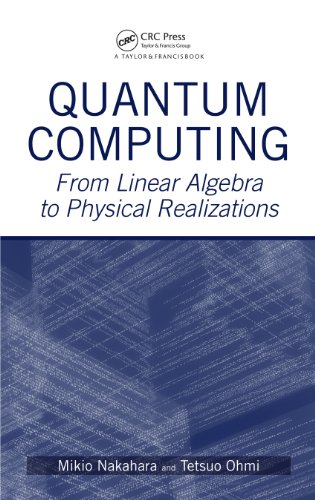
Covering both theory and progressive experiments, Quantum Computing: From Linear Algebra to Physical Realizations explains how and why superposition and entanglement provide the enormous computational power in quantum computing. This self-contained, classroom-tested book is divided into two sections, with the first devoted to the theoretical aspects of quantum computing and the second focused on several candidates of a working quantum computer, evaluating them according to the DiVincenzo criteria. Topics in Part I Linear algebra Principles of quantum mechanics Qubit and the first application of quantum information processing—quantum key distribution Quantum gates Simple yet elucidating examples of quantum algorithms Quantum circuits that implement integral transforms Practical quantum algorithms, including Grover’s database search algorithm and Shor’s factorization algorithm The disturbing issue of decoherence Important examples of quantum error-correcting codes (QECC) Topics in Part II DiVincenzo criteria, which are the standards a physical system must satisfy to be a candidate as a working quantum computerLiquid state NMR, one of the well-understood physical systemsIonic and atomic qubitsSeveral types of Josephson junction qubitsThe quantum dots realization of qubitsLooking at the ways in which quantum computing can become reality, this book delves into enough theoretical background and experimental research to support a thorough understanding of this promising field.
User’s Reviews
Reviews from Amazon users which were colected at the time this book was published on the website:
⭐I came at this book at as a theoretical computer science graduate student, and I found it wholly lacking. The authors put you in a physics mindset and try hard to keep you there. This might be good if you care about “physical realizations” as the subtitle indicates, but they don’t explain many of the key algorithms clearly (especially Grover’s).When I picked up Nielsen and Chuang, where they don’t shy away from P, NP, and BPP, I felt right at home (despite the minor errors they make in discussing complexity theory). If you’re already somewhat versed in computer science and looking to make the transition to quantum computing, Nielsen and Chuang is your book.
⭐This is a fantastic book that really explains things thoroughly and rigorously. However, the book lacks an introduction to a non math/science background.
⭐This is a wonderful textbook and reference book.Good for self-study and instruction.
Keywords
Free Download Quantum Computing: From Linear Algebra to Physical Realizations 1st Edition in PDF format
Quantum Computing: From Linear Algebra to Physical Realizations 1st Edition PDF Free Download
Download Quantum Computing: From Linear Algebra to Physical Realizations 1st Edition 2008 PDF Free
Quantum Computing: From Linear Algebra to Physical Realizations 1st Edition 2008 PDF Free Download
Download Quantum Computing: From Linear Algebra to Physical Realizations 1st Edition PDF
Free Download Ebook Quantum Computing: From Linear Algebra to Physical Realizations 1st Edition