

Ebook Info
- Published: 2014
- Number of pages: 840 pages
- Format: PDF
- File Size: 37.17 MB
- Authors: John Archibald Wheeler
Description
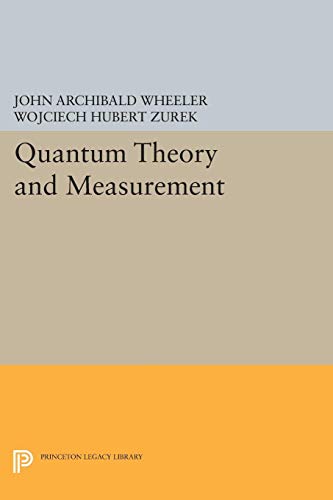
The forty-nine papers collected here illuminate the meaning of quantum theory as it is disclosed in the measurement process. Together with an introduction and a supplemental annotated bibliography, they discuss issues that make quantum theory, overarching principle of twentieth-century physics, appear to many to prefigure a new revolution in science.Originally published in 1983.The Princeton Legacy Library uses the latest print-on-demand technology to again make available previously out-of-print books from the distinguished backlist of Princeton University Press. These editions preserve the original texts of these important books while presenting them in durable paperback and hardcover editions. The goal of the Princeton Legacy Library is to vastly increase access to the rich scholarly heritage found in the thousands of books published by Princeton University Press since its founding in 1905.
User’s Reviews
Reviews from Amazon users which were colected at the time this book was published on the website:
⭐I like the fact that this tome has the research papers of David Bohm. That in itself makes this volume worthwhile. It would be nice to have this volume on a Kindel device.
⭐Everything OK !
⭐Physicist Steven Weinberg: ” I’m not as sure as I once was about the future of quantum mechanics.It is a bad sign that those physicists today who are most comfortable with quantum mechanics do not agree with one another about what it all means. The dispute arises chiefly regarding the nature of measurement in quantum mechanics.” (January 19, 2017 New York Review Of Books)I purchased a copy of “Quantum Theory and Measurement” in 1983. Now, as I write in 2017, I still enjoy many of these papers. The book is parsed into six parts. Happily, some of these papers are still relevant.Note: March 2018, Bell’s 1964 paper is free-online at the APS website (see Wheeler and Zurek, page 403).(1) Bohr’s infamous use of Relativity, where, as he says: “…the discussion, so illustrative of the power and consistency of relativistic arguments, thus emphasized once more the necessity of distinguishing, in the study of atomic phenomena, between the proper measuring instruments which serve to define the reference frame and those parts which are to be regarded as objects under investigation….”This paper can also be located in the historical book, Albert Einstein, Philosopher-Scientist (1949).(2) Mott’s lovely paper “The Wave Mechanics of alpha-ray Tracks (1929)” should be required reading for all physicists (from Proceedings of The Royal Society). Read: “…to show how one of the most typically particle-like properties of matter can be derived from wave-mechanics.” and “…the difficulty we have in picturing how it is…arises from our tendency to picture the wave as existing in ordinary three-dimensional space, whereas we are really dealing with wave-functions in the multi-space formed by the coordinates of the alpha-particles and every other atom in the Wilson chamber.”(3) Another classic, and one which physicists should be required to study, is London and Bauer, “Quantum Theory Of Observation (1939): “…the principle aim of this study will be the statistical interpretation of the formalism.” Forty masterful pages with the intent of removing the mysticism from quantum theory. Read: “the majority of the measurements in atomic physics really do not deal with an individual system; rather they seek to find out the general properties of an entire species of atoms–or, of molecules, or of elementary particles.”(4) The inimitable Eugene Wigner, given 1976, lecture notes from a course at Princeton: “Interpretation Of Quantum Mechanics” (37 pages). These course-notes should be required reading for all physicists.More from Wigner can be had in: Symmetries And Reflections (1967).(5) Hugh Everett is here: Relative State Formulation. John Bell is here: On The EPR Paradox. David Bohm is here: Hidden Variables. These authors can be perused in the anthologies of their respective papers. More David Bohm can be had through his 1951 textbook.(6) Read a lovely article “Complementarity In The Double-Slit Experiment” by Wooters and Zurek (1979, Physical Review D19), providing an information-theoretic foundation to Bohr’s complementarity principle, adding experimental substance to an otherwise cloudy issue !(7) The justly-famous article “Extensions of The Uncertainty Principle To Relativistic Quantum Theory” (1931) by Landau and Peierls, begins: “The significance of any physical theory is to derive from the result of an experiment conclusions regarding the results of subsequent experiments.” This is a paper which still retains its freshness ! It is followed by the fifty-page paper of Rosenfeld and Bohr (1933). That paper can be found in: Collected Papers of Leon Rosenfeld (1979).(8) Fifth part of the book deals with Irreversibility And Quantum Theory. Szilard’s 1964 paper is here. Von Neumann is here: One-hundred pages reprinted from his famous book “Mathematical Foundations Of Quantum Mechanics” (1955). While advanced, there is little doubt that John Von Neumann’s publication is a model of lucidity. No one can afford to ignore what Von Neumann has written.(9) A section reprinted here from another book: Mott and Massey’s “Theory Of Atomic Collisions (1965)”. Magnetic Moment Of The Electron. No one should ignore Mott and Massey’s book. So, get the book.(10) There is a 20 page guide to further literature. There is a thirty-page bibliography and commentaries.(11) One should read “Law Without Law” by John Archibald Wheeler (1979). It provides insight into the mind of John Wheeler. In any event, his paper is available from alternative sources (Some Strangeness In The Proportion, Einstein Symposium, 1980, Addison-Wesley).(12) Perhaps, the 1983 compendium has not been reprinted because most of the papers can be located through other (cheaper) sources. Regardless of interest, there is something for everyone: experiment, theory, speculation. So, from 1983, a timeless sourcebook of fascinating material.
⭐This is a great resource book, and I remember studying it intently before I entered the CalTech Phd program in physics in the early 1980’s. But I can’t understand why it is so expensive. Mostly it is just reprints of old papers, and some very useful commentary. This book should be a Dover book selling for about $25. Maybe Princeton books is hard up for money but this is ridiculous to price it completely out of reach of students on a reprint volume.
⭐Includes the EPR paper, Schroedinger’s cat paper, and many others.My only quibble is that, because the book was written in 1983, theAlain Aspect paper included is a very early one in the series.The other book on this subject which I whole-heartedly recommend in”Speakable and Unspeakable in Quantum Mechanics” by J. Bell.
⭐This is a must-own collection for anyone studying or working in quantum physics. These are the original papers concerning the so-called problem of measurement. Minority views are included; for instance, both parts of Bohm’s 1952 paper are here. Not only physicists, but also historians and philosophers of science, will want to read these papers.
⭐If you are not familiar with Princeton’s Legacy Library series it’s a digitally reprint edition from their past catalogue. Most of them are classics but for some reason mostly because of lack of demand it’s a digital reprint. I have others books in the series but this one in particular has the worst print quality. Let’s not forget that a digital reprint is quite inferior to actual print quality but that doesn’t mean that they are very bad. But for this particular book in the series is really bad. It feels like a cheap pirate copy. By cheap I am mostly referring to the print quality.The most frustrating thing is that it’s very expensive, when I bought it, it’s around 9000 rupees & it’s not a joke for a paperback reprint , it’s not even hardcover ! But let’s get to the main issue. Many of the print quality in the pages throughout are not uniform. Some are really poor, others are ok. The worst is the one on Schrödinger’s cat, a very famous paper by one of the founders of quantum mechanics. That chapter is barely readable. Because the ink are too thin & some of the letters are not even visible. Can you believe it for such an expensive book ?Another issue is that most of articles here are from journals & when they include it here they simply put it as it is. They don’t bother about changing the fonts because some of them are so small that it will definitely strain your eye. This is indeed unforgivable considering how expensive this book is. This is indeed a lazy move from the press.Verdict – If anyone’s interested in this book read it in library. I bought it at the first place because I thought it was worth it but the quality compromise from the printer/press makes me regret it. The price is astronomical high & it didn’t do justice with the final product one is receiving.
⭐Excellent
Keywords
Free Download Quantum Theory and Measurement (Princeton Series in Physics) in PDF format
Quantum Theory and Measurement (Princeton Series in Physics) PDF Free Download
Download Quantum Theory and Measurement (Princeton Series in Physics) 2014 PDF Free
Quantum Theory and Measurement (Princeton Series in Physics) 2014 PDF Free Download
Download Quantum Theory and Measurement (Princeton Series in Physics) PDF
Free Download Ebook Quantum Theory and Measurement (Princeton Series in Physics)