

Ebook Info
- Published: 2006
- Number of pages: 720 pages
- Format: PDF
- File Size: 6.54 MB
- Authors: Richard Robinett
Description
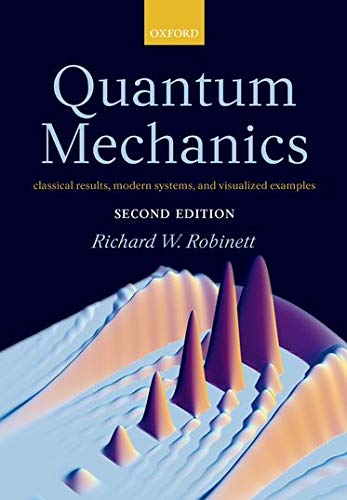
Quantum Mechanics: Classical Results, Modern Systems, and Visualized Examples is a comprehensive introduction to non-relativistic quantum mechanics for advanced undergraduate students in physics and related fields. It provides students with a strong conceptual background in the most important theoretical aspects of quantum mechanics, extensive experience with the mathematical tools required to solve problems, the opportunity to use quantum ideas to confront modern experimental realizations of quantum systems, and numerous visualizations of quantum concepts and phenomena. Changes from the First Edition include many new discussions of modern quantum systems (such as Bose-Einstein condensates, the quantum Hall effect, and wave packet revivals) all in the context of familiar textbook level examples. The book continues to emphasize the many connections to classical mechanics and wave physics to help students use their existing intuition to better learn new quantum concepts.
User’s Reviews
Editorial Reviews: Review Reviews of the First Edition”Richard Robinett has used his extenisve experience in teaching undergraduate quatum mechanics to write an outstanding textbook with a distinctive flavor….he does a masterful job in all these areas….the book is well organized….the heavy stress on visualization is to be commended….questions and problems of very high quality….Robinett has an elegant conversational style of writing which is succint and easy to read. The result is a well-written innovative book which stands apart from other undergraduate quantum mechanics texts.”–Uday Sukhatm, University of Illinois at Chicago, Foundations of Physics”Throughout, [Robinett] makes extensive use of comparison between the quantum and classical probability distributions. These enriching additions are overlaid on an excellently written, comprehensive treatment of quantum physics fundamentals….Each chapter ends with an especially rich and novel selection of problems at varying levels of difficulty….I definitely would choose Robinett’s book as a main textbook, and I highly recommend it for Physics libraries.”–Suzanne Amador, Haverford College, Physics Today”I would strongly recommend the book for consideration as a text”–R.D. Murphy, University of Missouri-Kansas City, American Journal of Physics”….its wide range of subjects, assortment of applications and problems, and visual environment make it a valuable resource in the teaching and learning or quantum mechanics.”–C. Michael McCallum, University of the Pacific, Journal of Chemical Education”Robinett offers not only a comprehensive introduction to the subject for undergraduates, but also an impressive array of visualizations and diagrams, to instill readers with a true feel for the science.”–Books Online About the Author Richard W. Robinett Professor of Physics, Penn State UniversityUniversity Park, PA 16802USA Undergraduate majors in Mathematics and Physics (Magna cum laude)from the University of Minnesota 1975Ph. D. (elementary particle theory, grand unified theories) fromUniversity of Minnesota, 1981Postdoctoral research positions at University of Wisconsin, Madison(1981-1983) and University of Massachusetts, Amherst (1803-1986)Assistant, Associate, and then Full Professor in the Department ofPhysics, Penn State UniversityAssistant/Associate Department Head, Physics Department, Penn State University, 1999 – present Elected Fellow of the American Physical Society (Forum on Education) 2003Robinett, Richard WPenn State UniversityCitation: For his contributions to undergraduate education in quantum mechanics, especially in visualization, and for demonstrated excellence in the training and advising of undergraduate physics majors.Nominated by: Forum on Education
Reviews from Amazon users which were colected at the time this book was published on the website:
⭐The first edition, here reviewed (580 pages), has been superseded by later editions (which I do not possess). This text remains a favorite reference. It is different in conception, execution, and pedagogy strategy: it warrants attention by well-prepared undergraduates. The text consists of twenty chapters and seven appendices. The appendices review mathematics (for instance: complex numbers, series expansions). Best to survey the exceptional student-problems, they are preceded by questions ( “does the notion of probability flux generalize to multiparticle wave-functions ? “):(1) We review Scaling Laws: “….re-derive all the results of example 1.1 for general power law…” (P1.6, page 24) and acquired experience with classical action and quantum trajectories (P.1.12, parts a, b, c ; page 25).(2) Learn of factorization of wave equation (P2.1) and a useful summation formula and its derivation (P2.9, page 48).(3) Klein-Gordon equation in three dimensions is revisited. A six-part problem, hints provided ! (page 65)(4) Revisit photons and probability distribution, a five-part problem with hints for solution (page 78).(5) Hermitian operators explored in a few problems (P5.11 to 5.14) and Airy differential equations (P5.21, page 108).(6) “A classical particle rattling around in a one-dimensional box would exert a force on the walls, the same is true in quantum mechanics. To evaluate it consider a particle in the ground-state of the standard well….” This inal exercise of chapter six deals with adiabatic changes and energy calculation (page 132).(7) Chapter 18: “this exercise shows that there is actually a kind of four-dimensional symmetry to the inverse-squarelaw problem, giving it its enhanced symmetries.” (page 438).(8) Casimir Effect in a Conducting Cavity (problem #19.32) concludes: “the exploration of the quantum world in manydiverse areas of research is ongoing, and many interesting questions remain to be answered…”That is merely a small sample of the fascinating exercises for the student to ruminate upon.(A) Look at content: Does this book replicate what is found in every other undergraduate textbook ? Answer: No ! Chapter one presents a beautiful exposition of dimensional analysis and a smattering of action principles. Brief review of classical waves, dispersion, and a look towards tunneling. Details regarding Gaussian wave-packets is a nice part of chapter three, a review of probability follows. Fifth chapter, Schrodinger equation, concludes with commutators. More than you may want to know about Infinite-well is presented twice: first from a conceptual standpoint, then, more formally. We meet a brief introduction to propagators (Green’s functions) as a conclusion to these two chapters. Next: many particles in the infinite-well. Applications abound: electrons in metal, nuclei, neutron stars and white dwarfs. It is here that we meet the Pauli exclusion principle: “In this case, Planck’s constant has predicted the dimensional factors correctly, but the exclusion principle can still play just as important a role in determining the actual state of the physical system.” (page 158, revisited chapter fifteen and seventeen). The harmonic oscillator is approached via traditional differential equations power-series solution. Focus upon connections to classical physics (pages 202-206). Approximations arrive: a nice discussion of numerics, Monte-Carlo, Rayleigh-Ritz culminates in an excellent review of matrices and connections to time-independent perturbation theory. We arrive at one-dimensional scattering, followed by lengthy formal aspects of operators (chapter thirteen) and more harmonic oscillators (factorization methods). We are introduced to supersymmetric quantum mechanics (pages 299-303).(B) Second part is chapters sixteen to twenty, read: “where the emphasis switches to more physical systems” (preface).We step up to two and three dimensions. I mention two highlights (personal favorites): Hydrogenic systems which touch upon Rydberg atoms, plus systems Muonic, Pionic, Positronium and Quarkonia. Gravity and electromagnetism…. touches upon Effects of Stark, Zeeman, Aharonov-Bohm, and Casimir. These enriching chapters (18 & 19) provides for a wealth of detail, at a vantage accessible to undergraduates.(C) Appendices span complex numbers, integrals, series and sums, special functions, Dirac-delta ‘functions’ and a brief review of Hamiltonian mechanics. My advice: Look at the appendices before tackling the textbook. If all is familiar, the contents of the text should be accessible. Robinett has provided a most enriching textbook. It is a bit more challenging than the more popular undergraduate textbooks (say, the excellent Griffiths– with different emphasis). Read more by Robinett in the American Journal of Physics (Volume 70,Number 3, March 2002) and Physics Reports (3 March 2014).(D) Concluding: This text can serve a dual purpose. It is both introductory and advanced. Both a text and a reference.It is great for an alternative exposition of standard material and a springboard to advanced material.
⭐This book teaches you a lot of important things that aren’t typically covered in an UG book, but it does so a bit too tersely. I used this in my UG QM1 course and hated it. The author throws pages and pages and pages of calculus and algebra at you and you get lost and forget that you were doing quantum mechanics. You sit there trying to evaluate 12 different integrals and do 6 terms divided by 9 terms of algebra and the course felt like “advanced techniques in college algebra” instead of “introductory QM.” The gaussian wavepacket problems are exemplary of this.Coming back as an individual now studying QFT/GR and higher, this book is much easier and I’m noticing some things that are insightful, but not digestable due to the pages of work. I completely missed the point of section 14.2 on seperable systems with multiple particles my first time around. It was just too many terms for my puny UG brain to understand. However, once you learn it with the dirac braket formalism, it’s as simple as can be. Why would one try to explain the concept of a separable wavefunction with N 3 dimensional integrals of a N particle wave function? Does
⭐Robinett’s book is a comprehensive is somewhat mathematical treatment of the fundamental aspects of this fascinating subject.Among the things most pleasing about the book are:1. A constant connection with classical physics principles;2. An early introduction to and development of the wave packet and operators and a physical interpretation of Schrodinger’s equation;3. A comprehensive discussion of various QM models in both their mathematical and physical aspects: the infinite well and other 1-D potentials, SHO, scattering;4. Two-D and Three-D QM and the development of the Hydrogen atom;5. Development of Gravity and QM;6. An abundance of examples, many based on experimental results for the student to try out.The mathematics is clear, and unlike many other books, the author takes the trouble to present many of the intermediate steps. I should say, however, that there are quite a few TYPOS sprinkled throughout the text. They are only a minor distraction and if anything, finding and fixing them can be a useful learning experience! My criticsm would be that the sections on the physical and mathematical development of Spin is too short. Indeed, the Stern-Gerlach and associated gedanken experiments which are so fundamental to an understanding of the postulates of QM do not get much of a mention.Having said this, the book is certainly a good introduction to the subject. It complements other traditional texts like French and Taylor quite well.
⭐I have been much impressed by Robinett’s introduction to quantum mechanics. He seriously attempts to teach the principles of the subject, and does so with considerable effect. His quasi-derivation of the Schroedinger equation is notable.I have used this twice in introductory quantum mechanics courses. Some students were vocal in their dislike of the book. However they seemed to have learned quite a bit from it. Given the adverse comments to be found about all other books in physics on Amazon the negative comments inspire contempt rather than respect. If Robinett errs, it is in attempting to teach Qm rather than in pounding formulae into students.
⭐This was the recommended textbook for a module, and I can understand why. Clear explanations, some question and answer sections and all written clearly.If you need something for Quantum Mechanics, this is the perfect answer.
⭐Oh parfait
Keywords
Free Download Quantum Mechanics: Classical Results, Modern Systems, and Visualized Examples 2nd Edition in PDF format
Quantum Mechanics: Classical Results, Modern Systems, and Visualized Examples 2nd Edition PDF Free Download
Download Quantum Mechanics: Classical Results, Modern Systems, and Visualized Examples 2nd Edition 2006 PDF Free
Quantum Mechanics: Classical Results, Modern Systems, and Visualized Examples 2nd Edition 2006 PDF Free Download
Download Quantum Mechanics: Classical Results, Modern Systems, and Visualized Examples 2nd Edition PDF
Free Download Ebook Quantum Mechanics: Classical Results, Modern Systems, and Visualized Examples 2nd Edition