Ebook Info
- Published: 2010
- Number of pages: 576 pages
- Format: PDF
- File Size: 3.19 MB
- Authors: A. Zee
Description
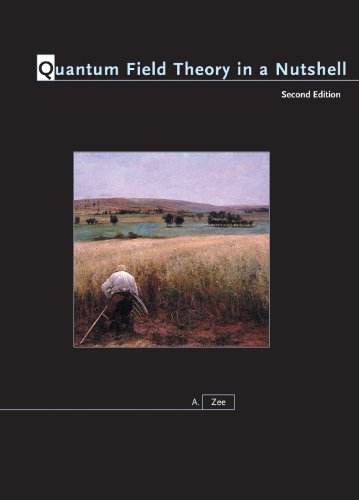
A fully updated edition of the classic text by acclaimed physicist A. ZeeSince it was first published, Quantum Field Theory in a Nutshell has quickly established itself as the most accessible and comprehensive introduction to this profound and deeply fascinating area of theoretical physics. Now in this fully revised and expanded edition, A. Zee covers the latest advances while providing a solid conceptual foundation for students to build on, making this the most up-to-date and modern textbook on quantum field theory available.This expanded edition features several additional chapters, as well as an entirely new section describing recent developments in quantum field theory such as gravitational waves, the helicity spinor formalism, on-shell gluon scattering, recursion relations for amplitudes with complex momenta, and the hidden connection between Yang-Mills theory and Einstein gravity. Zee also provides added exercises, explanations, and examples, as well as detailed appendices, solutions to selected exercises, and suggestions for further reading.The most accessible and comprehensive introductory textbook availableFeatures a fully revised, updated, and expanded textCovers the latest exciting advances in the fieldIncludes new exercisesOffers a one-of-a-kind resource for students and researchers Leading universities that have adopted this book include:Arizona State UniversityBoston UniversityBrandeis UniversityBrown UniversityCalifornia Institute of TechnologyCarnegie MellonCollege of William & MaryCornellHarvard UniversityMassachusetts Institute of TechnologyNorthwestern UniversityOhio State UniversityPrinceton UniversityPurdue University – Main CampusRensselaer Polytechnic InstituteRutgers University – New BrunswickStanford UniversityUniversity of California – BerkeleyUniversity of Central FloridaUniversity of ChicagoUniversity of MichiganUniversity of MontrealUniversity of Notre DameVanderbilt UniversityVirginia Tech University
User’s Reviews
Reviews from Amazon users which were colected at the time this book was published on the website:
⭐This is the book to get if you want a glimpse of QFT from a modern perspective. To fully appreciate what Zee has masterfully put together, you need to approach Nutshell with the right mindset. Though it is comprehensive, it is *not* a training manual to turn you into a whiz at calculating scattering cross-sections, or renormalizing loop diagrams, etc. But by the end of Nutshell, you will understand in broad strokes the conceptual framework that generations of theoreticians have applied to make calculations, and better appreciate the issues modern ideas (such as string theory, unification, etc) are attempting to tackle. The exercises are generally well crafted, and have a good spread in terms of their level of difficulty.At the outset, Zee assumes that the reader is familiar with graduate level quantum mechanics, Lagrangian mechanics, special relativity, and a healthy exposure to Green’s functions typically from an electrodynamics course, as well as rudimentary ideas in group theory.By the way, there is a (very) concise review of group theory in the appendices, and Zee has also authored a very excellent full fledged ‘group theory for physicists’ book. Knowledge of statistical mechanics will help make its analogy to QFT tighter, and the later chapters involving condensed matter systems more relatable. Having said that, a motivated reader can dive straight into the book without having the above prerequisites and pick up the material from other sources along the way. Being the second edition, there are no serious typos which would obscure the physics being put across.Zee’s QFT in a Nutshell was an absolute joy to read, and will prove to be an invaluable resource to students, teachers, and researchers alike.
⭐This “nutshell” covers a surprisingly large amount of material. Zee uses heavily the path integral formalism, which I like, to derive results. If you are path integral type, you’ll probably like this. Sometimes, I wish the notation was less sloppy though, I read this after a QFT course so it was easy to figure out when zee was talking about an operator/a classical field/a uniform scalar field, but if this was my first time, I would have been very confused.I think this book can serve a 3 main purpose:1. An very smart undergrad keen to start QFT right after a (good) undergrad QM course: this would work, but only if you already know complex integration, and you are pretty sharp. There will be times when it will be a bit overwhelming, so grad student you can access to ask questions would be immensely helpful.2. A nice intuitive feel for QFT after you completed your first QFT course, after maybe something like peskin & schroeder where you “shut up and calculate” but were left feeling a bit lost and empty because you lost track why QFT is the way it is.3. A fun read for an experienced quantum mechanic. If you already know most of the topics covered (let’s say you finished a full year QFT sequence), this is kinda of a fun read on the airplane, it reads like a novel! I sometimes use this if I want to quickly have an appetizer on a random QFT topic like Chern-Simons Theory, Random surface growth (lots of very cool topics in the later sections).
⭐I was tempted to give this book four stars, simply to stand out among the sea of five star reviews, but I cannot, for this book truly is deserving of five stars. This is indeed a wonderful book, though it is not the mythic “one field theory text you will ever need” or the book that can make Sarah Palin understand instantons.This book covers quite a bit of ground, but that does not mean it is shallow. I’ve read some crap textbooks whose authors try to cram every topic under the sun into the table of contents, but do nothing to convey any real understanding (I’m looking at you Professor Kaku). This book is at the other end of the spectrum.In physics identifying the truly interesting questions usually proves to be more difficult than performing the calculations, and what this book does really well is show what the interesting questions are and why they are interesting. If the calculational details Zee presents are too sparse, and I think they are in a few places, you can always find more information on the interwebs.I especially liked the occasional jabs Zee takes at those types who like to whine about a lack of rigor. To paraphrase the world’s most interesting man, there is a time and place for rigor in quantum field theory. The time is never, I’ll let you figure out the place on your own.
⭐I took QFT from Leon Cooper when I was a graduate student at Brown University working on my PhD in Applied Mathematics and I survived it with a good grade. Surviving is not understanding. I worked at IDA in Princeton and regularly interacted with Freeman Dyson but unfortunately never on QFT (or QED) since he was on the advisory board for IDA Center for Communications Research. My wife was a nurse at a retirement community and was assigned John Wheeler which afforded me interaction with him. But I talked to him about gravitation. So for 30 years I have struggled with getting a full gestalt on QFT. At age 64, in desperation, after reading some reviews I ordered Tony Zee’s book. It has been completely transformative in my understanding the concepts and the narrative behind the equations in QFT. I heartily recommend the book and admonish the reader who is serious to work the exercises. Thank you Tony for this book and your kindly email interaction.
⭐I really enjoy the style of writing and the way the material is presented. The way the author writes makes me feel that the subject is easy and exciting and I’m not afraid to read even the hardest topics. I also appreciate that the book contains a lot of thoughts about what kind of physics might be beyond what we currently know. Even if I don’t understand some of them (or even if these thoughts turn out to be wrong), these inclusions show that QFT is a developing subject, not a dead science.Of course, please do not expect to learn everything from this book. The author has an objective to make the reader love the subject, but doesn’t try to say the final word on every topic. Consulting other textbooks might be extremely useful and this is fine – why would you want one book to explain everything? Personally, I found that Folland’s “QFT: tourist’s guide for mathematicians” was helpful for me to begin my studies (I’m a Maths major without much background in Physics), while Peskin and Schroeder contains more details on renormalization and many other topics.Now, I need to say something about whether this book is serious – there were some accusations of this book not containing enough mathematical details to be considered serious. I strongly disagree. If “math” means “calculations”, then yes, this book doesn’t contain many of them. But for me, as a Math major, Mathematics is more about insights and meaning, and calculations should be better avoided if the same thing can be explained using some deep concepts. In this sense this book is perfect – whenever it’s possible to do without cluttering formulas it would do it. I would even say that this approach is much better – sometimes in the more traditional physics texts I get lost in calculations and can’t understand what are the ideas behind what we are doing. This definitely would not happen with this book.Conclusion – this book is a must have for anyone studying QFT. It can be helpful for beginners, as well as for advanced students who want a reminder of how exciting and easy the subject actually is. The number of physical and mathematical insights per page is extraordinary. But trying to learn everything from only this book would be a mistake.
⭐This is a great book for someone taking a course in Quantum Field Theory. Personally I think that Peskin & Schroeder is a better book on Quantum Field Theory, and certainly it has more details, but Zee is nice to read along side Peskin & Schroeder, since it is much more conversational in tone, and has some interesting examples and anecdotes. Moreover, I think it does a much nicer job of introducing the Path Integral Method of Quantisation. Overall I would recommend it.
⭐I gave up on page 24 after several steps where I could not work out how they were made. The link to the promised maintained web site remains broken. As a minor issue, I was promised fun but never encountered any before I gave up.Instead, I recommend “Student Friendly Quantum Field Theory” by Robert D Klauber. (Feel free to see my review for this book.)
⭐Zee has written an outstanding book on an introduction to QFT. This book along with Peskin and Schroeder’s offers the highest standard of textbooks for the subject, and Zee’s version is much less dry. A “bible” on the topic if there ever was one.
⭐Nice book.
Keywords
Free Download Quantum Field Theory in a Nutshell: Second Edition 2nd Edition in PDF format
Quantum Field Theory in a Nutshell: Second Edition 2nd Edition PDF Free Download
Download Quantum Field Theory in a Nutshell: Second Edition 2nd Edition 2010 PDF Free
Quantum Field Theory in a Nutshell: Second Edition 2nd Edition 2010 PDF Free Download
Download Quantum Field Theory in a Nutshell: Second Edition 2nd Edition PDF
Free Download Ebook Quantum Field Theory in a Nutshell: Second Edition 2nd Edition