Ebook Info
- Published: 2016
- Number of pages: 608 pages
- Format: PDF
- File Size: 10.04 MB
- Authors: A. Zee
Description
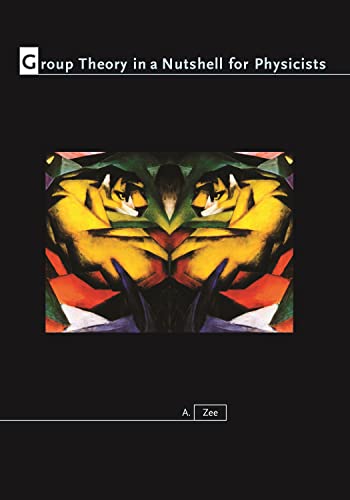
A concise, modern textbook on group theory written especially for physicistsAlthough group theory is a mathematical subject, it is indispensable to many areas of modern theoretical physics, from atomic physics to condensed matter physics, particle physics to string theory. In particular, it is essential for an understanding of the fundamental forces. Yet until now, what has been missing is a modern, accessible, and self-contained textbook on the subject written especially for physicists.Group Theory in a Nutshell for Physicists fills this gap, providing a user-friendly and classroom-tested text that focuses on those aspects of group theory physicists most need to know. From the basic intuitive notion of a group, A. Zee takes readers all the way up to how theories based on gauge groups could unify three of the four fundamental forces. He also includes a concise review of the linear algebra needed for group theory, making the book ideal for self-study.Provides physicists with a modern and accessible introduction to group theoryCovers applications to various areas of physics, including field theory, particle physics, relativity, and much moreTopics include finite group and character tables; real, pseudoreal, and complex representations; Weyl, Dirac, and Majorana equations; the expanding universe and group theory; grand unification; and much moreThe essential textbook for students and an invaluable resource for researchersFeatures a brief, self-contained treatment of linear algebraAn online illustration package is available to professorsSolutions manual (available only to professors)
User’s Reviews
Editorial Reviews: Review “Honorable Mention for the 2017 PROSE Award in Textbook/Best in Physical Sciences and Mathematics, Association of American Publishers””Another excellent entry in the ‘Nutshell’ series, Zee’s latest has it all: broad scope, depth, thorough explanations, history, and an appealing sense of humor. The author’s knowledge of mathematics and physics is encyclopedic, and he leavens the text generously with episodes and asides drawn from the life and work of the major figures in the development of group theory and its applications in physics.” ― Choice”In Group Theory in a Nutshell for Physicists, Anthony Zee . . . combines clarity of presentation with mathematical detail at a level of rigor acceptable to physicists. The result is a tour de force that guides readers through the universe of group theory and leads them to recent particle physics, cosmology, and condensed matter. The book is unique in its laid-back presentation.” ― Physics Today”This book lives up to my high expectations and can stand shoulder to shoulder with Zee’s other two Nutshell books.”—Johannes Koelman, Science 2.0″A highly accessible account of the principles of group theory. . . . Zee is a cheerful and inspirational guide to material that in many other hands could be dry and lifeless. . . . I really enjoyed reading Zee’s book and found it packed full of helpful insights, as well as being frequently irreverent and funny, not terms that are often used in descriptions of books on group theory.”—Stephen J. Blundell, Contemporary Physics Review “Zee’s lovely book on the theory of group representations is comprehensive and complete, both from the mathematical and physical points of view. While it doesn’t discuss the representations of the symmetric groups, the book’s got almost everything on the mathematical side, including roots and weights in the theory of compact Lie groups. The physics applications are mainly from high energy physics but also include some from chemical and condensed matter physics. Clearly written, this book makes an ideal text for a graduate course in physics on the subject.”―Barry Simon, California Institute of Technology”This excellent book stands out by its clarity of presentation.”―Eugene Demler, Harvard University”This is an ambitious book. Zee brings together a lot of material not easily found in one place.”―Savdeep S. Sethi, University of Chicago”Group Theory in a Nutshell for Physicists fills a gap in the market. Zee turns group theory into a less intimidating topic.”―Katrin Becker, Texas A&M University From the Back Cover “Zee’s lovely book on the theory of group representations is comprehensive and complete, both from the mathematical and physical points of view. While it doesn’t discuss the representations of the symmetric groups, the book’s got almost everything on the mathematical side, including roots and weights in the theory of compact Lie groups. The physics applications are mainly from high energy physics but also include some from chemical and condensed matter physics. Clearly written, this book makes an ideal text for a graduate course in physics on the subject.”–Barry Simon, California Institute of Technology”This excellent book stands out by its clarity of presentation.”–Eugene Demler, Harvard University”This is an ambitious book. Zee brings together a lot of material not easily found in one place.”–Savdeep S. Sethi, University of Chicago”Group Theory in a Nutshell for Physicists fills a gap in the market. Zee turns group theory into a less intimidating topic.”–Katrin Becker, Texas A&M University About the Author A. Zee is professor of physics at the Kavli Institute for Theoretical Physics at the University of California, Santa Barbara. His books include Quantum Field Theory in a Nutshell, Einstein Gravity in a Nutshell, and Fearful Symmetry: The Search for Beauty in Modern Physics (all Princeton). Read more
Reviews from Amazon users which were colected at the time this book was published on the website:
⭐I’m working my way through this book and it’s rich with insight and clever explanations, but A. Zee is sometimes super snotty. I think he’s just being cheeky, but he can come across as aggressively rude sometimes. Any mathy book that overuses “obviously” is (obviously) really annoying, but homeboy levels it up. The info in the book is great, and he really does a wonderful job of explaining the concepts presented, but his ‘tude does get kind of annoying after a while. And he’s a name-dropper (*eye roll*).
⭐After the debut in the textbook series “In a Nutshell”, titled “Quantum Field Theory in a Nutshell” which I enjoyed so much, nearly a decade had passed before A. Zee’s second textbook (on Einstein’s gravity) was released. Then, a few years later, his third – on group theory – came out. From my experience with “QFT in a Nutshell”, I came to realize that group theory is an indispensable tool to understand QFT (and the Standard Model especially), but sadly I wasn’t taught group theory when I was an undergraduate and to me the SO(N), SU(N) were horrible monsters. Motivated by the desire to clear obstacles to learning QFT, I decided to tackle his third book before saying hello to Einstein’s gravity.In view of the impressive achievement of “QFT in a Nutshell”, I have had high expectations on this book. Now that I’ve just read the first several chapters (about one-fourth of the book), but I can say that my expectations are met. This is definitely an ideal textbook on group theory tailored for physics-oriented guys. I’m one of these guys and find it hard to have joy going through textbooks on advanced mathematics in which the narratives are overwhelmed by floods of equations, formulas and mathematical symbols. But in this one, as in “QFT in a Nutshell”, I’m intoxicated by the lively, and sometimes funny, narratives. The mathematics are developed to the physicist’s level of rigor, whereas emphasis is put on the connection between group theory and physics. So for those who want to know how the ideas of groups are manifest in the physical world, listen, look no further, your wish would be fulfilled by Zee’s crystal-clear explanation. It is also ideal for self-study, provided the reader has some knowledge of linear algebras and quantum mechanics. Again, the footnotes in each chapter are full of interesting human stories and legends in the history of science, which make the book all the more humanely approachable.The above is my humble opinion based on my partial reading. Therefore the question is: Is it possible that my comment will be different after I have read the whole book? If yes, it would only be more positive. Unless the final parts were not written by the same author. The truth is, “Group Theory in a Nutshell for Physicists” turned me into a big fan of Zee, in much the same way as the film “2001: A Space Odyssey” turned me into a big fan of the director Stanley Kubrick, who made a masterpiece in every different genre of films.Being a big fan of the author, I very much wish that Zee would expand his excellent “In a Nutshell” series.
⭐I just finished reading this wonderful book filled with empowering puzzles. I’ve never had this much fun with a physics book, myself being at an age of 43, that means something.I started reading this book because I grew frustrated of so many particle physics books slowly explaining the basics of particles in ten chapters, and then at the end the author feels the need to explain the standard model in ten pages and you get one chapter full of deceptively simple looking equations like 9 = 5 + 3 + 1 where quite some readers (like myself) don’t really understand what the meaning of these equations are. I studied physics at the university, and we got a course on group theory, but those lectures did not come much further than a couple of finite groups and some playing around with Clebsches, we never saw any tensors there.Zee’s book really explains it all really well, you just have to do all the exercises to be able to follow, but when you do (and it is really doable because the exercises are really well balanced – not too simple and not too difficult), you will get a firm and steady grasp on the subject. At the very end of the book, there are some really great exercises (e.g. those where you have to decompose the 126 and the 120 of SO(10), where most of the book’s subjects come together. Really lots of fun playing a DIY grand unifier like that. Like the author encourages you to do many times, just do it !Now with physics not being the physics of the eighties anymore, many people are dying to learn more about what the AdS part of AdS/CFT means. With a nice chapter rather early in the book on topology and group (coset) manifolds, you have all the ingredients to understand the essence. This is a modern book on group theory, not afraid to cover many hot research topics of today. Finally infantile looking equations like 15 = 6 + 2 + 3 + 3 + 1 lost their impenetrable mysteriousness. The book made me buy the G nut and the QFT nut as well. Can’t wait to devour them!
⭐Just to get this out of the way: this is a must-buy.Group theory can be taught in a very boring way. See Georgi’s book for example, where he starts off by giving definition after definition without truly motivating things; this becomes cumbersome and causes the reader’s attention span to drop dramatically fast. In contrast, Zee approaches the subject in a much more accessible way, starting from very simple things (even has a nice review of Linear Algebra at the start of the book) and gradually and -unfortunately but inescapably- slowly builds up towards more advanced concepts.The fact that everything, from the very simple to the very abstract, is motivated is simply amazing and gives a whole new touch to how this subject is taught. I enjoyed reading it; from going through the small bits of physics history to following each small proof to reading the amazing gems of unique insight that the author provides, everything is enjoyable. And the humor is also good (although if you did not like the style of Zee’s other Nuts, then you won’t like the style of this one too).To give an example of something done really good, I mention that Zee is the only author of a Group theory book (at least from the popular ones) that has made me truly understand what exactly the quotient group is and why it is important. I mean, you can say that you totally get what the quotient group is through its definition, but besides that there’s a much-needed intuition to be built in order to truly appreciate why we define it. Zee provides this in spades.With these being said, this is no book for anybody wanting a rigorous exposition to this beautiful subject. Zee uses the slang of Group theory in most occasions, of course, but he omits doing everything with the painstaking accuracy of rigorous math. This leaves more space for the brain to deepen the understanding of the basics, so for me this is great. Bear in mind that I used this book for a Group theory course that is non-rigorous, so the course ties really well with this. I have to admit that sometimes I needed more rigor, but I just supplemented this with our lecture notes. The conclusion I draw from this is that this will probably serve you very well, no matter the approach you want to take, but I could definitely see some readers wanting to use this only as a supplement.Note that this is also great for undergrads who want to learn Group theory. This is a super good intro. Graduate students can at least use this as a supplement. One thing is true though: this is a gem that everybody must buy.Lastly, I want to also mention that I really like the breadth of the topics covered here. From the standard stuff of particle physics to cosmology and even condensed matter physics, the author provides us with really nice applications of Group theory in physics and the topics presented here showcase the author’s deep and wide understanding that comes from his own wide research experience (lot’s of condensed matter and high-energy physics).So, to conclude, this has the trademark writing style of Zee (smooth and easy-going), the unique insights of the author, breadth of topics and paves the way to deep intuitive understanding of the topic. A must-buy.
⭐First thing to note this is not a Maths book. If you want a maths book, you should probably look elsewhere. There are some excellent introductions to group theory for mathematicians: Stillwell’s Naive Lie Theory or Steinberg’s Representation Theory or at a more advanced level Hall’s Lie Groups. What you do get with Zee is the physics behind the maths, he explains why you should be interested in this stuff. His style is engaging albeit a little quirky at times but he does his best to make this fun and interesting and basically succeeds.The explanations are detailed enough to make the book suitable for self study (which is how I am using the book) and the exercises with solutions at the back help you test your understanding.Well worth the investment both in time and money!
⭐Although the content is brilliant, the book isn’t good quality. Pages 31-78 are in between pages 174-175. Printing books must be harder than writing it.
⭐I’ve taken a mathematics course on group theory, but it naturally taught me the subject from a mathematician’s point of view, which, although useful for appreciating the subject, leaves you hopelessly unprepared to tackle representations in particle physics. I’ve been studying this book incessantly to get myself up to speed, and if you liked Dr. Zee’s other books, you’ll definitely enjoy this one. The charm, the insight and the informal tone are all there, even Confusio is there. Now, I found some of the proofs wanting, like the Unitarity theorem is stated as “Finite Groups have unitary representations”. The first few times I read this statement, I interpreted (more or less naturally) as “Given a finite group, you can find a unitary representation”. It seems the Dr. Zee meant “A representation of a finite group is unitary”, since he uses it this way throughout. I’ve gone over the proof a few times, and to me, it really seems like the only thing actually proven is “A representation of a finite group is equivalent to a unitary representation”. So, OK, in terms of mathematical precision, this book isn’t the greatest, but I’m approaching the subject right now from a utilitarian point of view to understanding representations for the Quark Model and the Standard Model, and as far as I can tell, nobody has collected this impressive amount of material in a package as complete as Zee’s before. So it’s pretty good. Also, printing quality is top-notch, but all of Princeton’s Nutshell are.
⭐The book is falling apart without being use. The binding is terrible and the paper is very cheap: these series won’t last.
Keywords
Free Download Group Theory in a Nutshell for Physicists (In a Nutshell, 17) in PDF format
Group Theory in a Nutshell for Physicists (In a Nutshell, 17) PDF Free Download
Download Group Theory in a Nutshell for Physicists (In a Nutshell, 17) 2016 PDF Free
Group Theory in a Nutshell for Physicists (In a Nutshell, 17) 2016 PDF Free Download
Download Group Theory in a Nutshell for Physicists (In a Nutshell, 17) PDF
Free Download Ebook Group Theory in a Nutshell for Physicists (In a Nutshell, 17)