

Ebook Info
- Published: 2011
- Number of pages: 320 pages
- Format: PDF
- File Size: 4.09 MB
- Authors: Richard E. Cytowic MD
Description
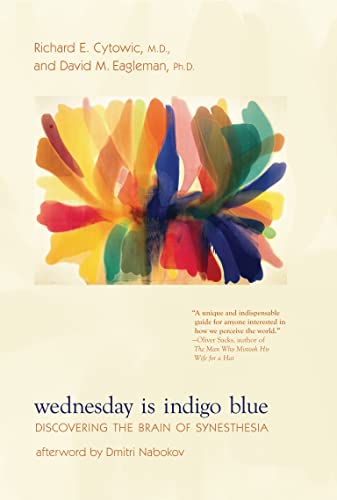
How the extraordinary multisensory phenomenon of synesthesia has changed our traditional view of the brain.A person with synesthesia might feel the flavor of food on her fingertips, sense the letter “J” as shimmering magenta or the number “5” as emerald green, hear and taste her husband’s voice as buttery golden brown. Synesthetes rarely talk about their peculiar sensory gift―believing either that everyone else senses the world exactly as they do, or that no one else does. Yet synesthesia occurs in one in twenty people, and is even more common among artists. One famous synesthete was novelist Vladimir Nabokov, who insisted as a toddler that the colors on his wooden alphabet blocks were “all wrong.” His mother understood exactly what he meant because she, too, had synesthesia. Nabokov’s son Dmitri, who recounts this tale in the afterword to this book, is also a synesthete―further illustrating how synesthesia runs in families. In Wednesday Is Indigo Blue, pioneering researcher Richard Cytowic and distinguished neuroscientist David Eagleman explain the neuroscience and genetics behind synesthesia’s multisensory experiences. Because synesthesia contradicted existing theory, Cytowic spent twenty years persuading colleagues that it was a real―and important―brain phenomenon rather than a mere curiosity. Today scientists in fifteen countries are exploring synesthesia and how it is changing the traditional view of how the brain works. Cytowic and Eagleman argue that perception is already multisensory, though for most of us its multiple dimensions exist beyond the reach of consciousness. Reality, they point out, is more subjective than most people realize. No mere curiosity, synesthesia is a window on the mind and brain, highlighting the amazing differences in the way people see the world.
User’s Reviews
Editorial Reviews: Review Filled with detailed tables, clarifying illustrations, and instructive chapters, this title, which includes an afterword by Nabokov’s son Dmitri (also a synesthete), should be required reading for teachers and anyone who works with children.―Library JournalThis is a clear, clever book that will appeal to synaesthetes in search of explanations, and to all with a passion for neurology’s wild territory.―Liz Else, New Scientist Review A fascinating survey of the enormous variety and creativity of the synaesthetic mind.―Daniel Tammet, synesthete and author of Born on a Blue Day About the Author Richard E. Cytowic, M.D., MFA, a pioneering researcher in synesthesia, is Professor of Neurology at George Washington University. He is the author of Synesthesia: A Union of the Senses, The Man Who Tasted Shapes, The Neurological Side of Neuropsychology and (with David M. Eagleman) the Montaigne Medal–winner Wednesday Is Indigo Blue: Discovering the Brain of Synesthesia, all published by the MIT Press.David M. Eagleman, Ph.D., is a neuroscientist at Baylor College of Medicine, where he directs the Center for Synesthesia Research. Read more
Reviews from Amazon users which were colected at the time this book was published on the website:
⭐This book review was completed as a class assignment at Georgia Tech.Richard Cytowic and David Eagleman’s “Wednesday is Indigo Blue: Discovering the Brain of Synesthesia” is a great read for anyone interested in learning about synesthesia and synesthetic experiences. The book is well structured, and filled with examples and testimonials from individuals with various forms of synesthesia. In addition to the entertaining and informative stories, the book also covers the current state of research in the field of synesthesia; from protocols used to tease out the differences between the synesthetic and nonsynesthetic brain to theories of how and why some brains develop synesthesia while others do not.The book begins with an anecdote to convey the view of synesthesia from the inside perspective and open the reader’s mind. There is no way of confirming that the reality you experience is the same as your neighbor’s reality. In fact, abnormal experiences, such as those experienced by synesthetes, prove to us that this is not the case. Delving into such extraordinary cases can teach us many things about the brain that we would not otherwise uncover. For this reason, the study of synesthesia is valuable, and will continue to expand as we gain a deeper understanding of how we perceive the world in which we live.The first chapter of the book explains difficulties with establishing an accurate prevalence of synesthesia. Individuals that have synesthesia have always had synesthesia, and generally assume that everyone else perceives the world in the same way, much as nonsynesthetes do. When they discover that is not the case, they often switch extremes, believing that nobody experiences what they experience. This alone is enough to keep most synesthetes from volunteering information about their internal experiences. Further, due to the extensive diversity of synesthetic cases, it is difficult to define precisely what constitutes synesthesia.In chapter 2, the authors discuss a few of the forms of synesthesia in detail; from the research data detailing measurable consistencies, to the subjective descriptions of the idiosyncrasies of the synesthetic experience. The chapter begins with more common forms, including number forms, colored graphemes, and tasted words. It continues into descriptions of rarer presentations of synesthesia, such as audio-motor, geometric pain, and sound to touch. Following the examples, the authors question why some kinds of synesthesia are more common than others, and whether there are limits on the variations of synesthesia left to be uncovered.While much of this book highlights benefits of having the “gift” of synesthesia, such as enhanced memory, in certain cases, the synesthetic experience can be burdensome. An example of this is provided in a synesthete with consistent bidirectional sound-color synesthesia. This synesthete explains that she avoids places with bright lights and loud noises, like the circus, whenever possible because she is unable to distinguish her synesthetic sensations from what is real, and that such an experience can be frightening and exhausting.This example of such an intense synesthetic experience is in contrast to `milder’ forms, such as grapheme-color synesthesia. In grapheme-color synesthesia, letters evoke a sensation of color, but in some individuals, the associations may be weak or even nonpresent for some letters of the alphabet. Such variances in intensity of the experience lead to the question: how much synesthesia is normal? The author proposes a cognitive continuum that ranges from perceptual similarities, to synesthetic equivalences to metaphoric identities to abstract language. The book makes a point to explain that synesthesia is perceptual and not merely metaphoric depictions of normal experience, but suggests that the human capacity to understand metaphor may be linked in some way to the ability for the brain to create synesthetic associations.The authors describe the landscape of associations in the brain as being similar to a mountainous landscape, in which only some of the peaks break through the cloud cover of consciousness. Further, they claim that, if this were the case, the cross-connections of synesthesia may be present in all brains, but contained below the level of consciousness. Supporting this claim, both synesthetes and nonsynesthetes consistently match higher pitches with brighter colors when asked. Further, the use of phrases of abstract language such as “a loud tie” or “cool jazz” shows that the normal human brain is capable of making and understanding cross-modal associations. However, in most cases, the associations made by synesthesia, such as a pain that feels like the shape of a grid, are foreign to the general population.The book closes with a description of the current state of synesthesia research and some questions ahead of us on the path to understanding synesthesia. The authors remind us that synesthesia is not localized in one brain region, and that we should be looking throughout distributed networks to understand it. They also suggest that we should be asking not whether cross-talk is present, but to what extent. They claim that both the cross-talk theory and the disinhibited feedback model of synesthesia are incomplete because they do not yet incorporate the role of learning. Depending on both genetics and learning over a ifetime, there are many possible ways in which brain areas may interconnect, leading to different forms of synesthesia. Studies are beginning to explore the individual differences of synesthetes. Finally, they state it is possible for a single gene to underlie all of the different forms of synesthesia, as the condition may be inherited in various forms, but to date, such a gene has not been found.”Wednesday is Indigo Blue: Discovering the Brain of Synesthesia” was an incredible book, and I would recommend it as both a knowledgeable book for anyone seeking to gain a well rounded understanding of synesthesia and an enjoyable book for a leisure read.
⭐This is the book to read. A fascinating look / feel – touch / taste-hear / see smell/taste mix of all the senses you never believed anyone else would think existed… colours there are no names for, experiences of the world as unique and individual as everyone in the world. If you ever felt like no one understands the way you feel the world or taste the wind … someone does. It’s nice to know not everyone sees the world in the same way… in fact, in what passes for reality / truth: no two people actually do. And this book confirms it. Even more importantly: if you have “an over-active imagination” … now you can feel sympathy for those who do not.
⭐clinical student here – i don’t have synesthesia (though i do wish i did after reading this!) but i’ve always loved psychology and “fringe” fields of neuroscience/neuropsychology, and i was surprised to find that synesthesia was anything but. the style of writing in this book is very logical and easy to follow, someone with no background in pyschology could read it cover to cover and thoroughly enjoy it. i’ll definitely be going back to this in the future to reference some of the themes/ideas raised. chapter nine lends itself to the more detail-oriented, but nevertheless is accessible to lamen and scholars alike. i would definitely be interested to read other works by either of these authors. i found their style of presenting complex material in a fairly straightfoward, easy-to-comprehend manner enjoyable.if you are interested in perception, cognition, psychology, or just how some of the stranger things around you work, i would recommend this book.*PRO TIP: absolutely do NOT purchase the kindle version of this book. you need the physical text, as the colored pictures are numerous in quantity and very much pivotal in entirely understanding some of the conditions explained.*
⭐This was a gift for a friend who has synesthesia and she loved it! It was a great purchase!
⭐My son realized he had synesthesia when he was in high school. Until that time, he never knew the rest of us don’t “hear” colors with music. I have been fascinated with synesthesia ever since, and wanting to know more about how he perceives the world. This book is a great description of the known physiology of synesthsia and some of the ways that synesthetes see, hear, taste, and touch the world.For parents, teachers and anyone else who wants to know more, this is a great book that is readable by the average lay person. I learned a lot, including wishing that could sense the world in this special way!
⭐First of all: “WEDNESDAY IS NOT INDIGO BLUE” – It’s Lavender with grey background! Now, that probably gives it away – I’m a synesthete. This book is extremely informative. Most of what was not too hard for me to understand, though I don’t have most of the synesthesia types explained in the book. I wish I did – it seems so fascinating! The one downturn is that it’s not that a page turner as I wished. But It’s nice to read for anyone interested in this topic for whatever reason.
⭐Synaesthesia (to give the correct spelling) is a brain function that is presenting continued enigma in the scientific community. How is it possible to hear music and see colour? Or, in my case hear music and experience tastes? Dr Cytowic has successfully demonstrated the varieties of synaesthesia, and the presence in the world population. However, he has not demonstrated the possibilities of acquired synaesthesia to my personal view; that is, if you learn a particular skill, there may be a synaesthetic component to your development. I look with interest to further discussion and research by this particular person.
⭐There are many information and pictures, thank you!
⭐I have synesthesia since childhood. I have always seen letters, words, numbers, days of the week, months, and peoples names in colour (grapheme-color synesthesia). I also have sequence-space synesthesia, can smell or taste certain words and briefly foreseen or sense the future. I am also an artistic person. I always thought that was normal but I recently discovered that not everyone feels or have this. I was interested in knowing and reading more about the subject and still do! This is probably the best book I read on the subject of synesthesia. This book was just what I needed. It is an approachable and well written book about synesthesia by Dr. Cytowic, a leading researcher and a pioneer scientist on the subject of synesthesia. Synesthesia is a genetic condition, for me it is also an extra sense or a gift. The best gift I ever had. I recommend this book to anyone with an interest on this fascinating topic!
⭐This book is very detailed but comprehensively written. (Almost) every “but how..?” is answered and even the ‘looser’ synaesthetic experiences (such as auras) are explored openly, with no sense of disregard or ridicule. For anyone with synaesthesia or with just an interest in it, this book is a must-read. For everyone else, it is still a fascinating exploration / explanation into the latest ideas / therories on how all our brains work.I absolutely recommend this!
⭐I haven’t finished reading this yet, but it is off to a very good start. It is full of information and must surely be of great interest to anyone wanting a more in depth knowledge of synesthesia.
⭐Husband loves this author and the book does not disappoint.
⭐This book is extremely interesting. Synesthesia is a wonderful phenomenon telling us, that the brain is still a great mystery. Why do we taste colors, see numbers colored – though printed in black, etc. etc. This book tells the story in great, interesting detIls
Keywords
Free Download Wednesday Is Indigo Blue: Discovering the Brain of Synesthesia (The MIT Press) in PDF format
Wednesday Is Indigo Blue: Discovering the Brain of Synesthesia (The MIT Press) PDF Free Download
Download Wednesday Is Indigo Blue: Discovering the Brain of Synesthesia (The MIT Press) 2011 PDF Free
Wednesday Is Indigo Blue: Discovering the Brain of Synesthesia (The MIT Press) 2011 PDF Free Download
Download Wednesday Is Indigo Blue: Discovering the Brain of Synesthesia (The MIT Press) PDF
Free Download Ebook Wednesday Is Indigo Blue: Discovering the Brain of Synesthesia (The MIT Press)