

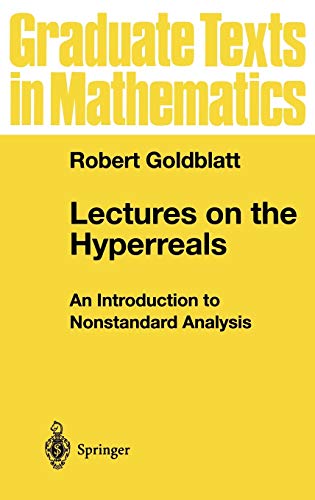
Ebook Info
- Published: 1998
- Number of pages: 307 pages
- Format: PDF
- File Size: 5.30 MB
- Authors: Robert Goldblatt
Description
An introduction to nonstandard analysis based on a course given by the author. It is suitable for beginning graduates or upper undergraduates, or for self-study by anyone familiar with elementary real analysis. It presents nonstandard analysis not just as a theory about infinitely small and large numbers, but as a radically different way of viewing many standard mathematical concepts and constructions. It is a source of new ideas, objects and proofs, and a wealth of powerful new principles of reasoning. The book begins with the ultrapower construction of hyperreal number systems, and proceeds to develop one-variable calculus, analysis and topology from the nonstandard perspective. It then sets out the theory of enlargements of fragments of the mathematical universe, providing a foundation for the full-scale development of the nonstandard methodology. The final chapters apply this to a number of topics, including Loeb measure theory and its relation to Lebesgue measure on the real line. Highlights include an early introduction of the ideas of internal, external and hyperfinite sets, and a more axiomatic set-theoretic approach to enlargements than is usual.
User’s Reviews
Editorial Reviews: Review R. GoldblattLectures on the HyperrealsAn Introduction to Nonstandard Analysis”Suitable for a graduate course . . . could be covered in an advanced undergraduate course . . . The author’s ideas on how to achieve both intelligibility and rigor . . . will be useful reading for anyone intending to teach nonstandard analysis.”―AMERICAN MATHEMATICAL SOCIETY
Reviews from Amazon users which were colected at the time this book was published on the website:
⭐I found this to be a very thorough treatment of hyperreals and how this affects proofs in real analysis.
⭐A well written book. The best I’ve read on the subject of hyperreals, it’s not too expensive either. A good, inexpensive companion book is the paperback written by J.M. Henle and E.M. Kleinberg entitled :”Infinitesimal Calculus”.
⭐Goldblatt presents a very nice view of Nonstandard analysis and its applications beginning with a historical overview and some of the ways it can simplify the calculus in the standard sense. This book is a great reference for anyone studying this interesting branch of mathematics.
⭐This is hands down the best introductory book on nonstandard analysis. If you want to learn nonstandard analysis then you should start here.
⭐This is an outstanding book. First of all, the subject matter is interesting. It is often said that the worst thing about nonstandard analysis is its name. “Nonstandard” suggests that the subject is divorced from the rest of mathematics, perhaps relying on some alternative logic. The ideas, however, are completely “standard”. One way to construct the reals is via equivalence classes of Cauchy sequences. The hyperreals are also equivalence classes of sequences, modulo an ultrafilter. Hence, the sequence {1/n} is representative of a hyperreal which is positive, yet smaller than any positive real number; i.e., an infinitesimal. Inverses of infinitesimals are “unlimited”. These ideas permit a very simple and intuitive development of the calculus, where the derivative becomes a linear map with infinitesimal approximation error, and the Riemann integral becomes a sum over a partition with infinitesimal mesh. All the cumbersome epsilon-delta statements are banished, making for a very clean development.Later in the book, the author introduces the concept of a “universe”. Universes are essentially structures which can encompass most of “standard” mathematics: topological spaces, measure spaces, etc. It is then shown that such universes can be embedded in larger ones: nonstandard universes. This formalizes the idea that nonstandard analysis is an extension of standard mathematics, with new and interesting objects. The notion of transfer allows one to prove sophisticated statements via simple ones; e.g., see the proof of the intermediate value theorem by partitioning the domain into subintervals of infinitesimal width.Another good aspect of the book is the quality of the writing. Most graduate-level analysis textbooks are deliberately dense, forcing beginners to spend hours per page. In contrast, this book is very easy to read, and the pages fly. This is because the author is careful to motivate the main ideas, and to include most of the logical steps in the proofs. The exercises are also excellent, being strangely both easy and instructive, making the book valuable for self-study, which was my case.In any first edition, there are bound to be typos. This book contains remarkably few. However, the discussion of hyperfinite summation seems flawed. The author wants to sum functions over their domains, and proposes to do this by summing over the image. The problem with this, of course, is when the function is not a bijection. For example, the sum of a function which is constant and one should count the domain. However, the sum of its image is just 1. This problem is easily fixed. Define the set of all finite sequences and the function which sums them. Transfer this. Then sum functions over finite sets by making a bijection between the domain and a finite sequence. By transfer, one obtains summation of functions over hyperfinite domains.Another small complaint: for pedagogical reasons, the author has chosen to merely state Los’s theorem (on transfer), and then illustrate its use repeatedly. Although I agree with this, after becoming familiar with transfer, I reached the point where I wanted to see the proof, which should have been included somewhere at the end of the book.
⭐Most of the book on hyperreal numbers I’ve seen use a heavy logic formalism to treat and introduce this subject. This book introduces this concept in a very intuitive way ( which becomes more and more rigourous as the author points out different arising difficulties, and the necessity to use more sophisticated tools to avoid them) , and the first 50 pages wich give the main ideas behind the construction of these numbers can be read very easily. The historic introduction of the book by itself is a jewel. I ( a condensed matter physicist ) highly recommand this book.
⭐確率論の大数の弱法則・強法則を勉強していたときに、通常の測度論を用いた確率では「通常のサイコロで7が出るというような絶対に起きない事象」も「弓道で的の中心に矢が当たるような稀には起きる事象」も同じ0(ゼロ)と捉えることに、違和感を覚えていた。通常の測度論は確率を大体は表現しているが、確率を十分表現するにはきめが粗いと感じた。そんなとき、かつて知っていたNon-standard Analysisの超実数を思い出し、勉強してみようと思った。斎藤正彦先生の「超準解析」は専門書すぎ、訳本のキースラー「無限小解析の基礎」は、超実数の構成がしっくりこなかった。そんな中でたまたま買ってみたこの本は、多くの実際の講義を経て作られただけあって、Non-standard Analysisを知らない者に向けて、超実数の構成を1から丁寧に説明してある。超実数の構成には、フィルターというものを利用するが、はじめに”Large Sets”として導入してからフィルターの定義に進み、フィルターの性質と必要性がよく分かった。
⭐
Keywords
Free Download Lectures on the Hyperreals: An Introduction to Nonstandard Analysis (Graduate Texts in Mathematics, 188) 1998th Edition in PDF format
Lectures on the Hyperreals: An Introduction to Nonstandard Analysis (Graduate Texts in Mathematics, 188) 1998th Edition PDF Free Download
Download Lectures on the Hyperreals: An Introduction to Nonstandard Analysis (Graduate Texts in Mathematics, 188) 1998th Edition 1998 PDF Free
Lectures on the Hyperreals: An Introduction to Nonstandard Analysis (Graduate Texts in Mathematics, 188) 1998th Edition 1998 PDF Free Download
Download Lectures on the Hyperreals: An Introduction to Nonstandard Analysis (Graduate Texts in Mathematics, 188) 1998th Edition PDF
Free Download Ebook Lectures on the Hyperreals: An Introduction to Nonstandard Analysis (Graduate Texts in Mathematics, 188) 1998th Edition