Ebook Info
- Published: 2005
- Number of pages: 280 pages
- Format: PDF
- File Size: 1.68 MB
- Authors: Paul Thagard
Description
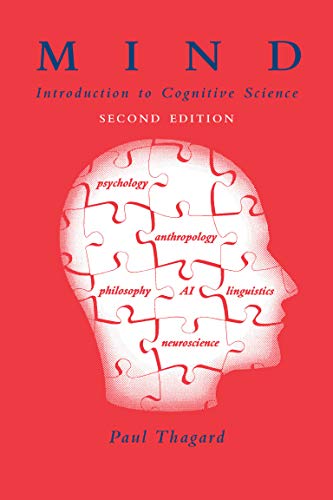
Cognitive science approaches the study of mind and intelligence from an interdisciplinary perspective, working at the intersection of philosophy, psychology, artificial intelligence, neuroscience, linguistics, and anthropology. With Mind, Paul Thagard offers an introduction to this interdisciplinary field for readers who come to the subject with very different backgrounds. It is suitable for classroom use by students with interests ranging from computer science and engineering to psychology and philosophy.Thagard’s systematic descriptions and evaluations of the main theories of mental representation advanced by cognitive scientists allow students to see that there are many complementary approaches to the investigation of mind. The fundamental theoretical perspectives he describes include logic, rules, concepts, analogies, images, and connections (artificial neural networks). The discussion of these theories provides an integrated view of the different achievements of the various fields of cognitive science.This second edition includes substantial revision and new material. Part I, which presents the different theoretical approaches, has been updated in light of recent work the field. Part II, which treats extensions to cognitive science, has been thoroughly revised, with new chapters added on brains, emotions, and consciousness. Other additions include a list of relevant Web sites at the end of each chapter and a glossary at the end of the book. As in the first edition, each chapter concludes with a summary and suggestions for further reading.
User’s Reviews
Editorial Reviews: Review “The second edition of “Mind” represents a significant advance for an already excellent book. My enthusiasm for continuing to use Thagard’s accessible and consistently informative volume for Berkeley’s large Introduction to Cognitive Science course has been fully refreshed, as the updates in the new edition have made it a superb text for undergraduates.”–Michael Ranney, Graduate School of Education, Department of Psychology, and the Institute for Cognitive and Brain Sciences, University of California, Berkeley”This little gem of a book has three major virtues. First, it is easy to read and easy to understand. Second, it clearly states the central thesis of cognitive science and precisely lays out the explanatory patterns underlying various theories of cognition. Third, the book is unique in its presentation of the material, arranging it along various types of knowledge representations such as rules, concepts, and images.”–Ashok Goel, College of Computing, Georgia Institute of Technology”The second edition of& quot; The second edition of Mind represents a significant advance for an already excellent book. My enthusiasm for continuing to use Thagard’s accessible and consistently informative volume for Berkeley’s large Introduction to Cognitive Science course has been fully refreshed, as the updates in the new edition have made it a superb text for undergraduates.& quot; –Michael Ranney, Graduate School of Education, Department of Psychology, and the Institute for Cognitive and Brain Sciences, University of California, Berkeley& quot; This little gem of a book has three major virtues. First, it is easy to read and easy to understand. Second, it clearly states the central thesis of cognitive science and precisely lays out the explanatory patterns underlying various theories of cognition. Third, the book is unique in its presentation of the material, arranging it along various types of knowledge representations such as rules, concepts, and images.& quot; –Ashok Goel, College of Computing, Georgia Institute of Technology” The second edition of “Mind” represents a significant advance for an already excellent book. My enthusiasm for continuing to use Thagard’s accessible and consistently informative volume for Berkeley’s large Introduction to Cognitive Science course has been fully refreshed, as the updates in the new edition have made it a superb text for undergraduates.” –Michael Ranney, Graduate School of Education, Department of Psychology, and the Institute for Cognitive and Brain Sciences, University of California, Berkeley” This little gem of a book has three major virtues. First, it is easy to read and easy to understand. Second, it clearly states the central thesis of cognitive science and precisely lays out the explanatory patterns underlying various theories of cognition. Third, the book is unique in its presentation of the material, arranging it along various types of knowledge representations such as rules, concepts, and images.” –Ashok Goel, College of Computing, Georgia Institute of Technology–Ashok Goel, College of Computing, Georgia Institute of Technology–Michael Ranney, Graduate School of Education, Department of Psychology, and the Institute for Cognitive and Brain Sciences, University of California, Berkeley Review The second edition of Mind represents a significant advance for an already excellent book. My enthusiasm for continuing to use Thagard’s accessible and consistently informative volume for Berkeley’s large Introduction to Cognitive Science course has been fully refreshed, as the updates in the new edition have made it a superb text for undergraduates.―Michael Ranney, Graduate School of Education, Department of Psychology, and the Institute for Cognitive and Brain Sciences, University of California, Berkeley About the Author Paul Thagard is Professor of Philosophy at the University of Waterloo, Ontario. He is the author of The Cognitive Science of Science (MIT Press, 2012) and many other books. Read more
Reviews from Amazon users which were colected at the time this book was published on the website:
⭐This book presents the Computational-Representational Understanding of the Mind (CRUM). To be fair, the book is particularly well written and provides extremely helpful end of chapter summaries. Yet while the author does try to be even handed in presenting often opposing theories, there are definite preferences communicated. In short, it’s an intriguing book on current thinking on how we really think.
⭐Very good book regarding the Computational Representational Understanding of Mind (CRUM). Althought only focusing on one theory to explain the fucntioning of our mind it has concise and easy to understand explanations, going from the most basic representations to the most complex.
⭐The book is like new. I am very satisfied. It is perfect. I am glad I bought this item here.
⭐Thagard’s book is little more than an extremely superficial skim of and introduction to cognitive science. I know that the book is supposed to be a simple introduction, but in many ways it is far to simplistic and glossed over. There are many times at which he introduces new terms and concepts without defining them. He also jumps around quite a bit. His examples are very short and do not provide much insight beyond the obvious. Unless you need the book for class, I would avoid it. If you are just looking for an informative introduction to cognitive science, this is not the book for you.
⭐The linguistic-analysis tradition in philosophy had achieved ascendancy in twentieth-century philosophy of science. But it has been characterized by a nominalist view, which admits a two-level semantics consisting of only (1) the linguistic symbol, such as word, and (2) the objects or individual entities the symbol references. Nominalism recognizes no mediating third level consisting of the idea, concept, “intension”, proposition, or any other mental reality between linguistic signs and nonlinguistic objects.The two-level semantics is also the view typically held by the Positivist philosophers, who rejected mentalism in psychology, and who like B.F. Skinner prefer behaviorism. However Thagard, like Herbert Simon, explicitly rejects the behavioristic approach in psychology and advocates cognitive psychology, which recognizes mediating mental realities.The two-level semantics is also characteristic of philosophers such as Quine who accept the Russellian predicate calculus. This calculus of symbolic logic contains a notational convention that uses quantification to express existence claims. It therefore fabricates an Orwellian-like nominalist newspeak in which predicate terms are semantically vacuous, unless they are placed in the range of quantifiers, such that they reference some kind of entities called either “mental entities” or Platonic “abstract entities.” The philosopher Nelson Goodman for example therefore divides all philosophers into nominalists and Platonists. Not surprisingly the Russellian symbolic logic was adopted by the Logical Positivists. Oddly Thagard does not reject the Russellian symbolic logic, although it is not clear that he recognizes the ontological implications of its notational conventions.In this book, Mind: Introduction to Cognitive Science (1996), intended as an undergraduate textbook, Thagard states that the central hypothesis of cognitive science is that thinking can best be understood in terms both of representational structures in the mind and of computational procedures that operate on those structures. He labels this central hypothesis with the acronym “CRUM”, by which he means “Computational Representational Understanding of Mind.” This hypothesis assumes that the mind has mental representations analogous to data structures and computational procedures analogous to algorithms, such that computer programs using algorithms applied to data structures can model the mind and its processes.Readers interested in more commentary on Thagard are invited to read my ebook titled
⭐, and see especially BOOK VIII. Also see my
⭐.Thomas J. Hickey
⭐I thought the book sounded intriguing and was actually interested in the topic but found the book quite boring. I was not a fan of the organization of the book and found it kind-of confusing. I had to read the book for a college class, but would have tried to return it had I bought it for myself outside of class.
⭐Unlike the other review I just read -This TEXTBOOK is clear, concise, and logically organized.The book provides relevant, in-line definitions for all terms and concepts used. The book teaches you the concepts, principles, and methods of cognitive science, gently in an interesting way as you read the text. The author’s writes in everyday language and creates his examples and situations in the “everyday” world to illustrate specific concepts and/or methods.This is the best, most comprehesive, easy-to-understand, introductory overview of cognitive science I have ever read. All of this is packed into a slim, 5″ by 8″ volume consisting of 230 pages of text & exercises by a knowledgable author with great writing skills. A great text from beginner to practioner.You don’t need a masters degree in some specific subject to understand what the author is presenting. This book applies the standards and elements of critical thinking unself-consciously and transparently. Every student should be required to read this text because it teaches critical thinking skills in both content AND message. Delightful!!I have not (yet) read any of Paul Thagard’s other textbooks but you can be SURE that I will.
⭐This book seems to have been a reference in the 2000s. Reading today however one finds that there are very few recent citations.
⭐The book is so well written and easy to read. It was required reading for an Intro to Cognitive Science course, which was cross listed with a Philosophy course, so (for me) it was challenging material. The book was the best part of the course and I’d be interested in reading more by Dr. Thagard!
⭐Arrived on time and was great
⭐Nice book
Keywords
Free Download Mind: Introduction to Cognitive Science, , 2nd Edition 2nd Edition in PDF format
Mind: Introduction to Cognitive Science, , 2nd Edition 2nd Edition PDF Free Download
Download Mind: Introduction to Cognitive Science, , 2nd Edition 2nd Edition 2005 PDF Free
Mind: Introduction to Cognitive Science, , 2nd Edition 2nd Edition 2005 PDF Free Download
Download Mind: Introduction to Cognitive Science, , 2nd Edition 2nd Edition PDF
Free Download Ebook Mind: Introduction to Cognitive Science, , 2nd Edition 2nd Edition