Ebook Info
- Published: 2009
- Number of pages: 258 pages
- Format: PDF
- File Size: 1.81 MB
- Authors: Dan Hooper
Description
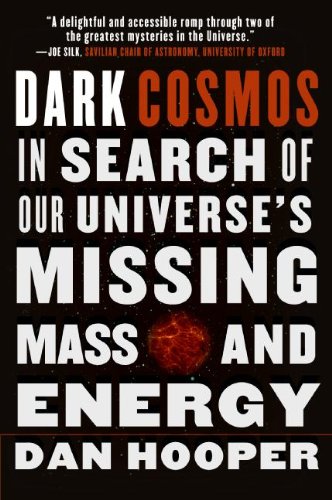
The twentieth century was astonishing in all regards, shaking the foundations of practically every aspect of human life and thought, physics not least of all. Beginning with the publication of Albert Einstein’s theory of relativity, through the wild revolution of quantum mechanics, and up until the physics of the modern day (including the astonishing revelation, in 1998, that the Universe is not only expanding, but doing so at an ever-quickening pace), much of what physicists have seen in our Universe suggests that much of our Universe is unseen—that we live in a dark cosmos.Everyone knows that there are things no one can see—the air you’re breathing, for example, or, to be more exotic, a black hole. But what everyone does not know is that what we can see—a book, a cat, or our planet—makes up only 5 percent of the Universe. The rest—fully 95 percent—is totally invisible to us; its presence discernible only by the weak effects it has on visible matter around it.This invisible stuff comes in two varieties—dark matter and dark energy. One holds the Universe together, while the other tears it apart. What these forces really are has been a mystery for as long as anyone has suspected they were there, but the latest discoveries of experimental physics have brought us closer to that knowledge. Particle physicist Dan Hooper takes his readers, with wit, grace, and a keen knack for explaining the toughest ideas science has to offer, on a quest few would have ever expected: to discover what makes up our dark cosmos.
User’s Reviews
Reviews from Amazon users which were colected at the time this book was published on the website:
⭐Popular science books have been getting chattier and chattier in recent years. Perhaps this is a result of the success of Brian Greene’s successful Sagan-like melding of science and personality. The problem is, not everyone is Brian Greene or Carl Sagan. “Dark Cosmos” is at times too much about Dan Hooper and not enough about dark energy. When the book does get serious and focuses on the physics, it does a good job of explaining the distinction between dark energy, dark matter, and regular “baryonic” matter at a level the typical educated layman can appreciate.From his authorial asides the reader can glean that Hooper is only about 28 or so. His youth gives him an advantage in describing the most recent developments and theories in cosmology, which of course is the main thrust of Dark Cosmos. Where the young Hooper sometimes goes wrong is in relating the history of cosmology. His account of cosmologist Georges Lemaître’s original formulation of what would become the Big Bang Theory falls into the usual trap of not being able to get past Lemaître’s incidental second career as a Catholic priest.One other problem is that Hooper does not always clearly distinguish between ideas which are almost universally accepted in cosmology and more speculative or even controversial ideas which perhaps only a small minority of cosmologists – including Hooper – adhere to. When he remembers to, Hooper sometimes quite fairly warns the reader that a particular idea is still considered to be highly fanciful. The problem is, Hooper doesn’t always remember to include these necessary cautions.There are some useful basic illustrations in the book, which help the readers to visually understand such notions as “infinite inflation.”All in all, the book is a good intro to the ideas of dark energy and the missing mass problem. Those who have already read Lee Smolin’s, Roger Penrose’s, or other writers’ more in-depth takes on the subject perhaps will not get much new out of this relatively short introduction to the subject. But for newcomers, this is a more than acceptable introduction to current cosmology.
⭐The case for missing matter and energy is clearly made, and even though the book was written 20 years ago, is still relevant. The search for missing matter then, as now, centers on looking for new particles of Ordinary Matter. After 20 years of failing to find them, it’s time to look elsewhere, such as suggested by theory concerning Black Marbles and Bright Energy, which proposes the missing matter is not Ordinary Matter at all,
⭐Dan Hooper has done a great job ,in explaining a complex subject in simple terms.Reading his book has for the first time made me understand clearly Einstein’s theory of General relativity,and the concept of lensing. Still reading through the book,……..Thumbs up to Dan.ATUL RADIA (MR) U.K.
⭐I still don’t understand how the Big Bang can continue with our universe generating expansions (big bangs) to start successive universes. Where did the next microdot that Banged out of or from our Universe get its restart? Didn’t our universe keep most of that Bang? Wouldn’t successive universes be smaller and smaller unto microscopic?
⭐If you’re the least bit interested in Physics/astronomy there is nothing new presented in this book and you’re better off tackling more difficult works like Brian Greene or even, if you’re lucky enough, access to local university physics research databases which have more comprehensive up to date material. If you’re a laymen looking for an easy to read, easy to relate to intro to physics this is a decent book for you. There’s some discussion on dark energy but only enough to wet your appetite.
⭐Candid and clear. A neat summary of the latest thinking but some of the answers are still theoretical.charles Muhle
⭐Like the book a lot very nice like new condition. Great price.
⭐It is an easy book to read, and quite enjoyable, don’t miss the opportunity to read it.
Keywords
Free Download Dark Cosmos: In Search of Our Universe’s Missing Mass and Energy in PDF format
Dark Cosmos: In Search of Our Universe’s Missing Mass and Energy PDF Free Download
Download Dark Cosmos: In Search of Our Universe’s Missing Mass and Energy 2009 PDF Free
Dark Cosmos: In Search of Our Universe’s Missing Mass and Energy 2009 PDF Free Download
Download Dark Cosmos: In Search of Our Universe’s Missing Mass and Energy PDF
Free Download Ebook Dark Cosmos: In Search of Our Universe’s Missing Mass and Energy