Ebook Info
- Published: 2004
- Number of pages: 290 pages
- Format: PDF
- File Size: 13.84 MB
- Authors: Barry Mazur
Description
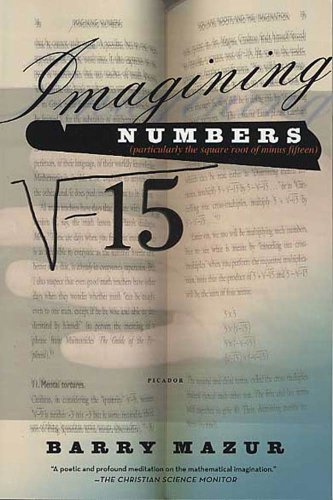
How the elusive imaginary number was first imagined, and how to imagine it yourselfImagining Numbers (particularly the square root of minus fifteen) is Barry Mazur’s invitation to those who take delight in the imaginative work of reading poetry, but may have no background in math, to make a leap of the imagination in mathematics. Imaginary numbers entered into mathematics in sixteenth-century Italy and were used with immediate success, but nevertheless presented an intriguing challenge to the imagination. It took more than two hundred years for mathematicians to discover a satisfactory way of “imagining” these numbers. With discussions about how we comprehend ideas both in poetry and in mathematics, Mazur reviews some of the writings of the earliest explorers of these elusive figures, such as Rafael Bombelli, an engineer who spent most of his life draining the swamps of Tuscany and who in his spare moments composed his great treatise “L’Algebra”. Mazur encourages his readers to share the early bafflement of these Renaissance thinkers. Then he shows us, step by step, how to begin imagining, ourselves, imaginary numbers.
User’s Reviews
Reviews from Amazon users which were colected at the time this book was published on the website:
⭐I have read a few math books, prime obsession most recently, and this book wasn’t technically very interesting, it also wasn’t fun to read either. There are some good parts at the very beginning and end but middle is incoherently dry. Basically I believe that in some ways the way the author was trying to thought provoking and intelectual is where it lost it’s was. Neither technical, historical, or fun enough you lost your audience
⭐This is the first book (I think) I bought from this book store; I am pleased with the condition of the book.
⭐Mr Mazur writes intelligently and well, but for me the book failed to live up to some of the other reviews and descriptions. Mathematicallly, there is reallly nothing new or startling here. Anyone familiar with analytic geometry will already have a pretty good idea of what the book is about. Otherwise I can’t comment.
⭐It’s a fascinating book. The concept of imaginary numbers and the fact that they have broad application in real life has always fascinated me and Mr. Mazur has an excellent style of writing and brings it to life.
⭐As advertised
⭐Good transaction
⭐The author notes that the aim of this book is not to provide an historical account of the development of imaginary numbers, but rather “recreate, in ourselves, the shift of mathematical thought that makes it possible to imagine these numbers.” The presentation used in this book to accomplish this aim involves a smattering of poetry throughout. Poetry involves shifts of thought and demands our paying attention to various turns. The book then passes back and forth between “reflections on the imaginative work of thinking about poetry and thinking about mathematics.”We try to understand some basic concepts first, such as square roots and the quadratic formula, before delving into the musings of Girolamo Cardano and his use of the square root of -1. Eventually, Cardano in his Ars Magna is forced to reckon with the square root of -15. These imaginary numbers were difficult to comprehend as half a century after a geometric rationale for imaginary numbers was discovered, they still baffled the mind. Another important figure comes onto the scene, and that is Rafael Bombelli of the 16th century and his important work L’Algebra. In this work, it seems Bombelli had trouble believing that square roots of negative numbers could exist. We are introduced to Dal Ferro’s formula, which was a solution to something called the depressed cubic, which is a simplification of the general cubic equation. In all of this, the author is tasked to “recreate the tension of imagination that yearns for a dissolution of that mistrust, and to experience the emergence of the viewpoint that enabled people to incorporate quantities like [the square root of minus one] in their work and to do this with mental ease rather that mental torture.”The author proceeds to explain to us the “complex number” and how the square root of minus one or “i” can be displayed on a cartesian coordinate system by using a ninety-degree rotation of the number line for these numbers. We learn about addition and multiplication in this new complex plane. We see how the Cartesian description makes addition easy while the polar description make multiplication easy. There is a connection between the underlying algebra of the complex numbers and their geometry. What I found interesting, was that the bridge between geometry and algebra took centuries to cohere spanning the time between two great mathematicians: Nicolas of Oresme (14th century) and Descartes (17th century). Many great mathematicians played a part in endeavoring to understand these strange numbers, such as De Moivre, Casper Wessel, Francais Viete, Jean-Robert Argand, Joseph Gergonne, among others.
⭐The author is trying to bridge the gap between the “two cultures” -scientific minded, and the literary minded. He is trying to target the literary camp in particular.He gently tries to introduce the reader to complex numbers by use of examples. We can ‘imagine’ positive integers, and we can imagine negative ones too. At least, we aren’t bothered by not really knowing them; we can find physical analogies for them.Mazur tries to do the same with imaginary numbers. I think he did an okay job. I can imagine adding them now, and multiplying them, and even taking their square roots. He does, however, stop short of raising a number to an imaginary exponent. The imagery is simply transformations on the plane.By reading this book, it is immediately apparent that the author has an encyclopedic knowledge. But, this is the problem however.He’s all over the place with analogies. We have drawings of cockroaches, passages about a particular tulip versus an idealized tulip, talks about Allah. None of it has anything to do with imaginary numbers, nor imagining them. Instead, these images are used to describe how ideas come into fruition. He tries to say something like, “hey ideas take time to bubble up into consciousness, we have traces of it in the atmosphere. Later, we can feel it and know it’s there. Finally we get a handle on it, and it becomes concrete.”Looking briefly through this book right now, I notice these irrelevant imageries don’t take much book space, but they are so oddly out of place, they take up a majority of my impression of the book.I can’t say this book is a complete waste of time. I enjoyed his explanation of the basics of algebra, and why we can’t divide by zero, and why a negative times a negative is a positive. In fact, it’s the best explanation I’ve read so far.Also, the history of the emergence of complex numbers is abbreviated, but informative. However, things are just watered down and lost by these crazy tulip analogies about how ideas become concrete. This book is so-so. I feel that if someone wants to know the history of imaginary numbers and how to think about them, they could probably find a better book.If there is a second edition, I think Barry should expand his bookkeeping example as an introduction to algebraic rules. Then cut to the chase, show us to grasp imaginary numbers, think of them as points on the plane, and operations on them as transformations and vector addition. He can later discuss how this mental model of imaginary numbers came to be, and these tulip images won’t stick out so sorely.This would be much like how people view a great painting or a magnificent edifice. Rarely is anyone privileged to see a magnificent work in progress. And those who do rarely grasp or appreciate the beauty that is forming before their eyes. Rather, after appreciating the final work, we then watch a documentary on how such and such a building was built.Barry would do better to follow this formula, instead of immersing us in a work in progress, and more-or-less, confusing his readers.Finally, I hope Barry uses his tremendous intellect to show how imaginary numbers relate in the day to day. And not via electrical engineering! Imaginary numbers are used in electricity, but since electricity is hare to grasp, real world examples using electricity would be confusing.What I’m getting at is this: We can find uses for negative numbers in the day to day: walk 3 north, 4 south, and you’ll be 1 south. Perhaps there is something quite simple for complex numbers too.If in succeeding with that last point, then we may not be so bothered by not grasping imaginary numbers, because we have a physical analogy of them, and then we can pretend to know what they are, just as we do the integers.
⭐.. Extremely redundant and stretched out; Could have been a 5 page article. Though it introduces ideas, not sure how many of them are unthought of by anyone who loves math at one point or the other.
⭐読んだ本が面白くないとき、あるいは部分的によくわからないとき、人は普通「この本は自分に合わなかった」と思う。しかし、時に表題と内容の著しい乖離や、読者の想定を間違えてはいないか、などと著者を責めたくなることがある。私のこの本の読後感想はどちらかというと後者に近い。本書は「想像するということ」に大きな重点を置き、そして、その対象の一つとして「数」があるということらしい。この本で最もよく目立つ言葉は「yellow of the tulip」である。「黄色い花のチューリップ」は簡単に想像できる。しかし、「チューリップという花における黄色それ自体をイマジンせよ」とはどういうことか、というプラトンのイデアみたいなことを論じている本である。そして、imagineということばから数学の対蹠にある「詩」の話が出てくる。なんとも変わった本である。本書の著者は数学の一般書としてかなりいい本を何冊も書いているので信用して買ったが、この本だけはまさにハズレであった。とはいえ、あちこちに煩わしく出てくる「詩」の話を全部無視して数学の部分だけ読んでいくと「この説明いいね!」という部分が出てくる。√―1(ルートマイナス1)の話になったとき、「正の数を乗ずることが数直線を拡大縮小する」と考えるとき、「-1をかけることは数直線を180度回転させる」と考えられる。だから、「2乗すると―1になる√-1を1回だけかける」ということは、「-1の半分の90度回転だ」という論理、代数を幾何で説明するという手法で複素数平面を持ち込む点は確かに「詩人」でもわかるだろう。数学の知識を増やしたい詩人、数学が好きで詩も大好きな人、そうした人が世間にたくさんいればきっと売れる本になるに違いないが、少なくとも私はそのいずれでもない。買おうか買うまいか思案している方で、「数学書」を買いたい方にはお勧めできない本である。
⭐
⭐畑村洋太郎「直感でわかる数学」を読んで、複素数の話が面白かったので、積ん読してあったこの本を引っ張り出して覗いてみました。 「直感で~」ではほとんど省かれていた、複素数と回転の関連性が初歩から丁寧に積み上げて説明してあり、「文系人間」としてはその点は満足できました。ポイントは、-1を掛けるという操作を回転として捉えられるかどうかで、そこさえクリアすれば複素数までまっしぐらなんですね。 ただし、全体の中で膨大な比率を占める詩的想像力の話題は、ハッキリ言って数学の大家らしい著者のハイブラウな趣味という印象で、少なくとも私には不必要と思えました。まあ、もっと数学に詳しかったら、詩と数学の類似・差異というテーマも楽しめたのかもしれませんが・・・ また著者が想定する読者レベルが「高卒程度」らしいのですが、これはアメリカの高卒でしょう。2次方程式の解の公式なんて、日本では中学生じゃなかったっけ。そのため、説明はチョー基本的なところから始まり、じれったい気持ちもありました。しかも、複素数に辿り着いて、それなりに親切な解説があったと思ったら、そこから先は細かい説明を省略しながらドンドン水準を上げていくので、ついていけない部分もありました。 訳文は全体に読みやすい印象ですが、人名のカタカナ表記でかなり疑問符つきのものがありました。ベンサムをベンタムとか、レイコフをラコフとか、これは意図的なものなんでしょうか。私が知らない名前についても同様の問題がありそうで、日本語で関連文献を調べたりするときのことを考えると、ちょっと心配です。
⭐
Keywords
Free Download Imagining Numbers: (particularly the square root of minus fifteen) in PDF format
Imagining Numbers: (particularly the square root of minus fifteen) PDF Free Download
Download Imagining Numbers: (particularly the square root of minus fifteen) 2004 PDF Free
Imagining Numbers: (particularly the square root of minus fifteen) 2004 PDF Free Download
Download Imagining Numbers: (particularly the square root of minus fifteen) PDF
Free Download Ebook Imagining Numbers: (particularly the square root of minus fifteen)