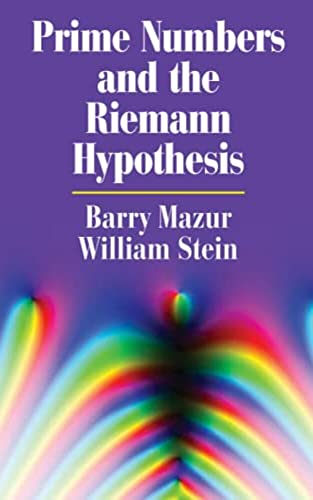
Ebook Info
- Published: 2022
- Number of pages: 186 pages
- Format: PDF
- File Size: 20.86 MB
- Authors: Barry Mazur
Description
Prime numbers are beautiful, mysterious, and beguiling mathematical objects. The mathematician Bernhard Riemann made a celebrated conjecture about primes in 1859, the so-called Riemann Hypothesis, which remains to be one of the most important unsolved problems in mathematics. Through the deep insights of the authors, this book introduces primes and explains the Riemann Hypothesis. Students with minimal mathematical background and scholars alike will enjoy this comprehensive discussion of primes. The first part of the book will inspire the curiosity of a general reader with an accessible explanation of the key ideas. The exposition of these ideas is generously illuminated by computational graphics that exhibit the key concepts and phenomena in enticing detail. Readers with more mathematical experience will then go deeper into the structure of primes and see how the Riemann Hypothesis relates to Fourier analysis using the vocabulary of spectra. Readers with a strong mathematical background will be able to connect these ideas to historical formulations of the Riemann Hypothesis.
User’s Reviews
Reviews from Amazon users which were colected at the time this book was published on the website:
⭐A couple of books on the Riemann hypothesis have appeared for the general public: Derbeshire 2003, Du Sautoiy 2003, Sabbagh 2003, Rockmore 2005, Watkins 2015, van der Veen and van der Craats 2015 and now Mazur-Stein 2016. More for mathematicians are Koblitz 1977, Edwards 2001, and Stopple 2003. From general expositions, one should also mention the paper of Conrey of 2003 which won the Conant prize for expository writing as well as a nice paper of Bombieri of 1992. Is this too much for the subject? No. A problem like the Riemann hypothesis can never be written too much about, especially if texts are written by experts. It is the open problems which drive mathematics. The Riemann hypothesis is the most urgent of all the open problems in math and like a good wine, the problem has become more valuable over time. What helped also is that since the time of Riemann, more and more connections with other fields of mathematics have emerged. The book of Veen-Craats and Mazur-Stein have emerged about at the same time. They are both small and well structured. Veen-Craats has been field tested with high school students and has focus mostly on the gorgeous Mangoldt explicit formula for the Chebychev prime distribution function, sometimes called the “music of the primes”. Mazur-Stein do it similarly, however stress more on the Riemann spectrum and go didactically rather gently into the mathematics of Fourier theory as well as the theory of distributions. The book is carefully typeset, has color prints and some computer code for Sage. While Veen-Craats has many nice exercises, an exercise of Mazur-Stein led me to abandon other things for a couple of weeks, since it was so captivating. So be careful! A student who has taken basic calculus courses, should be able to read it. By the way, except Sabagh’s book “Dr Riemann’s zeros”, which was written by a writer and journalist, the other books were created by professional mathematicians. The Mazur-Stein book has probably the best “street cred” among the RH books for the general audience: both have done important work in number theory, also related to zeta functions: Mazur’s name is on one of the grand generalizations of the Riemann zeta functions, the Artin-Mazur zeta function which has exploded into a major tool under the lead of Ruelle who made it into a tool of dynamical systems and statistical mechanics. Other generalizations of zeta functions are spectrally defined and abundant in studies of differential geometry of a geometric space, one of the simplest cases being the circle, where it is the Riemann zeta function. Even other generalizations appear in algebraic geometry related to Diophantine equations and modular forms, where both authors, Mazur and Stein are leading experts working on the interplay between the analytic, geometric and number theoretic aspects of these functions. Additionally, Stein is the architect of the Sage computer algebra system. What distinguishes the book from the others? First of all, it is refreshingly short, gorgeous, inspiring and the publisher also kept it affordable. And since it can keep you caught, be prepared to shelf any other plans you might have while reading.
⭐Prime Numbers and the Riemann Hypothesis by Barry Mazur and William Stein is a slender (142 pg.) book aimed at a varied audience of the mathematically curious. It is profusely illustrated, mainly with pictures of what the authors call the staircase of primes, a function that starts at zero and goes up by one each time a prime is encountered, though several recarpentried versions of the staircase also make the scene.The book is divided into 38 very short chapters, organized into four sections, with the first and longest section (chapters 1-24) aimed at readers without a calculus background. The second section demands a bit of calculus (not much!) and the third some Fourier analysis, while the fourth gets to the nitty-gritty of the zeta function.The figures and many of the calculations were done with Sage, a free mathware package developed by the second author, and made available to the eager experimenter.The first section has a lot of the lore primes that is accessible at the elementary level, and that is a great deal. How many consecutive primes, for example, are separated by two (3-5, 5-7, 41-43,…)? Nobody knows. How many are separated by an even number less than or equal to 246? That turns out to be known to be infinitely many.This isn’t a textbook, and doesn’t have problems, as such, but there are a few “you might try proving” suggestions. Here is the first one, a fairly good test of your basic algebra (or at least mine): A number of primes have the form 2^p – 1. Show that if p is not prime, then 2^p – 1 is composite (not prime). If that’s too tough, try this: How many pairs of consecutive primes are separated by an odd number? ;-)Along the way, we meet several different incarnations of the Riemann Hypothesis, the first one being: For any real number X the number of prime numbers less than X is approximately Li(X) and this approximation is essentially square root accurate. Here Li(X) is the log integral of X = Integral[(1/Log(t))dt, {t,0,X}]. (by Log we mean natural Log)Sections II and III of the book are devoted building up the apparatus needed to transform this statement into Riemann’s form, which looks superficially very different: All the non-trivial zeroes of the zeta function lie on the vertical line in the complex plain consisting of the complex numbers with real part 1/2. These zeroes are (1/2 plus or minus i*theta(i)) where the theta(i) comprise the spectrum of primes talked about in the earlier chapters.Despite a good deal of verbiage devoted to the subject in the earlier chapters, I was never quite clear on exactly how these values are calculated, though I think that they are the Fourier transform of some version of the staircase of primes. I’d just like an equation that said theta(i) = some expression.
⭐This is beautifully produced, very clear print with coloured photos and graphs. But the idea that the Riemann Hypothesis can be conveyed this way in 140 pages with a lot of spacing is foolish, I believe. I have led five maths departments, served on a national committee on maths and have a fellowship in it but I struggled to penetrate it fully. I am not sure it can be done this way. Derbyshire’s book is miles better, actually exciting. But there is a lot of numerical work here and that is a good idea. As a teacher I understand very well the difficulty of overcoming higher mathematical proofs like the Maxwell Equations, The Transcendence of e and pi but I think this little book fails, did not have a chance of success given its aims, despite the expertise of its authors.I will try it again but I will go back to Derbyshire’s more readily. The problem there was to convey in a graph of some kind the nature of the Zeta function with the complex numbers. Grasping the problem is the first problem. Everyone wants the chance to work on it fully, flat out for there is some structure to be discovered that is very illuminating, I sense.
⭐I found the considerations on the spectrum of the distribution of primes very useful. The theme is addressed by Fourier transform of distributions.
⭐The book contents are anyway excellent. One may read other reviews for comments on the same. This is a word for the publisher. Simply excellent print quality. Nowadays, one doesnt get color prints for semi-technical/technical books at this price. So kudos to Cambridge publishing in India!Solid quality, the book is a joy to hold. Great especially given the low price.Comparison to be made especially to Wiley Red Books, which gives absolutely the worst prints on newspaper quality paper for the “Eastern Edition” at similar prices as this book (Rs 700-1000).
⭐Il testo è troppo conciso, abbastanza esauriente ma non esaustivo, non aggiunge nulla di nuovo rispettonad altri testi analoghi, e costa troppo in rapporto a quanto fornito.Shall highly encourage the reader to explore more on this dense subject together with several mathematical techniques. Crisp and sharp this is a marvellous book on mathematics .
Keywords
Free Download Prime Numbers and the Riemann Hypothesis in PDF format
Prime Numbers and the Riemann Hypothesis PDF Free Download
Download Prime Numbers and the Riemann Hypothesis 2022 PDF Free
Prime Numbers and the Riemann Hypothesis 2022 PDF Free Download
Download Prime Numbers and the Riemann Hypothesis PDF
Free Download Ebook Prime Numbers and the Riemann Hypothesis