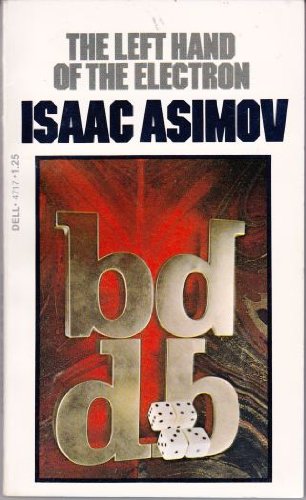
Ebook Info
- Published: 1974
- Number of pages:
- Format: PDF
- File Size: 0.91 MB
- Authors: ISAAC ASIMOV
Description
Science essays by a master.
User’s Reviews
Reviews from Amazon users which were colected at the time this book was published on the website:
⭐Very good explanation, for the dilettante, of left hand versus right hand organic molecules and the history of how science figured it out. Good explanation of several other science topics and their history as well. However, his discussion of the population bomb tended to stray into the pop culture science of the 1970 era so it was highly dated. This book certainly changed my mind from thinking that Asimov was just a science fiction writer. In fact I am leaning towards thinking his non-fiction books were better than his fiction. My next purchase of Amazon used books is going to be Asimov’s book on Shakespeare.
⭐Brilliant read! Asimov is a master at explaining complex concepts! The paperback is in excellent condition!
⭐Isaac Asimov distinguished himself as both a fiction and nonfiction writer.Along with Robert Heinlein and Arthur C. Clarke Asimov was considered one of science fiction’s Big Three.In this nonfiction book Asimov displays his skill as a writer and erudition when he talks about chirality, oceans, non Euclidean mathematics, the nature of genius and his views on the then current concern regarding the explosion of the human population.Chirality refers to the handedness of atoms. If you were to have super good vision and could see and atom you would notice that some atoms could oriented to look just like their mirror image. You would also notice that some atoms could not be oriented that way.It’s a little like if you wrote a series of letters on a sheet of paper and held them up to a mirror. O I and T would all look like their mirror image while S Q and B would not. In this case we would call S Q and B chiral because they lack mirror symmetry.Surprising as it may seem life on Earth has this chiral property to it. Our DNA has a left handed bent. One way to know we’d truly encountered an alien form would be if its DNA were right handed.In his sections on chirality Asimov admirably describes the then existing state of knowledge and how scientists discovered that knowledge. Interested readers may wish to follow this book with Lucifer’s Legacy, a more recent entry on chirality to discover more current developments in this field.However all readers will still be served by the clarity of Asimov’s account. They’ll also be served by the clarity of Asimov’s account on oceans as well. In these sections Asimov discusses the properties of H2O and why Earth water is so conducive to life. However he also discusses other hydrogen based liquids like methane and the various temperatures where they’re liquid, solid and gaseous and how these characteristics would play out in terms of them being the solution in which life emerges.His section on non Euclidean math is also very informative. In it Asimov goes back to the basics by discussing the estimable Euclid’s Elements, a book which revolutionized mathematics some thousand years ago. In discussing Euclid’s assertion that parallel lines never meet Asimov picks at a loose mathematical string that so helped revolutionize modern mathematics. In confronting the flaws of just assuming a thing because it seems logical Asimov points to a richer fuller appreciation of nature and reality that emerges when even basic assumptions are questioned.Readers wishing to follow up on this section would be well served by that great book Chaos Coincidence and All That Math Jazz. Really motivated readers could try Roger Penrose’s Road to Reality. Either way they are still very well served by Asimov’s introductory thoughts as outlined in his non Euclidean sections.As a member of Mensa, an organization of high IQ individuals, Asimov also brings unique insight into his discussion of the nature of genius. Though his thoughts could be taken as an attempt at pop psychology I think they’re much better read as just helpful suggestions from a master.The one arguably sour note in this book comes with Asimov’s discussion of the population problem. In it Asimov suggested law would come into play forcing countries to require their citizens to limit the number of children they would have. Though Asimov’s thoughts can read as being very dated I found them to be interesting as well.It is interesting how even the best among us may misinterpret trends or evidence and allow their thinking to go off on a track which the happenstance of history fails to confirm. Inadvertantly Asimov’s section on population sets the stage for interested readers to other thinking and contemplation. Here my book recommendation would be Thomas Kuhn’s The Structure of Scientific Revolutions. In that book Kuhn touches on some of the issues I openly touched on here and like I said Asimov sort of obliquely touched on by way of illustration.This is a very good, thought provoking book and I hope anyone who reads it based on my suggestion enjoys their experience with it.
⭐For people interested in science and varieties of related issues, I’d recommend this book by Isaac Asimov. The title is highly deceptive, in that it suggests a book about electrons. Discussions of electrons comprise only a small segment of the book. Numerous other essays are found throughout the book — including an essay on the problem of human overpopulation.As for this reader — a devout theist — Asimov’s skepticism about anything spiritual or divine is somewhat of a turn-off. However, the man wrote brilliantly, and his very impressive knowledge of the sciences (as well as knowledge in general) renders his books highly informative.All in all, this book is not at all a bad one to read, if one likes science or mathematics, or simply likes to read what an engaging and prolific author has to say about our wondrous world.
⭐I First read this book in 1980 or there abouts. I have been an Asimov fan since high school (early 60’s – you do the math!) and picked it up on a whim as I was a fan of his science fiction. I rapidly became a fan of his non fiction as well including his Guide to the Bible and Understanding Physics. Asimov writes clearly so that even the most science averse (me for example) person can understand and grasp the fundimentals. A book well worth the effort, the price and a treasure to be had.
⭐If you’re interested in some of Science’s most fascinating secrets, or if you’re just interested to learn more about modern science, or even if you are just looking for an interesting book to read – this title is the one you need to look for! Isaac Asimov can tell you, wether it’s a matter of science, art, or human affairs, the Good Doctor has the answer for you. And it will be the right answer, told in a way that is complete, understandable, and funny. Some of the problems presented in the book are: The problem of Left and Right, The problem of Oceans, The problem of numbers and lines, The problem of the Platypus, The problem of History, The problem of population.
⭐what I wanted..
⭐If you’re an Asimov fan you’ll know what to expect. He simply doesn’t fall short of excellent.
Keywords
Free Download The Left Hand of the Electron in PDF format
The Left Hand of the Electron PDF Free Download
Download The Left Hand of the Electron 1974 PDF Free
The Left Hand of the Electron 1974 PDF Free Download
Download The Left Hand of the Electron PDF
Free Download Ebook The Left Hand of the Electron