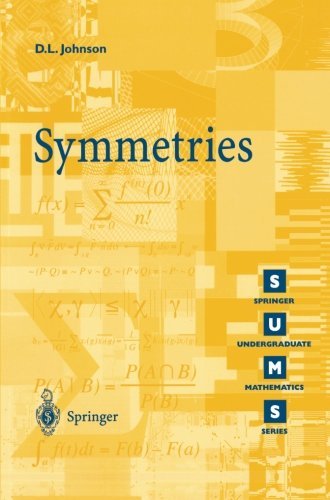
Ebook Info
- Published: 2004
- Number of pages: 216 pages
- Format: PDF
- File Size: 14.01 MB
- Authors: D.L. Johnson
Description
… many eminent scholars, endowed with great geometric talent, make a point of never disclosing the simple and direct ideas that guided them, subordinating their elegant results to abstract general theories which often have no application outside the particular case in question. Geometry was becoming a study of algebraic, differential or partial differential equations, thus losing all the charm that comes from its being an art. H. Lebesgue, Ler;ons sur les Constructions Geometriques, Gauthier Villars, Paris, 1949. This book is based on lecture courses given to final-year students at the Uni versity of Nottingham and to M.Sc. students at the University of the West Indies in an attempt to reverse the process of expurgation of the geometry component from the mathematics curricula of universities. This erosion is in sharp contrast to the situation in research mathematics, where the ideas and methods of geometry enjoy ever-increasing influence and importance. In the other direction, more modern ideas have made a forceful and beneficial impact on the geometry of the ancients in many areas. Thus trigonometry has vastly clarified our concept of angle, calculus has revolutionised the study of plane curves, and group theory has become the language of symmetry.
User’s Reviews
Reviews from Amazon users which were colected at the time this book was published on the website:
⭐This book has its good and bad together. First the good:It is correctly titled. That is not meant as a back handed complement, but sincerely. Too many books have a misleading title,and it will lure you into buying a book you really didn’t want. (We’ve all been there).By that, I also mean that it delivers what it promises. You get a mathematical treatise on symmetry and enough information in there to use it, provided you already know group theory. As an added benefit the author also uses some humor along the way in what is usually considered a very dry subject matter, so that’s another plus in favor of the book. Also, there’s a very nice index of mathematical notation at the end of the book which I used frequently.Where the book fails is on a few accounts: It just isn’t beefy enough. It’s too sketchy due to the lack of explanation. So, you’ll get the information you want on mathematical symmetry, but the highly concentrated version, proof after proof after proof.So, the prime complain is the light explanations. The book could easily have double the pages to make everything more concrete in the reader’s mind. Other books on this subject matter have a “walk-through” style of writing. They take a known geometrical object, and analyze it using group theory. This book keeps it mostly abstract. Even the Wikipedia page gives you a walk-through on the symmetry of the square, and I found myself repeatedly referring to Wikipedia for more in-depth explanations of material the book was lacking. When I was reading about isomorphisms in a different book, that writer provided side-by-side tables of two different isomorphic groups, and the idea of an isomorphism was something very easy. That’s the kind of writing that should have been in this book, but wasn’t.My other complaint is that no where does it say that you need to already know abstract algebra in order to understand this symmetry book. Well it does on the back cover in an off-hand way, when it says its for people that are in their second or third years of a mathematics undergraduate course. I’d rather that they spell it out: You must already know group theory for this book to be useful (despite the crash course in this book). Also, another problem is that the drawings could be better. You get a few drawings, but they don’t spell out what’s going on. Like figure 4.1. Where are the arrows showing where the point P gets mapped to? Then in the coverage of Platonic solids, why not show an icosahedron or a dodecahedron? Not everyone knows what they look like already.So, overall, I have to give the book 3 stars. It somewhat succeeds in what it sets out to do, but lacks all the explanatory prose you’d expect out of a book (a textbook no less). If you’re doing self-study then Symmetry by Roy McWeeny (kind of old, but still good), or maybe the Armstrong book would be good choices. They cover the material with a lot of prose, pictures, walk-through examples. Unfortunately, the DL Johnson book comes across as a lecture put to paper.
⭐good
⭐
Keywords
Free Download Symmetries (Springer Undergraduate Mathematics Series) in PDF format
Symmetries (Springer Undergraduate Mathematics Series) PDF Free Download
Download Symmetries (Springer Undergraduate Mathematics Series) 2004 PDF Free
Symmetries (Springer Undergraduate Mathematics Series) 2004 PDF Free Download
Download Symmetries (Springer Undergraduate Mathematics Series) PDF
Free Download Ebook Symmetries (Springer Undergraduate Mathematics Series)