

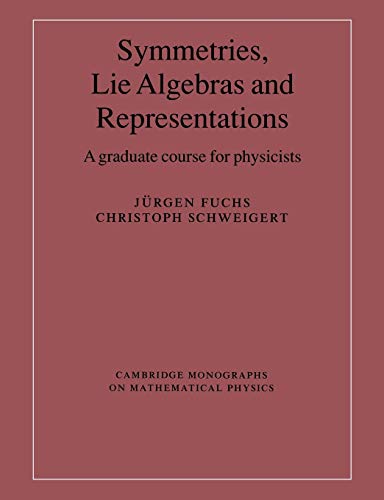
Ebook Info
- Published: 2003
- Number of pages: 464 pages
- Format: PDF
- File Size: 40.51 MB
- Authors: Jürgen Fuchs
Description
This is an introduction to Lie algebras and their applications in physics. The first three chapters show how Lie algebras arise naturally from symmetries of physical systems and illustrate through examples much of their general structure. Chapters 4 to 13 give a detailed introduction to Lie algebras and their representations, covering the Cartan-Weyl basis, simple and affine Lie algebras, real forms and Lie groups, the Weyl group, automorphisms, loop algebras and highest weight representations. Chapters 14 to 22 cover specific further topics, such as Verma modules, Casimirs, tensor products and Clebsch-Gordan coefficients, invariant tensors, subalgebras and branching rules, Young tableaux, spinors, Clifford algebras and supersymmetry, representations on function spaces, and Hopf algebras and representation rings. A detailed reference list is provided, and many exercises and examples throughout the book illustrate the use of Lie algebras in real physical problems. The text is written at a level accessible to graduate students, but will also provide a comprehensive reference for researchers.
User’s Reviews
Editorial Reviews: Review ‘One finds a striking wealth of material in this book … The reviewer wholeheartedly recommends this text to graduate students as well as to researchers in theoretical physics and related areas.’ Acta. Sci. Math’The presentation of material is next to perfect, … this book may be considered as an excellent textbook … I agree with the authors that ‘many readers will even use it as a reference tool for their whole professional life’.’ Vladimir D. Ivashchuk, General Relativity and Gravitation Book Description A graduate level introduction to Lie algebras and their applications in physics.
Reviews from Amazon users which were colected at the time this book was published on the website:
⭐Lie groups and Lie algebras permeate most parts of theoretical physics. Every student in physics should have some basic notions of the subject as it sometimes tends to have unsuspected applications.The first three chapters of this book include exemples and motivation for the more formal aspect of the Lie theory. Those are also meant to set the notation used later throughout the book. Topics covered should be well-known from a senior undergraduate student with a good background in quantum mechanics (harmonic oscillator, the rotation group) and particle physics (mostly the “zoological” part of it : classification of particles, the eightfold way and so on).From chapter 4 on, the Maths definitely take the most prominent part of the stage. Chapter 4 is a reminder of basic notions in algebra, as covered in an undergraduate course in algebra and classical groups.Chapter 5, on representation, should not be a challenge to the physicist.The core of the subject is presented in chapter 6, where the idea of the Cartan-Weyl basis is given a nice presentation. This chapter is a little bit more demanding. Some statements are not proved. However, a committed student in physics, should be able to devise proofs for him/herself.Chapter 7 is particularly enjoyable, dealing with Dynkin diagrams and the classification of finite simple Lie algebras, and introducing infinite dimensional ones. The way Kac-Moody algebras appear, through relaxing the axioms of the Chevalley-Serre construction should be appreciated. Also, physical exemples are to the point.However, beginning with chapter 12, the wrongs of this book become somewhat annoying. For instance, in chapter 12, the authors of this book freely speak of Verma modules, highest weight representations, while these concepts are to be introduced and properly developped in later chapters. I found this chaffing from an introductory book. From chapter 12, it seems that the reader is to gently follow and accept the statements made by the author, without encountering much proof or hint to this all.Things come more acceptable in later chapters only, where invariant tensors and other things more familiar from a physicist with no previous acquaintance to Lie algebras, are exposed.All in all, a good book for some parts of it but whose value could have surely been enhanced by adopting a more pedagogical presentations. Some proofs to key facts in the more “exotic subjects”, would have been welcome, too. All the more, that some chapters of this book did not require much work from the authors, as it seems that they were taken from Dr. Fuchs “Affine Lie algebras”.Hopefully, welcome additions will be added to a further edition.Beginners or readers with a casual interest in Lie algebras should better learn it from another source.
⭐
⭐
⭐
⭐
Keywords
Free Download Symmetries, Lie Algebras and Representations: A Graduate Course for Physicists (Cambridge Monographs on Mathematical Physics) in PDF format
Symmetries, Lie Algebras and Representations: A Graduate Course for Physicists (Cambridge Monographs on Mathematical Physics) PDF Free Download
Download Symmetries, Lie Algebras and Representations: A Graduate Course for Physicists (Cambridge Monographs on Mathematical Physics) 2003 PDF Free
Symmetries, Lie Algebras and Representations: A Graduate Course for Physicists (Cambridge Monographs on Mathematical Physics) 2003 PDF Free Download
Download Symmetries, Lie Algebras and Representations: A Graduate Course for Physicists (Cambridge Monographs on Mathematical Physics) PDF
Free Download Ebook Symmetries, Lie Algebras and Representations: A Graduate Course for Physicists (Cambridge Monographs on Mathematical Physics)