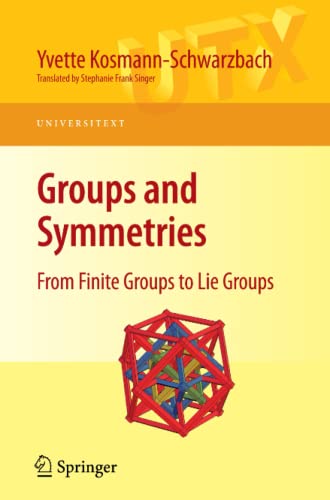
Ebook Info
- Published: 2010
- Number of pages: 212 pages
- Format: PDF
- File Size: 1.91 MB
- Authors: Yvette Kosmann-Schwarzbach
Description
– Combines material from many areas of mathematics, including algebra, geometry, and analysis, so students see connections between these areas- Applies material to physics so students appreciate the applications of abstract mathematics- Assumes only linear algebra and calculus, making an advanced subject accessible to undergraduates- Includes 142 exercises, many with hints or complete solutions, so text may be used in the classroom or for self study
User’s Reviews
Editorial Reviews: Review From the reviews:“Groups and Symmetriesis a short, concise book … that provides an introduction to the subject of Lie Groups, Lie Algebras, their representations, and their uses in theoretical particle physics. … Anyone interested in understanding the connection between quarks and representation theory is an expeditious fashion should read this book. … at the end of each chapter, Groups and Symmetries has a helpful reference section that provides readers with historical comments and additional references to the topics covered.” (Thomas R. Hagedorn, The Mathematical Association of America, April, 2010)“This book by Kosmann-Schwarzbach (École Polytechnique, France) also starts with the basics but rapidly moves on to enrich group theory with notions from topology, analysis, and (multi) linear algebra. Surely one finds many monographs on Lie groups for students on the way to specializing. … Summing Up: Recommended. Upper-division undergraduates, graduate students, and professionals.” (D. V. Feldman, Choice, Vol. 47 (11), July, 2010)“This book gives a gentle introduction to the theory of group representations and its applications in quantum mechanics. … This book is well written and is well suited for a course aimed at advanced undergraduates and early graduate students.” (Aloysius Helminck, Mathematical Reviews, Issue 2011 g)“The author gives a very clear and comprehensible introduction to the representation theory of groups focussing in particular on Lie groups. … A series of nine problems and solutions completes this well thought-out and well organized book, which can be recommended already to advanced undergraduates.” (G. Kowol, Monatshefte für Mathematik, Vol. 164 (2), October, 2011) From the Back Cover Unlike many other texts, this book deals with the theory of representations of finite groups, compact groups, linear Lie groups and their Lie algebras, concisely and in one volume.Key Topics:• Brisk review of the basic definitions of group theory, with examples• Representation theory of finite groups: character theory• Representations of compact groups using the Haar measure• Lie algebras and linear Lie groups• Detailed study of SO(3) and SU(2), and their representations• Spherical harmonics• Representations of SU(3), roots and weights, with quark theory as a consequence of the mathematical properties of this symmetry groupThis book is illustrated with portraits and a few historical remarks. With only linear algebra and calculus as prerequisites, Groups and Symmetries: From Finite Groups to Lie Groups is accessible to advanced undergraduates in mathematics and physics, and will still be of interest to beginning graduate students. Exercises for each chapter and a collection of problems with complete solutions make this an ideal text for the classroom and for independent study. About the Author A former student of the École Normale Supérieure, Yvette Kosmann-Schwarzbach holds a Doctorat d’État in mathematics as well as a degree in physics from the University of Paris. She has been a professor of mathematics at the University of Lille, at Brooklyn College of the City University of New York, and most recently at the École Polytechnique (France). She has organized numerous conferences, and has held visiting positions and lectured on four continents.The author of the forthcoming historical study, The Noether Theorems. Invariance and Conservation Laws in the Twentieth Century (Sources and Studies in the History of Mathematics and Physical Sciences), she has published some 70 research articles in differential geometry, algebra and mathematical physics, and has also co-edited The Verdier Memorial Conference on Integrable Systems (Progress in Mathematics), Integrability of Nonlinear Systems (Lecture Notes in Physics) and Discrete Integrable Systems (Lecture Notes in Physics). Read more
Reviews from Amazon users which were colected at the time this book was published on the website:
⭐be forewarned that this very concise book is not an easy read, except for someone with a very solid background in abstract and advanced linear algebra. It deserves 5 stars for the lucidity of the mathematical presentation, but I deducted 1 star as a heads up because despite its claim to be aimed at advanced undergraduates / beginning graduates in math *or* physics, I think the book would be tough going for many readers who fit that description. As a math-degree-less autodidact, I found the book very challenging in places. To be fair, I found Chapter 2, Representations of Finite Groups, the most difficult chapter, and this no doubt colored my perception of the book as a whole. So if you can power through that chapter, you might well find the rest fairly smooth sailing.One major plus is that there are a large number of problems and complete solutions (pp 129 – 183).For me, the most outstanding feature — and the reason I read the book – is that it explains in very clear, mathematically rigorous terms the basic group-theoretic math behind the standard model of elementary particle physics. If you make it through to the end, then you’ll come to understand in a mere 100 pages, what, mathematically speaking, the Eightfold Way and quarks really are! This is quite an accomplishment. I have not found any other introductory book that does this except Frankel’s
⭐, which, although a superb book for self-study, is a very long read. There are also a number of well-written books aimed at physicists like Sternberg’s
⭐or Ramond’s
⭐that deal with the topic in some detail and are well worth studying, but no introductory book on the standard model I’ve consulted, e.g., Griffiths’
⭐, even attempts to address the issue. (If you know of one that does, please leave me a comment informing me.)In sum, this is a very clear but ultra-concise exposition of the essential mathematics needed to understand mathematically what those diagrams of representations of groups you see in physics books on the standard model really mean. But if you’re not 100% comfortable with very condensed mathematical presentations, this book is probably not the right first book._________________P.S. If you’d like a succinct but clear introduction to the more basic mathematics used in this text or e.g. in Robinson’s exceptionally well written but more informal
⭐, check out Tapp’s
⭐or Stillwell’s
⭐.
⭐It is hard to know who this book is intended for. It is certainly not the right place to start if you know nothing about representation theory. Very few results are derived completely and the beginner will simply be confused. If on the other hand you do know something about representation theory, then you will probably learn nothing from this book. It is the sort of book that Math professors who have only looked at the table of contents recommend. If you are really just beginning and can put up with Zee’s somewhat irritating style then maybe Group Theory in a Nutshell is for you. It is written from a physicists perspective and will get you to the good stuff on gauge theories and unification. But be warned the style is not for everyone.If you really want to understand the theory of finite groups then try Steinberg’s Representation Theory of Finite Groups which will take you from basic linear algebra to a good basic understanding.As a next step you might then want to move on to Hall’s Lie Groups, Lie Algebras and Representations which is a notch up in difficulty but well worth the effort.
Keywords
Free Download Groups and Symmetries: From Finite Groups to Lie Groups (Universitext) 2010th Edition in PDF format
Groups and Symmetries: From Finite Groups to Lie Groups (Universitext) 2010th Edition PDF Free Download
Download Groups and Symmetries: From Finite Groups to Lie Groups (Universitext) 2010th Edition 2010 PDF Free
Groups and Symmetries: From Finite Groups to Lie Groups (Universitext) 2010th Edition 2010 PDF Free Download
Download Groups and Symmetries: From Finite Groups to Lie Groups (Universitext) 2010th Edition PDF
Free Download Ebook Groups and Symmetries: From Finite Groups to Lie Groups (Universitext) 2010th Edition