

Ebook Info
- Published: 2006
- Number of pages: 440 pages
- Format: PDF
- File Size: 3.11 MB
- Authors: Jeremy Black
Description
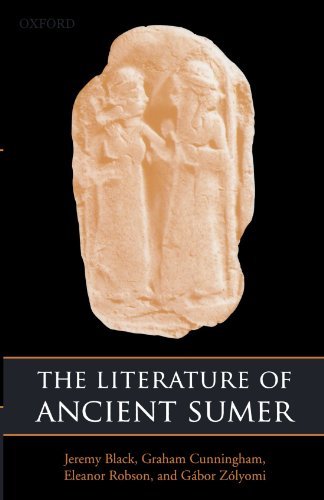
This anthology of Sumerian literature constitutes the most comprehensive collection ever published, and includes examples of most of the different types of composition written in the language, from narrative myths and lyrical hymns to proverbs and love poetry. The translations have benefited both from the work of many scholars and from our ever-increasing understanding of Sumerian. In addition to reflecting the advances made by modern scholarship, the translations are written in clear, accessible English. An extensive introduction discusses the literary qualities of the works, the people who created and copied them in ancient Iraq, and how the study of Sumerian literature has evolved over the last 150 years.
User’s Reviews
Reviews from Amazon users which were colected at the time this book was published on the website:
⭐Most of us can only buy this book second hand because a new one costs lots of money. It’s not like Oxford University is struggling financially and I don’t know how students can afford books like this on top of all their other expenses. If they want to make the Sumerian works accessable to the public then they should make the price more reasonable. I’m taking off one star just because of the price of it.The reason I brought this book is because I don’t like reading lots of things on the computer screen and the introduction at the beginning of this book and the introductions before each translation makes it easier to understand them. The website […] has all the translations listed in this book and more, but the book version will give you a better understanding of the translations. The introductions will give you a description of what each tablet is about and the important parts of it. I have read the Nag Hammadi Library by James M. Robinson and that book had introductions before the translations as well and I’m used to fragmentary texts with lots of lines and words missing. The Nag Hammadi Library is a lot more fragmentary than The Literature of Ancient Sumer so this book is easier to read. This book contains a fifth of the translated tablets and they have selected the most interesting ones to include in this book. They left out the mundane things, although they are important to understanding the Sumerian civilization and the fragmentary tablets have been left out as well.These translations are grouped by themes, the deities and other things like the function they served. They aren’t grouped according to modern or ancient systems of classification.There’s a common misconception that The Epic of Gilgamesh was part of the Sumerian texts, but that was the final Babylonian version written sometime from 1000 to 1300 BC. This book has the first flood myth written down, unfortunately two thirds of it is missing. The Epic of Gilgamesh isn’t in this book, but you can read it on the Internet. The flood survivor is called King ZiudsuraThis book is good because it’s the first literature written and it’s interesting to read the writings of such an old civilization. Everyone’s familar with the Bible, but these writings came 2000 years before the birth of Jesus. Imagine you lived in a time period where you had no idea of Christianity, Rome, Greece, the Western world etc. Imagine you lived in a world that was on the borderline of prehistory. This book will give you a glimpse into this murky and forgotten world.
⭐This seems to be the best available recent introduction to Sumerian literature, but it’s seriously flawed. Kramer’s work doesn’t benefit from recent scholarship, but this work suffers from current ideology. Sometimes this is merely annoying, when the editors use “B.C.E.” rather than the traditional “B.C.,” or waste time discussing an example of modern poetry. Sometimes it’s critical, however: Their modernity seems to prevent them from explaining what is (or isn’t) known about the rules of Sumerian versification [location 159]. Ideology is also explicitly used as an excuse for dodging the most interesting question in the origins of civilization: Where did the ancestors of the Sumerian-speaking people come from? [location 631]About the Kindle Edition:Like most Kindle editions, this hasn’t been checked by a human. Basic functionality is incorrect, e.g., the table of contents links are slightly wrong: The very first leaf node, for instance, for “The literature of ancient Sumer,” actually brings you to the previous page, “Introduction.” No-one even checked the beginning of the book: The second page contains merely a repetition of the title, which may make sense in a dead-tree edition, but not an electronic one.Sometimes the behavior was even worse. I had repeated trouble and delays in navigation, which eventually crashed the book-reader application and deleted all my notes.Casual sloppiness abounds, though most of my examples were lost in the crash. I found one more example in the table of contents: a footer (“VII CONTENTS”) appears in the middle of a page [location 32].The illustrations weren’t checked either. The very first, “Map of Sumer,” is both smaller than necessary, and unreadable.
⭐Greatest respect and gratitude to all the archaeologists and scholars who bring this literature to light.However, I have the impression that the translations and, even more so, the organization of the material reflect deep retrojection bias typical of the Euro-American tradition.Accordingly, I take with a grain of salt certain aspects of the commentary aimed at placing the texts into the framework typical of that biased tradition and draw my own conclusions instead.Fair enough, nothing is perfect.
⭐This is a great contribution for people who want to learn about the Sumerian culture and their literature. It comprises many categories of writing. The translations are not especially pleasant to read, as the translators in this language have to spend their entire energy on presenting what is plausibly accurate. My only sorrow was that I paid $55, but I have become accepting as I realize that this represents so much work by such great scholars.
⭐All was Great! It arrived in good condition and speedily. I will very much enjoy this work as I prepare to write my novel.
⭐If you are interested in Sumer then this book is brilliant from the clear and detailed introduction to the rendition of the various poems (hymns) in prose.Some 360 pages long in about A5 size it covers just about every well known Sumerian ‘poem’ that I am aware off – which isn’t saying a lot really. I particularly like “Inana’s descent into the underworld”. As with other poems the book gives you a page or so of explanation before the poem itself which helps set the scene. With this one and a couple of others I have a spoken word CD which really sets the thing off.Not sure what else I can say really, impressive – only down side is the stupid use of B.C.E., only to be expected though as this version was published in America.
⭐Très bon livre mais qui s’adresse à des “clients initiés” , pas vraiment grand public mais ceci dit même pour découvrir la litt assyro-babylonienne pourquoi pas
⭐
Keywords
Free Download The Literature of Ancient Sumer 1st Edition in PDF format
The Literature of Ancient Sumer 1st Edition PDF Free Download
Download The Literature of Ancient Sumer 1st Edition 2006 PDF Free
The Literature of Ancient Sumer 1st Edition 2006 PDF Free Download
Download The Literature of Ancient Sumer 1st Edition PDF
Free Download Ebook The Literature of Ancient Sumer 1st Edition