

Ebook Info
- Published: 2002
- Number of pages: 382 pages
- Format: PDF
- File Size: 5.98 MB
- Authors: Lane A. Hemaspaandra
Description
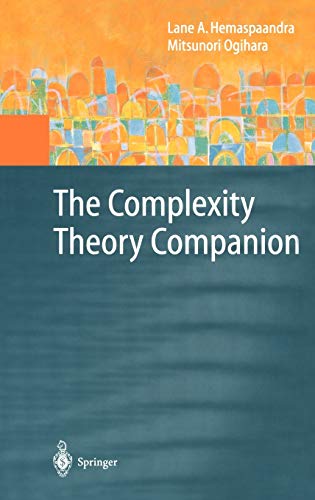
Here is an accessible, algorithmically oriented guide to some of the most interesting techniques of complexity theory. The book shows that simple algorithms are at the heart of complexity theory. The book is organized by technique rather than by topic. Each chapter focuses on one technique: what it is, and what results and applications it yields.
User’s Reviews
Editorial Reviews: Review From the reviews of the first edition:”The introduction … begins with two secrets: that algorithms are at the heart of complexity theory, and moreover that simple algorithms are at the heart of complexity theory. The main body of the book then proceeds to try and illustrate this view. … While all the chapters primarily deal with a succession of theorems, lemmas and proofs, the surrounding text makes it fairly accessible and readable. … The appendices are very well laid out and could probably replace a small library of textbooks.” (A. Weaver, Journal of the Operational Research Society, Vol. 54, 2004)”The book is intended for readers who seek an accessible, algorithmically oriented research-centered, up-to-date guide to several interesting techniques of computational complexity. In contrast to the organization of other books, each chapter of this book focuses on one particular technique in complexity theory. … The book contains two appendices, the first presenting a concise overview on complexity classes, the second one on reductions. The book presents a survey on a great variety of recent interesting techniques in complexity.” (Ludwig Staiger, Zentralblatt MATH, Vol. 993, 2002) From the Back Cover The Complexity Theory Companion is an accessible, algorithmically oriented, research-centered, up-to-date guide to some of the most interesting techniques of complexity theory.The book’s thesis is that simple algorithms are at the heart of complexity theory. From the tree-pruning and interval-pruning algorithms that shape the first chapter to the query simulation procedures that dominate the last chapter, the central proof methods of the book are algorithmic. And to more clearly highlight the role of algorithmic techniques in complexity theory, the book is – unlike other texts on complexity – organized by technique rather than by topic. Each chapter of this book focuses on one technique: what it is, and what results and applications it yields.This textbook was developed at the University of Rochester in courses given to graduate students and advanced undergraduates. Researchers also will find this book a valuable source of reference due to the comprehensive bibliography of close to five hundred entries, the thirty-five page subject index, and the appendices giving overviews of complexity classes and reductions.
Reviews from Amazon users which were colected at the time this book was published on the website:
⭐It’s a great book! Besides a couple of minor dents (barely noticeable), it looks new! Was pleasantly surprised to see it was hardcover too!
⭐The aim of this book is to introduce complexity theory using a more technique-oriented approach, which is not seen in other complexity theory textbooks. Techniques covered are:- self-reducibility- one-way function- tournament divide and conquer- isolation technique (aka. isolation lemma)- witness reduction- polynomial interpolation- nonsolvable group (used in Barrington’s theorem to show that width-five branching program can simulate any Boolean formula and thus the complexity class NC1)- random restriction technique- polynomial techniqueThis seems like an awesome approach and I couldn’t agree with the authors more about the organization. In fact, this was the reason why I bought the book.Unfortunately, the results are badly presented in a lot of places. Proofs are extremely tedious with unnecessary details and notations. This overly formal approach prevents the reader from seeing the big strategy or idea behind each proof. For example, Barrington’s theorem has a very elegant and readable 1-page proof (cf. Boppana-Sipser survey “The Complexity of Finite Functions”, 1989). But I couldn’t understand why they decided to include an ugly 6-page proof in this book!The students will learn more from “Computational Complexity” by Arora and Barak, where only the most elegant and readable versions of proofs are selected. Papadimitriou does not cover recent results, but is also a solid textbook with full of excellent exercises.
⭐
Keywords
Free Download The Complexity Theory Companion 2002nd Edition in PDF format
The Complexity Theory Companion 2002nd Edition PDF Free Download
Download The Complexity Theory Companion 2002nd Edition 2002 PDF Free
The Complexity Theory Companion 2002nd Edition 2002 PDF Free Download
Download The Complexity Theory Companion 2002nd Edition PDF
Free Download Ebook The Complexity Theory Companion 2002nd Edition