

Ebook Info
- Published: 2013
- Number of pages: 207 pages
- Format: PDF
- File Size: 9.17 MB
- Authors: Steven Homer
Description
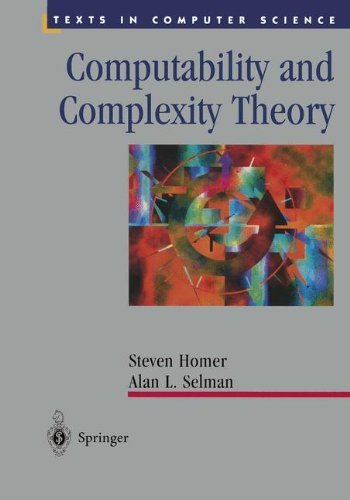
Intended for use in an introductory graduate course in theoretical computer science, this text contains material that should be core knowledge in the theory of computation for all graduates in computer science. It is self-contained and is best suited for a one semester course. The text starts with classical computability theory which forms the basis for complexity theory. This has the pedagogical advantage that students learn a qualitative subject before advancing to a quantitative one. Since this is a graduate course, students should have some knowledge of such topics as automata theory, formal languages, computability theory, or complexity theory.
User’s Reviews
Reviews from Amazon users which were colected at the time this book was published on the website:
⭐This book is dense, in the sense that there is a lot of information explained using very few words, which means you have to do some thinking to get anything out of it. You have to make sure you have a firm grasp on each concept before you go on, because they just keep building on each other. There’s nothing necessarily bad about the book; but for the purpose of the class that I read the book for, it could have offered a little more by way of explanation and reminders, to help the student learn and understand what it was talking about.
⭐I found this one disapointing. For example, they do a nice job very carefully and clearly distinguishing “decidable” and “acceptable” languages. Then they talk about languages Turing machines “recognize” without saying if these are acceptable or decidable or what. This kind of thing is frustrating. That said, I did learn things from this book. Many things are well covered. But if you buy one book, buy Sipser instead.
⭐There is zero formatting in this text – it looks like its just popped right out of latex and it is hard to read. Variables are defined early on in the book and then referenced 50 pages later and you have no idea what they are talking about. The overall organization is horrible and the writing is horrible. I ask that you don’t buy it new if you need it for school simply because you’ll regret supporting the author for this terrible thing.
⭐Because of the price I bought a used book. The new book costs $90 and this used-like new one costs only $9. It’s really like new and I’m very satisfied with that.
⭐Excellent!
⭐It’s rather disappointing that many universities use this textbook in courses on the subject matter. While it does cover some inseresting and important things, in general the book is terribly written. The back cover states that this text assumes no prerequisites – nothing could be further from the truth. The first chapter purports to provides all prerequisites needed, but it is poorly done and insufficient. Both the first chapter and all subsequent chapters make use of mathematical and computational symbols and terminology that are not explained. Even if you’re generally familiar with them, you’ll still have to look up the exact definitions in another book. Most of the text in the book is written in a terribly confusing manner that requires it to be re-read multiple times. The proofs are the same way (I have seen some of these proofs written in a very clear manner elsewhere). The authors even omit some proofs because they’re “obvious” (although I have been confronted with having to come up with these proofs on graduate-level exams). Possibly the most frustrating thing about this book is the fact that frequently (usually when introducting a new topic) it will give a tiny bit of background and then throw out a few homework problems. Instead of explaining what’s going on, the authors decide to let these homework problems take the place of a few pages of definitions, explanations, and examples (note that there are no solutions to the hw problems in the book). Not only will you struggle with the rest of the material if you can’t get those problems, but it makes it nearly impossible to merely read the book.
⭐This book is aimed as an introductory text book on computer science theory. The book is suited for both undergraduate and graduate studies.I would have never expected a book of only a few pages to cover computability and complexity theory basics from introductory undergraduate to early graduate levels. This is because, the author focusses only on core concepts and strives to make them as clear and concise as possible using the power of the mathematical language. It explains the hard theory and logic by easy sentences and words. Even if you use English as foreign language you can read this book by yourself and understand its contents easily having a good background on mathematical language and mathematical thought.
⭐Couldn’t they have explained just a little more? I find this book maddening as I try to deciper sometimes cryptic assertions. And once I get stuck it seems I have nowhere to turn. It’s not like the local library carries texts on this subject so there’s not much easily available for me to supplement this book with, so I’m left to stare at the page for 3 days until I figure it out.
Keywords
Free Download Computability and Complexity Theory (Texts in Computer Science) 1st Edition in PDF format
Computability and Complexity Theory (Texts in Computer Science) 1st Edition PDF Free Download
Download Computability and Complexity Theory (Texts in Computer Science) 1st Edition 2013 PDF Free
Computability and Complexity Theory (Texts in Computer Science) 1st Edition 2013 PDF Free Download
Download Computability and Complexity Theory (Texts in Computer Science) 1st Edition PDF
Free Download Ebook Computability and Complexity Theory (Texts in Computer Science) 1st Edition