

Ebook Info
- Published: 1995
- Number of pages: 496 pages
- Format: PDF
- File Size: 8.76 MB
- Authors: Rajeev Motwani
Description
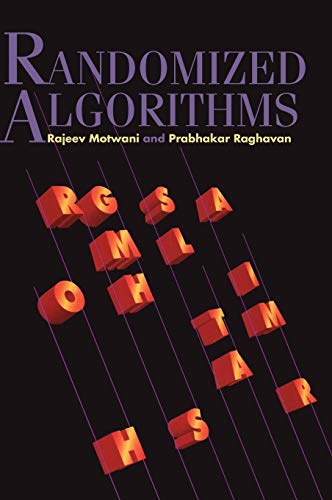
For many applications, a randomized algorithm is either the simplest or the fastest algorithm available, and sometimes both. This book introduces the basic concepts in the design and analysis of randomized algorithms. The first part of the text presents basic tools such as probability theory and probabilistic analysis that are frequently used in algorithmic applications. Algorithmic examples are also given to illustrate the use of each tool in a concrete setting. In the second part of the book, each chapter focuses on an important area to which randomized algorithms can be applied, providing a comprehensive and representative selection of the algorithms that might be used in each of these areas. Although written primarily as a text for advanced undergraduates and graduate students, this book should also prove invaluable as a reference for professionals and researchers.
User’s Reviews
Editorial Reviews: Review “The techniques described by Rajeev Motwani and Prabhaker Raghavan are wide-ranging and powerful, so this book is an important one…We are particularly lucky, therefore, that this excellent volume does us so proud!…clearly written and well thought out, with an interesting collection of exercises and applications, and shows the comprehensive breadth and valuable insights of a mature text…I would recommend the book both to newcomers to the field and to more seasoned practitioners…It is a pleasure to read.” John H. Halton, American Scientist”…the first comprehensive account of the current state of this burgeoning subject…Every aspect of this book…shows evidence of ample thoughtfulness…an essential acquisition…” D.V. Feldman, Choice”Randomization has come to be recognized as a fundamental tool for the construction of simple and efficient algorithms. Motwani and Raghavan provide an excellent overview of randomized techniques in algorithm construction, demonstrating their impact on virtually every domain in which computation is done. This book will surely exert a powerful influence on the way algorithm design is practiced and taught.” Richard M. Karp”This is an authoritative work by researchers active in the field. The book is welcome as a reference work, as a source book for algorithmic ideas, and as a graduate-level course text….In the latter role, the book is greatly enhanced by the provision of numerous exercises scattered throughout the text (to test and deepen the reader’s understanding), together with extensive selections of harder problems at the end of each chapter. The continued attention of seasoned researchers is assured by the inclusion of a number of open research problems. This is very much an active research area, and if newcomers are attracted into it through reading this book, then it will have served an additional useful purpose.” Mark R. Jerrum, Mathematical Reviews”The book can serve as an excellent basis for a graduate course. It is also highly recommended for students and researchers who wish to deepen their knowledge of the subject.” Y. Aumann, Computing Reviews”…carefully written, with exact definitions and complete proofs…. I believe that the book, with its vast coverage, will be an invaluable source for active researchers in the field.” Y. Aumann, Theory of Computation Book Description This book presents basic tools from probability theory used in algorithmic applications, with concrete examples.
Reviews from Amazon users which were colected at the time this book was published on the website:
⭐I’ve taken two CS classes that use this book and I always felt like this book was very informative. The algorithms and concepts that Motwani brings forth are extremely insightful and interesting. However, the presentation of the proofs has a lot of room for improvement. Notation is carried over from previous chapters and is sometimes unexplained, which makes it very difficult for someone who does not have a lot of familiarity with the material presented. The book presents very interesting topics and leaves a lot of open (unresolved) questions to the reader’s curiosity and challenge.
⭐This book is a jewel. It demonstrates how clever and beautifully simple probabilistic ideas can lead to the design of very efficient algorithms. I like its very verbal intuitive style,with proof strategies being always transparently explained.For computer scientists, this is *the* reference work in randomized algorithms, by now a major paradigm of algorithms design. For classical probabilists, thiscould serve as an eye-opener on unsuspected applications of their field to important areas of computer science.
⭐This is definitely a classic, however, the copy I received was badly printed–it was like a scanned copy. Some mathematical symbols were even warped and blurry.
⭐A mathematician at heart in the world of software engineering, this is one of those few books that I take out from time to time and leave beside my bed. With it’s wide scope it is sometimes terse and needs careful reading. Yet the world of randomized algorithms comes through with strength on a good formal basis. It is an entertaining and yet highly educational book.
⭐The book has an exoustive amount of algorithms. Not everything is proved. Sometimes the proof contains to few steps to be understood. There are many algorithms explained well. After reading this book it is easy to create your own randomized algorithms.
⭐Overall, the authors explain core concepts, the examples and the possible applications well. However, the readibility of their proof is far from that of the above three. Honestly some proofs should be re-written completely.For example, in page 116, they try to use the induction method to prove Lova(‘)sz Local Lemma. After reading that page many times, I still didn’t understand the structure of their proof.I was TA for under-grad level algorithm course, got A+ in advanced Calculus II and A in intro. to PDE (both in under-grad level), really knew something about induction method and a little bit about algorithm. I am not smart, but far from stupid.In the end, I google the internet and found a 3-page proof for the same thing. That’s easy to catch in few minutes, and then, I understand the 1-page proof in the book. Is it ironic?
⭐Algorithms are my specialty, and I’m really interest in everything that is connected with them. This is one of the few books from the field of algorithms that I was a problem to read. I found this book hard to read because of several reasons.Firstly, i have a problem with the composition of material from the book. The material is in the many places presented in the unnatural way. Book is method oriented, so often same problem is treated in several places in the book. On the other hand the book is not fully method oriented, so there are chapters of the book that don’t present any method of building randomized algorithms. There are several chapters that are organized around some concept from the probability theory. I don’t see the reason for these two orientation to be mixed.Often I have a feeling that authors are not particulary interested in randomized algorithms, and that thet their main interest is to show probability methods in the theory of algorithms. So, there are, for example, chapters in the book named “Moments and Deviations” and “Tail Inequalities”. I don’t want to say that these concepts are not important for the randomized algorithm complexity claculations, but I think that such chapters belongs to book on probability theory, not randomized algorithms book. On the other side, therms of Monte Carlo and Las Vegas algorithms get together one section in the chapter in which they are described. It is true that in these chapters contain randomized algorithms as examples of usage of mathematical concepts, but the question is: should this book present general mathematical concepts, or randomized algorithms.The second big drawback is lack of precise mathematical notion in many places in the book. For example, in the chapter on game theory the reader get impression that the whole game theory are game trees. Yet, authors fail to define what game tree is. The definition they give is more lausy desciption than definition. They don’t say which kind of tree is game tree. Is it binary? Of course it is not, but authors in this section work only with binary trees. Further, in the text authors said that this tree is uniform. I have to admit that I never heard about uniform trees. The problem is that all definitions in the book is given in this way, by the paragraph of the text, which describe the term, not define it. In fact, the only concepts that are properly defined are ones form the probability theory. None of the concepts from the algorithms theory or data structures theory is not defined as it should be.The third great problem with the book is that these concepts are never ilustrated with the concrete example. There is a section about the game trees, for example, but there is no single game tree for some game generated in this section. This is not a single case. All examples in the book are about mathmatical, or nore precisely probability theory concepts, and all of them looks like they are taken from the workbook on probability theory, and doesn’t have any connection with algorithms.Another problem is that all chapters are not builded in the same manner. There are chapters (unfortenately very little of them) that have theoretical overview of the method they deal with, but in the other chapters there are no proper theoretical description of the method of the matter.To resume, this book shows the lack of concept and system in the writting, as well as the interest of authors more in mathmatics than in algorithm field.My opinion is that there are much better books on the randomized algorithms tnan this one.
⭐One of the standard beginning graduate level books on randomized algorithms. Might seem a bit terse, especially if you don’t have a computer science background. Covers standard material, starting from min-cut and going all the way to primality checking (Miller-Rabin). In between, it explains the probabilistic facts used in the book. Widely used by the instructors at standard places.
⭐This book goes very deep into the topic (much deeper than most textbooks that I know). The information content is absolutely brilliant, but I am a graduate computer scientist and I still find it very hard to understand. This is fair, considering the depth of the content, but be aware that this is a book for absolute experts!
⭐Neatly written. Concepts clearly explained. Not for beginner. Good book for advanced readers. Need basic understanding of probability, markov chain etc
Keywords
Free Download Randomized Algorithms 1st Edition in PDF format
Randomized Algorithms 1st Edition PDF Free Download
Download Randomized Algorithms 1st Edition 1995 PDF Free
Randomized Algorithms 1st Edition 1995 PDF Free Download
Download Randomized Algorithms 1st Edition PDF
Free Download Ebook Randomized Algorithms 1st Edition