

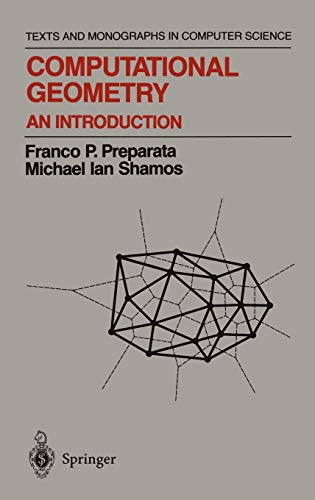
Ebook Info
- Published: 1985
- Number of pages: 390 pages
- Format: PDF
- File Size: 17.51 MB
- Authors: Franco P. Preparata
Description
From the reviews: “This book offers a coherent treatment, at the graduate textbook level, of the field that has come to be known in the last decade or so as computational geometry. … … The book is well organized and lucidly written; a timely contribution by two founders of the field. It clearly demonstrates that computational geometry in the plane is now a fairly well-understood branch of computer science and mathematics. It also points the way to the solution of the more challenging problems in dimensions higher than two.” #Mathematical Reviews#1 “… This remarkable book is a comprehensive and systematic study on research results obtained especially in the last ten years. The very clear presentation concentrates on basic ideas, fundamental combinatorial structures, and crucial algorithmic techniques. The plenty of results is clever organized following these guidelines and within the framework of some detailed case studies. A large number of figures and examples also aid the understanding of the material. Therefore, it can be highly recommended as an early graduate text but it should prove also to be essential to researchers and professionals in applied fields of computer-aided design, computer graphics, and robotics.” #Biometrical Journal#2
User’s Reviews
Reviews from Amazon users which were colected at the time this book was published on the website:
⭐I only got this book because I could get a good copy at a decent price. Yes, it’s a classic, the first book on the topic, and I am glad that I finally have it on my shelves. It’s still a good read, mostly to get some insight on the ideas going on in the heads of the people who were establishing the field. This being said, it has long been known that the book is not well written. The algorithms are incomplete, as are many/most of the proofs. Someone who wants to study Computational Geometry is much better off getting the book by de Berg, Cheong, van Kreveld, and Overmars, or even the O’Rourke book. This one is strictly for historical perspective in my opinion.
⭐This is a good book which explains a number computational geometry techniques. It doesn’t appear to be aimed at engineers or neophytes making it hard to read but quite interesting. It doesn’t appear to be a good general introduction to computational geometry but it does contain a lot of depth on sweepline algorithms for convex hull and line segment intersection. It focuses on algorithmic complexity without covering any of the myriad of degenerate cases and details needed to implement practical algorithms.
⭐Good
⭐It arrived on time and was an excellent product.
⭐This book is to computational geometrists what the King James Version of the Bible is to christian fundimenalists. Even though newer translations of the Bible are easier to read, somehow nothing sounds quite so authentically like the voice of God than those Elisibethen cadences, written in an almost archaic language…….similarly for this book. Many times, the descriptions of algorithms presented in this book are made unnecesarily hard by very arcane langauge.But this book is authoritative and definitive in a way that no other text on computational geometry is ever likely to achieve. Even though there are any number of books which are newer and easier to read, it seems like this the one book on the shelf of every serious computational geometer I know.
⭐I have just happened to exhume this book from my library, after it spent some years gathering dust above the shelf. In spite of the long time I have not being reading it, it still retains the full meaning it showed me when I was using in calculations relating radar domain definition. May be the textbook wins by far the comparison to the current vague and inflated computer publications, may be it is not a manager-oriented issue but it is for nearly specialistic use, you find in it clearly stated, and straight, answers to the questions you meet, or at least a definite reference where a more detailed explanation can be find. It presents interesting problems, and explains you how to solve them. I think it is the best you can say about a computer science book.
⭐The ideas and algorithms presented in this book are clear enough for straight implementation in code. I have long experience in developing comercial and production software for VLSI layout applications, which made extensive use of the algorithms presented in this book.I also use some chapters of this book as a part of a graduate course in VLSI layout algorithms being tought at the Technion, Israel. The contents of this book is well understood by EE and CS students.I personally love this book, which introduced me into the area of computational geometry and its applications.
⭐Most of the papers that I’ve read on computational geometry refer to this text — and for good reason. There’s many good algorithms to be found here.The book only gets 4 stars because it’s hard to read. It took me several tries to pick up the ideas in this text. I think the De Berg text is MUCH easier to read.The book is also getting a little dated. Some of the topics have come a long way since the 80’s.This book seems to be in most University libraries if you have that option.
Keywords
Free Download Computational Geometry: An Introduction (Texts and Monographs in Computer Science) in PDF format
Computational Geometry: An Introduction (Texts and Monographs in Computer Science) PDF Free Download
Download Computational Geometry: An Introduction (Texts and Monographs in Computer Science) 1985 PDF Free
Computational Geometry: An Introduction (Texts and Monographs in Computer Science) 1985 PDF Free Download
Download Computational Geometry: An Introduction (Texts and Monographs in Computer Science) PDF
Free Download Ebook Computational Geometry: An Introduction (Texts and Monographs in Computer Science)