

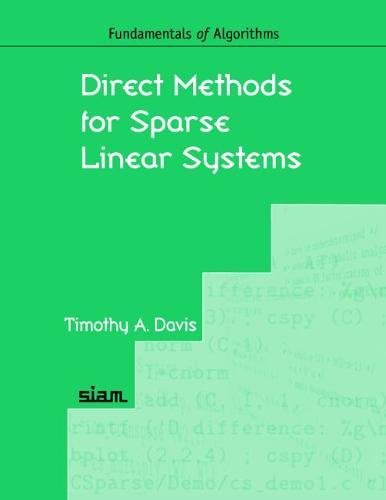
Ebook Info
- Published: 2006
- Number of pages: 184 pages
- Format: PDF
- File Size: 9.74 MB
- Authors: Timothy A. Davis
Description
Computational scientists often encounter problems requiring the solution of sparse systems of linear equations. Attacking these problems efficiently requires an in-depth knowledge of the underlying theory, algorithms, and data structures found in sparse matrix software libraries. Here, Davis presents the fundamentals of sparse matrix algorithms to provide the requisite background. The book includes CSparse, a concise downloadable sparse matrix package that illustrates the algorithms and theorems presented in the book and equips readers with the tools necessary to understand larger and more complex software packages. With a strong emphasis on MATLAB® and the C programming language, Direct Methods for Sparse Linear Systems equips readers with the working knowledge required to use sparse solver packages and write code to interface applications to those packages. The book also explains how MATLAB performs its sparse matrix computations.
User’s Reviews
Editorial Reviews: Review ‘Everything you wanted to know but never dared to ask about modern direct linear solvers.’ Chen Greif, University of British Columbia’Overall, the book is magnificent. It fills a long-felt need for an accessible textbook on modern sparse direct methods. Its choice of scope is excellent …’ John Gilbert, University of California, Santa Barbara Book Description Essential guide for computational scientists and software developers to the theory and algorithms for solving large sparse linear systems. Book Description An essential guide for computational scientists and software developers who want to understand the theory and algorithms behind modern techniques used to solve large sparse linear systems. The book also serves as an excellent practical resource for students with an interest in combinatorial scientific computing. About the Author Timothy A. Davis is an Associate Professor in Computer and Information Science and Engineering at the University of Florida. He is the author of a suite of sparse matrix packages that are widely used in industry, academia, and government research labs, and related articles in SIAM, ACM, and IEEE journals. He is the co-author of a well-used introduction to MATLAB, the MATLAB Primer (Chapman & Hall/CRC Press, 2005). He is a member of the editorial boards of the IEEE Transactions on Parallel and Distributed Systems, and Computational Optimization and Applications. Read more
Reviews from Amazon users which were colected at the time this book was published on the website:
⭐Good as new for a very good price!
⭐I really recommend this book if you need a c code for the sparse linear algebra.
⭐Excellent book.
⭐Good book for handling sparse matrix.
⭐This books provides a decent library of sparse matrix functions. However, it can be difficult to understand the code at times because the author chose to use cryptic variable names.
⭐Overall, I would say this is a pretty good book. I picked it up looking for something a bit deeper (and hopefully faster-executing) than what is found in the usual numerical analysis books, and that is what I got. Davis carefully steps through the code he developed, CSparse, from the bottom to the top. Sometimes the explanations are hard to follow, but I think that is because I’m an engineer, not a computer scientist, so my background really isn’t on par with what it should be before reading this book.The code (in C and/or Matlab) that is presented is very terse, and seems to combine as many operations per line as possible. If it weren’t for the text, trying to understand what is going on in the code would be impossible. Spartan coding has its place, surely, but not in textbooks.The book is missing two things. One, parallelism. Seriously- its 2008 (the fact that the book came out in 2006 doesn’t change my claim)- multicore processors are everywhere, and clusters are becoming cheaper and more ubiquitous. If a reader is interested enough in this topic to want to take advantage of sparsity, chances are they want to solve large sparse linear systems. Second, the proof that’s in the pudding is in the tasting. Davis only ever mentions the theoretical execution times of the various algorithms and pieces of algorithms. I would like to see a graph (that is, an x-y plot) of run time vs matrix size for the various methods (as well as the theoretical predictions). Not only that, but let’s see it for a finite element problem with an unstructured mesh over a non-trivial geometry….you know, a real problem.If nothing else, this book is a concise reference for the modern methods for treating sparse linear systems. The last book exclusive to the topic was some 20 years ago, and a lot of research has happened since then. If the algorithms presented in the book don’t help you (which I doubt), then at least Davis cites several references to point you in the right direction.
⭐マルチフロンタル法を用いる直接法ソルバー開発に対して、本書は有益な情報を提供してくれる。本書には、Right-Looking LU分解をベースとするマルチフロンタル法の説明、および消去木を用いた「LU分解後の列および行の非ゼロ数カウント」、「列の非ゼロ数カウント方法をベースとしたAMDオーダーリング」の理論と実装が詳しく書かれている(但し、行の非ゼロ数カウントのコードは不完全であるため、正しく動作する列の非ゼロ数カウントのコードを参考に適宜修正が必要である)。本書で述べられる消去木とは、行列全体におけるフロンタルマトリックスの親子関係(集合木)ではなく、フィルインを考慮した係数行列の非ゼロパターンの親子関係(消去木)であり、実装においては個々のフロンタルマトリックスに対して適用される木構造である。実際に並列直接法ソルバーを開発するためには、NDとAMDを組み合わせたオーダーリングが必要であり、フロンタルマトリックスのLU分解(最も外側となるkループの処理を途中で止める)にはBLASライブラリの利用も必要となる。本書にはこのあたりの情報が書かれていないが、シンボリックアナリシス(LU分解前の前処理)について詳しく書かれているので★5としました。
⭐
Keywords
Free Download Direct Methods for Sparse Linear Systems (Fundamentals of Algorithms, Series Number 2) in PDF format
Direct Methods for Sparse Linear Systems (Fundamentals of Algorithms, Series Number 2) PDF Free Download
Download Direct Methods for Sparse Linear Systems (Fundamentals of Algorithms, Series Number 2) 2006 PDF Free
Direct Methods for Sparse Linear Systems (Fundamentals of Algorithms, Series Number 2) 2006 PDF Free Download
Download Direct Methods for Sparse Linear Systems (Fundamentals of Algorithms, Series Number 2) PDF
Free Download Ebook Direct Methods for Sparse Linear Systems (Fundamentals of Algorithms, Series Number 2)