

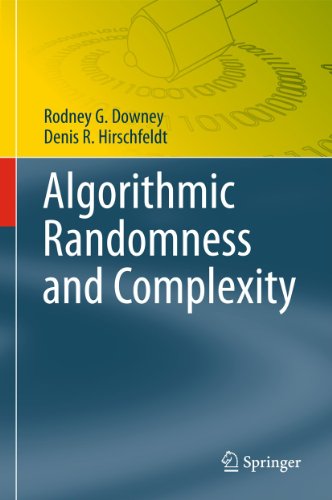
Ebook Info
- Published: 2010
- Number of pages: 883 pages
- Format: PDF
- File Size: 5.32 MB
- Authors: Rodney G. Downey
Description
Computability and complexity theory are two central areas of research in theoretical computer science. This book provides a systematic, technical development of “algorithmic randomness” and complexity for scientists from diverse fields.
User’s Reviews
Editorial Reviews: Review From the reviews:“Develops the prerequisites to algorithmic randomness: computability theory and Kolmogorov complexity. … Studying these … one should be able to proceed in the area with confidence. A draft of the book under review has been circulating for years and the reviewer found it to be the best source when attempting to conduct research in the area … . It is advantageous for the future of the area of algorithmic randomness that these two books were published at the cusp of a period of great activity.” (Bjørn Kjos-Hanssen, Mathematical Reviews, Issue 2012 g)“A thorough and systematic study of algorithmic randomness, this long-awaited work is an irreplaceable source of well-presented classic and new results for advanced undergraduate and graduate students, as well as researchers in the field and related areas. The book joins a select number of books in this category.” (Hector Zenil, ACM Computing Reviews, October, 2011) From the Back Cover Intuitively, a sequence such as 101010101010101010… does not seem random, whereas 101101011101010100…, obtained using coin tosses, does. How can we reconcile this intuition with the fact that both are statistically equally likely? What does it mean to say that an individual mathematical object such as a real number is random, or to say that one real is more random than another? And what is the relationship between randomness and computational power. The theory of algorithmic randomness uses tools from computability theory and algorithmic information theory to address questions such as these. Much of this theory can be seen as exploring the relationships between three fundamental concepts: relative computability, as measured by notions such as Turing reducibility; information content, as measured by notions such as Kolmogorov complexity; and randomness of individual objects, as first successfully defined by Martin-Löf. Although algorithmic randomness has been studied for several decades, a dramatic upsurge of interest in the area, starting in the late 1990s, has led to significant advances. This is the first comprehensive treatment of this important field, designed to be both a reference tool for experts and a guide for newcomers. It surveys a broad section of work in the area, and presents most of its major results and techniques in depth. Its organization is designed to guide the reader through this large body of work, providing context for its many concepts and theorems, discussing their significance, and highlighting their interactions. It includes a discussion of effective dimension, which allows us to assign concepts like Hausdorff dimension to individual reals, and a focused but detailed introduction to computability theory. It will be of interest to researchers and students in computability theory, algorithmic information theory, and theoretical computer science.
Reviews from Amazon users which were colected at the time this book was published on the website:
⭐This book (which is available as a free pdf, look around) was way above my pay grade and did nothing for me, yet i still feel confident in my judgments. I have to rate it highly because if you’re already an expert in the subject, you will find what you need here. This book collects a dizzying array of results, many of which had never been published.But if you’re trying to _learn_ algorithmic information theory, even if you’re a graduate student, this book won’t help. It’s theorem-proof theorem-proof theorem-proof all the way down. Proofs are for _proving_, they’re not for knowledge transfer. The representation of a subject that mathematicians carry in their head is differently structured than proofs, and it’s that representation that needs to be communicated. To see this, the authors state explicitly that their chapter 2 on information theory does not serve as a textbook for that subject, yet the rest of the book is in exactly the same style and moves at exactly the same pace as chapter 2.There’s no big picture here – the big results don’t stand out from the small ones.And finally, I’m fed up with nonconstructive mathematics. A thing doesn’t “exist” if the universe is guaranteed to be in heat death before someone encounters it. Maybe this particular subject has to be that way, but i’d love to see a good constructivist mathematician take it on.
⭐[from a review I wrote for the Bulletin of Symbolic Logic]The book a whole community has been waiting for! Rod Downey and Denis Hirschfeldt’s Algorithmic randomness and complexity was already cited dozens of times before it was published, as the authors maintained an online draft during most of the writing process. This online draft has now become a 850-page book, the first published by Springer in its new book series Theory and Applications of Computability.The subject of this monograph is algorithmic randomness (a.k.a. effective randomness). The main purpose of this area of research is to answer the philosophical question: “What does it mean for a single object to be random?”. Classical probability theory allows us to talk about the probability of an event to occur, but it says nothing about the outcome of an experiment, even when some outcomes look much less random than others (for example, the outcome 44444…4 [1000 times 4] for the experiment consisting of throwing a regular dice 1000 times looks “non-random” despite having the same probability of occurrence as any other outcome). The first attempts to formalize this intuition go back to von Mises in the 1910s, but it was only in the 1960s that this was done in a rigorous manner by Solomonoff, Chaitin and Kolmogorov for finite objects and by Martin-Löf for infinite ones. Both approaches involved computability theory. More progress was made in the 1970s by researchers such as Levin, Solovay and Schnorr (it is worth mentioning that Solovay never published his work in this area, and only left a manuscript containing numerous deep theorems; Downey and Hirschfeldt got ahold of this manuscript and present its central results, which nobody had done before them). The field decreased somewhat in popularity in the 1980s and 1990s (some remarkable results were still proven at the time, e.g., by Kucera and Gacs), but regained the interest of computability theorists in the early 2000s, and has been growing rapidly since then. It is currently one of the most central and active topics in computability theory.Algorithmic randomness and complexity consists of four parts. The first hundred pages are a crash course in computability theory in an attempt to make the book as self-contained as possible. Then the central notion of algorithmic randomness for finite strings, Kolmogorov complexity, is introduced and the main results of this theory are presented. The first part also includes a chapter on effective real numbers (mostly lower semicomputable ones) which are of utmost importance in the rest of the book.The second part deals with the theory of effective randomness for infinite sequences, and how one can define a random sequence. The “big three” paradigms of algorithmic randomness are presented:* typicality: a random sequence should have all properties of measure 1 that can be tested algorithmically* incompressibility: a random sequence should have no simple description; in other words, it should be hard to compress (this is the paradigm that relates random- ness for finite strings and randomness for infinite ones)* unpredictability: a random sequence should be hard to guess; there is no effective strategy which can guess its bits with better-than-average accuracy.Of course, these paradigms are rather informal, and different interpretations lead to different randomness notions. More than twenty different randomness notions have emerged from these paradigms, and most of them are introduced in this second part. A large part of the exposition, however, focuses on four or five of them, with particular attention paid to the notion that is considered to be the best of all: Martin-Löf randomness. The delicate interactions between the three above paradigms and the subsequent randomness notions are illustrated by a great number of results. These interactions are so deep that most of the interesting randomness notions can be expressed via all three of them. This part of the book also illustrates the deep interplay between effective randomness and computability theory, which holds in both directions: computability theory is essential to define and study effective randomness, but the objects and tools of this theory give a fresh point of view on some computability questions, yielding new results. Readers who are familiar with computability theory but not with algorithmic randomness might be amazed to see in Chapter 8 (“Algorithmic randomness and Turing reducibility”) that high degrees, diagonally non-computable degrees, PA degrees, GL1 degrees, hyperimmune-free degrees, jump inversion theorems, to name only a few, all have something to do with algorithmic randomness.This interplay between randomness and computability is perhaps even more present in the third part of the book, which addresses the natural question: when can we say that an infinite sequence is more random than another one? Again, there are several ways to approach this question, and the authors discuss many of them: comparison of initial segment complexity, randomness relativized to an oracle, Solovay reducibility for lower semicomputable random reals, etc. This study of relative randomness natu- rally leads one to look at the other extreme: sequences that are far from random. A particular class, the class of K-trivial sequences, plays a fundamental role in this line of study. Originally defined by Chaitin as sequences of minimal prefix-free Kolmogorov complexity, the K-trivial sequences have been proven by Nies and several co-authors to coincide with two classes of computationally weak sequences introduced independently by Zambella (the class of oracles that do not affect Martin-Löf randomness) and Muchnik (the class of oracles that do not affect prefix-free complexity). The declinations of this idea (“far from random equals computationally weak”) has become one of the central topics in algorithmic randomness and is discussed at length by Downey and Hirschfeldt, in particular in Chapter 11 and Chapter 12. Another gem of algorithmic randomness is presented in Chapter 13: effective Hausdorff dimension. The work of Lutz, Mayordomo, Staiger and others show that the most natural constructive version of Hausdorff dimension (in the set of infinite binary sequences with its usual distance) has a very natural characterization in terms of Kolmogorov complexity. It is quite amazing that these two seemingly unrelated notions are in fact so tightly connected, and the study of effective Hausdorff dimension has lead to fascinating developments, such as the work of Downey, Greenberg and Miller on the links between this notion and diagonally non-computable Turing degrees.Perhaps a bit artificially separated from the rest of the book, the last part discusses three particular topics: strongly jump traceable sequences (a subclass of the K-trivials), the relativizations of Chaitin’s Omega numbers (which are exactly the lower semicomputable, Martin-Lo ‘f random reals) and the initial segment complexity of computably enumerable sets.Overall, this book is an absolutely remarkable piece of work, both for its breadth and its depth. The authors have managed to keep an eye on most of the interesting developments in the field over the last ten years (with a few notable exceptions, such as randomness for spaces other than the space of infinite binary sequences, or the interac- tions between Kolmogorov complexity and combinatorics), and have included the most important results in their book. “Encyclopedia of Algorithmic Randomness” would have been a suitable alternative title! Of course, the downside of the encyclopedic nature of Downey and Hirschfeldt’s book is that it is rather difficult to “navigate”. Many chapters present a series of theorems, some of truly fundamental importance, some only of interest to experts, and the distinction between the two is not always made clear. This unfortunately means that this book cannot really serve as a textbook for a first course on effective randomness. However, it is nicely structured and very well written, and therefore, with some guidance, it will make a valuable introduction to al- gorithmic randomness for graduate students and researchers outside the field. Downey and Hirschfeldt’s Algorithmic randomness and complexity is a most impressive book, playing at least in the same league as modern classics such as Soare’s or Odifreddi’s monographs on computability theory. It definitely sets a very high standard for the Theory and Applications of Computability book series it initiates.
⭐This long-awaited book is an irreplaceable source of well-presented classic and new results in algorithmic randomness and algorithmic complexity. It should be in the shelves of every theoretical computer scientist. It is clearly the product of two researchers in love with their field. Read the full review online from the (ACM) Computing Reviews (requires a password):[…]
Keywords
Free Download Algorithmic Randomness and Complexity (Theory and Applications of Computability) 2010th Edition in PDF format
Algorithmic Randomness and Complexity (Theory and Applications of Computability) 2010th Edition PDF Free Download
Download Algorithmic Randomness and Complexity (Theory and Applications of Computability) 2010th Edition 2010 PDF Free
Algorithmic Randomness and Complexity (Theory and Applications of Computability) 2010th Edition 2010 PDF Free Download
Download Algorithmic Randomness and Complexity (Theory and Applications of Computability) 2010th Edition PDF
Free Download Ebook Algorithmic Randomness and Complexity (Theory and Applications of Computability) 2010th Edition