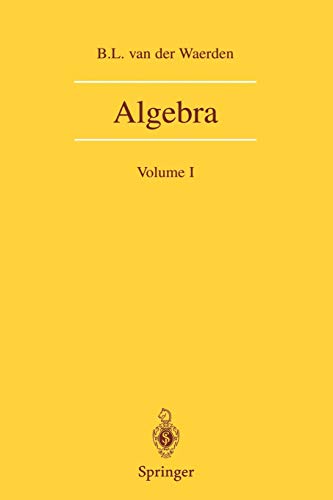
Ebook Info
- Published: 2003
- Number of pages: 279 pages
- Format: PDF
- File Size: 15.43 MB
- Authors: B.L. van der Waerden
Description
This beautiful and eloquent text transformed the graduate teaching of algebra in Europe and the United States. It clearly and succinctly formulated the conceptual and structural insights which Noether had expressed so forcefully and combined it with the elegance and understanding with which Artin had lectured. This text is a reprinted version of the original English translation of the first volume of B.L. van der Waerden’s Algebra.
User’s Reviews
Editorial Reviews: Review From the reviews:”The book … is a reprinted version of the original English translation of the first volume of B. L. van der Waerden’s ‘Algebra’, without any alterations. However, it is the first softcover printing, worth the price and particularly handy. It is very gratifying to have such an edition … so that further generations of students can both afford it and use it as still one of the best sources … . is one of the most influential textbooks in mathematics of the 20th century.” (Werner Kleinert, Zentralblatt MATH, Vol. 1032 (7), 2004)”In the glad to have you back department, I’m delighted that Springer has decided to reprint the two volumes of B.L.van der Waerden’s Algebra. Based in part on lectures by Emmy Noether and Emil Artin, this is the book that brought ‘abstract algebra’ to the mathematical world. … the book reflects the excitement that accompanied the birth of axiomatic algebra. … a book to treasure. I am glad it’s back.” (MAA-Online, March, 2004) From the Back Cover …This beautiful and eloquent text served to transform the graduate teaching of algebra, not only in Germany, but elsewhere in Europe and the United States. It formulated clearly and succinctly the conceptual and structural insights which Noether had expressed so forcefully. This was combined with the elegance and understanding with which Artin had lectured…Its simple but austere style set the pattern for mathematical texts in other subjects, from Banach spaces to topological group theory…It is, in my view, the most influential text in algebra of the twentieth century.- Saunders MacLane, Notices of the AMSHow exciting it must have been to hear Emil Artin and Emmy Noether lecture on algebra in the 1920’s, when the axiomatic approach to the subject was amazing and new! Van der Waerden was there, and produced from his notes the classic textbook of the field. To Artin’s clarity and Noether’s originality he added his extraordinary gift for synthesis. At one time every would-be algebraist had to study this text. Even today, all who work in Algebra owe a tremendous debt to it; they learned from it by second or third hand, if not directly. It is still a first-rate (some would say, the best) source for the great range of material it contains.- David Eisenbud, Mathematical Sciences Research InstituteVan der Waerden’s book Moderne Algebra, first published in 1930, set the standard for the unified approach to algebraic structures in the twentieth century. It is a classic, still worth reading today.- Robin Hartshorne, University of California, Berkeley
Reviews from Amazon users which were colected at the time this book was published on the website:
⭐I am satisfied with my book. Thank you.
⭐Never understood the fascination for those Capital Gothic letters in these older textbooks. Just makes it hard to decipher them sometimes.
⭐so fast
⭐There are millions of Christian books to explain God’s Words, but the best book is still The Bible.Isomorphically, this book is the “Bible” for Abstract Algebra, being the first textbook in the world (@1930) on axiomatic algebra, originated from the theory’s “inventors” E. Artin and E. Noether’s lectures, and compiled by their grand-master student Van der Waerden.It was quite a long journey for me to find this book. I first ordered from Amazon.com’s used book “Moderne Algebra”, but realised it was in German upon receipt. Then I asked a friend from Beijing to search and he took 3 months to get the English Translation for me (Volume 1 and 2, 7th Edition @1966).Agree this is not the first entry-level book for students with no prior knowledge. Although the book is very thin (I like holding a book curled in my palm while reading), most of the original definitions and confusions not explained in many other algebra textbooks are clarified here by the grand master.For examples:1. Why Normal Subgroup (he called Normal divisor) is also named Invariant Subgroup or Self-conjugate subgroup.2. Ideal: Principal, Maximal, Prime.and who still says Abstract Algebra is ‘abstract’ after reading his analogies below on Automorphism and Symmetric Group:3. Automorphism of a set is an expression of its SYMMETRY, using geometry figures undergoing transformation (rotation, reflextion), a mapping upon itself, with certain properties (distance, angles) preserved.4. Why called Sn the ‘Symmetric’ Group ? because the functions of x1, x2,…,xn, which remain invariant under all permutations of the group, are the ‘Symmetric Functions’.etc…The ‘jewel’ insights were found in a single sentence or notes. But they gave me an ‘AH-HA’ pleasure because they clarified all my past 30 years of confusion. The joy of discovering these ‘truths’ is very overwhelming, for someone who had been confused by other “derivative” books.As Abel advised: “Read directly from the Masters”. This is THE BOOK!Suggestion to the Publisher Springer: To gather a team of experts to re-write the new 2010 8th edition, expand on the contents with more exercises (and solutions, please), update all the Math terminologies with modern ones (eg. Normal divisor, Euclidean ring, etc) and modern symbols.
⭐OK, it’s a classic. Still, I’ve got complaints.Consider this:A Euclidean ring is defined in van der Waerden’s “Algebra” in such a way that the reals are a Euclidean ring. Just define g (the norm) as a constant. Since every number has an inverse, the division algorithm is satisfied since we can always have a remainder of zero. Fine. No problem.Now, half a page under the definition of Euclidean ring, we have a discussion about “the” greatest common divisor of two elements, a, and b, of a Euclidean ring. The ‘definition’ of the term ‘greatest common divisor’ is given:” … d is also the ‘greatest common divisor’; that is, all common divisors of a and b are divisors of d.”OK. Fine. Now, consider the reals which are a Euclidean ring by the definition given here (and I’ve seen similar elsewhere). Every non-zero real is a common divisor of every pair of reals. Furthermore, every non-zero real divides every one of these common divisors, so every common divisor is a greatest common divisor. That is, every non-zero real is a greatest common divisor of every pair of real numbers.Well, this is not inconsistent, but the term ‘greatest common divisor’ in this case, is not descriptive to say the least. Furthermore, the description of a number fitting the definition of greatest common divisor as ‘the’ greatest common divisor is worse. It is, in this case, wrong.So we have a mess. The difficulty would go away if we could not make fields fit the definition of Euclidean ring.Here’s another one:”An ideal in D is called ‘maximal’ if it is not included in any other ideal in D except D itself, …”. OK, at this point, it sounds like D is a maximal ideal, but maybe not, depending on exactly what is meant by “… other … except…” (although, that D’s exclusion is implied by these words is far from clear and one wonders why, if it is intended that D be excluded, it is not made explicit).However, the definition continues with an alternate wording, “… or in other words, if it has no proper divisors except the unit ideal D.” OK, so this recasting excludes D itself if it is taken to mean that it is required that D be an exceptional proper divisor, but again, this is far from clear. But then the implication that the term ‘maximal ideal’ includes the ring D itself is strengthened in the statement of the theorem which follows immediately: “Any maximal ideal p in D, different from D itself, …”.Well if D is not supposed to be maximal, why put in the unnecessary words “different from D itself”?We are given a very ambiguous idea of ‘maximal ideal’ here. In definitions given by others, ‘maximal ideal’ unambiguously excludes the ring D, itself, which is better.These are not the only problems of this sort.Still, the book is very interesting. As an early translation, these kind of problems are forgiveable. I would hope a modern text on the settled, well understood material covered in van der Waerden’s text would not have such problems. Unfortunately, I find that most texts covering well understood, settled material do have such problems, and it is a rare gem that does not.It takes a lot more time to read a book with difficulties like those described above, time that could be devoted to learning something else.I wonder whether the original German text had these problems.
⭐This book covers a whole lot of subjects in not-so-many pages. As someone pointed before, it is not intended as a first book on the subject. For one thing: there is not many examples on each topic, the exercises require you to really think and solve a problem, rather than introduce further easy examples to fix the concepts taught. My own experience is, I was puzzled first by the level of abstraction, and the lack of concrete examples on ‘foreign’ topics (at that time) was a little frustrating. Kind of “So what’s the big deal with an ideal being principal or not? What’s this all about?”. After reading other, slower paced books on some of the same topics, van der Waerden becomes clear. I stringly recommend
⭐and
⭐by John Stillwell, and Serge Lang’s
⭐before attacking this one.That said, I do not regret buying this book at all. On the contrary, the first frustration became a strong motivation to complement it; and on the way I discovered a whole wonderful world.
⭐I think there are few words to say about this book. This is a classic of Abstract Algebra very well known around the world among algebrists. This is a book that everybody interested about Algebra must read.
⭐Great Quality. A book that will be in the bibliography of all algebra textbooks. Worth collection.
⭐Bien
⭐
Keywords
Free Download Algebra: Volume I in PDF format
Algebra: Volume I PDF Free Download
Download Algebra: Volume I 2003 PDF Free
Algebra: Volume I 2003 PDF Free Download
Download Algebra: Volume I PDF
Free Download Ebook Algebra: Volume I