Ebook Info
- Published: 2007
- Number of pages: 448 pages
- Format: PDF
- File Size: 31.78 MB
- Authors: B. L. van der Waerden
Description
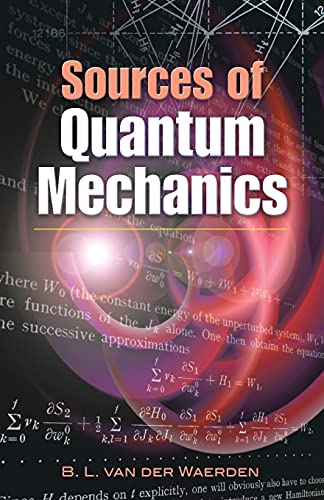
Max Planck’s famous lecture of 1900 expressed quantum theory in its essential form, but his statement was just the beginning. This volume features seventeen early papers that developed quantum theory into its modern form. These papers appeared from 1917 to 1926 and were written by the leading physicists of the early twentieth century.The collection begins with Einstein’s “On the Quantum Theory of Radiation,” an illuminating derivation of Planck’s Law. Other important early papers by Ehrenfest, Bohr, Born, Van Vleck, Kuhn, and others prepared the way for the “turning point” in quantum mechanics. This crucial step is taken in Heisenberg’s paper “Quantum-Theoretical Re-Interpretation of Kinematic and Mechanical Relations.” Additional papers by Born, Dirac, Pauli, and Jordan develop the theory in full. Eleven of these seventeen papers are reproduced unabridged; all are in English.A 59-page historical introduction by the editor, Professor B. L. van der Waerden, provides connective commentary. Quoting from relevant correspondence, noting the thinking behind each discovery, and evaluating the extent of each individual’s contribution, it re-creates the era’s intellectual foment and excitement.
User’s Reviews
Reviews from Amazon users which were colected at the time this book was published on the website:
⭐This book is a treasure trove. All original papers from the founders of quantum mechanics. A treat!
⭐This goes beyond a simple collection of the translated papers (which could probably be found free of charge elsewhere): it starts with a 60-page introduction where the author summarizes each paper, giving its context in the development of quantum physics broadly, and its relation to the other papers in particular — but even beyond that, the editor provides plentiful background, clarification and anecdotes from his (obviously voluminous) personal correspondence with the authors.My one gripe: while all of the actual papers are provided in English, the editor gives quotations from correspondence (both his own and that between the authors and their collaborators) in the original language (mostly German) without translation. This isn’t an insurmountable barrier to understanding the gist, but it seems like an odd choice in a collection of translated articles.
⭐Beautiful book, beautifully packed and quickly delivered!
⭐Indispensable book on the English translations of the papers leading to quantum mechanics by Einstein, Bohr, and others, and the original papers (English translations of the German papers) on the matrix formulation of quantum mechanics by Heisenberg, Born, Jordan, Pauli, and Dirac.
⭐Wow! What a collection! A must for all physicists.
⭐Serious lovers of the foundations of physics must have this volume in their bookshelves.
⭐Matrix mechanics (your topic) and Max Born (your guide). It is imperative to read the historical introduction (60 pages) and the preface (stating that papers on “wave-mechanics” were omitted and intended for a second volume). Secure a copy of Thomas Jordan’s Quantum Mechanics in Simple Matrix Form (1986, John Wiley Publishers). That book shows how far you can get using simple matrix mechanics ! Sources of quantum mechanics is a resource of 17 papers (6 of them ‘abridged.’):(1) Paper 1 is Einstein’s “Planck” paper of 1917 (first transmitted 1916). A tour de force and a paper which should be required reading for all physics students. Einstein’s is a model of lucid writing. If you desire more: the fascinating book by Cheng, Einstein’s Physics (2013, Oxford University Press).(2) Historical introduction reminds us that Paul Dirac “rediscovered Born’s formula for the canonical transformation.” (page 59). Note terminology of the day: multiply periodic systems represents a system having purely discrete energy spectrum (which explains why it can be represented by finite matrices).(3) Ladenburg has presented a beautiful paper (this is in 1921) relating experimental numbers to whatever theoretical speculations were then current. Read: “we shall attempt to deduce from absorption measurements the magnitude of the various transition probabilities.” (page 143). This is physics !(4) The BKS paper (Bohr, Kramers, Slater) is qualitative: no equations ! Anyone can understand it ! Perhaps best utilized (and, remembered) as an introduction to the so-called correspondence principle.(5) Paper 7 is Max Born’s explication of perturbation theory (1924). Born proceeds from classical to quantum, utilizing analogy. Born uses the term “quantum jumps” (page 192). Born builds upon the BKS Paper. Kramers and Heisenberg are referenced. This is a nice paper, careful to give attribution to the main players. Notice that the footnotes reference collaborative papers (1922-1925): Born and Heisenberg, Born and Pauli, Born and Jordan.That is, Max Born deserves his credit where his credit is due !(6) Van Vleck’s paper carries-on the theme of correspondence principle. The following paper, Kramers and Heisenberg, presents the quantitative aspects of the previous BKS paper (it was purely qualitative).(7) Paper twelve begins the second part of the resource book, entitled “birth of quantum mechanics.” Note that this is not “birth of wave mechanics,” that is for another volume (it never materialized). Heisenberg (paper 12): “the validity of classical mechanics simply cannot be maintained.” (page 262). This is 1925, notice that nowhere does Heisenberg explicitly invoke “probability.” (but, see page 267). He does invoke the phrase “observable quantities only.” (page 268).(8) The next, great, paper, Born and Jordan (shortened from the original by five pages) presents an explicit discussion of the mathematics of matrices. Interestingly, they begin with “infinite-square matrices.” From there to dynamics (Hamilton and Lagrange), then to energy conservation, Here we encounter diagonal matrices. We get anharmonic oscillator as application (first deriving the solution for the simple harmonic oscillator). Now read: “we furnish substantiation for the assumption made by Heisenberg that the squares of the absolute values of the elements in a matrix representing the electrical moment of an atom provide a measure for the transition probabilities.“ (page 279).(9) Dirac’s beautiful paper (1926) emphasizes that “the correspondence between the quantum and classical theories lies not so much in the limiting agreement when Planck’s constant approaches zero as in the fact that the mathematical operations on the two theories obey in many cases the same laws.”(10) Another beauty, paper 15, Born, Jordan and Heisenberg: On Quantum Mechanics 2, has it all ! This is a tour de force, required reading for students. The conclusion of the paper: “we now calculate the mean-square-deviation from the interferences of quantum mechanics.” (page 380).(11) What are we to make of this volume ? It is not yet Schrodinger’s wave-mechanics. However, referring to the papers in matrix-mechanics as “out-of-date” overlooks that matrix and Schrodinger wave-mechanics are isomorphic(read: Collected Papers on Wave Mechanics). These papers are as fresh today as they were in their own time.Discover for yourself how the discoverers viewed these problems. Highly recommended.
⭐Thank God we moved beyond this confusion of the past. The problem with these papers is that they were written for a very specific audience. Not just physicists, but German physicists. So they’re translations, not very good ones, on top of that old notation, and on top of that the physics curriculum back then that they had to learn was much different. Good luck trying to figure out all these equations if you’re from an American university in modern times, unless you have someone who understands all that historical notation and can help you translate it. I found it basically useless, and the realization I had, was the founders barely understood what they were doing. And most people still have not much of a clue about quantum, but at least it’s better. We have a more functional analytic interpretation using operator theory and algebras, and the structure of the group theory as well as the geometry is more coherent. In other words, we have something closer to a mathematical theory, rather than a hodge podge collection of equations. Dirac did a lot to help that, but don’t expect to find his work as coherent as Principles, and even that is a pretty tough read for the new modern notation we have that is much simpler. I wouldn’t waste your time with this.
⭐This volume is completely described by its title and the Look Inside pages, save that the first page of the Preface is omitted. In short, Max Born had conceived of publishing a collection of seminal papers on quantum mechanics (a term he claims to have coined [see page 20]), after translating into English those originally published in German (here the majority), and discussed the selection with Pauli and the publishers’ consultant, Paul Rosbaud. After the latter’s death, the project was completed by the present editor (also a member of the translation team), following discussions also with Dirac, Heisenberg, Hund, Jordan, Kuhn and Wigner. [Preface]Naturally, most papers assume knowledge of advanced mathematics, and all papers of classical electrodynamics, as mostly does the editor’s Introduction [see Look Inside pages]. But, to those of us lacking such knowledge, the latter gives some assistance (whilst remaining essentially an introduction to the historical development of the physics and its mathematical interpretation) and at least the introductions to most of the papers can be followed. Paper 5 contains but a single equation, and is in Bohr’s inimitable style.As can be seen [page vi] various papers were omitted (including those on Wave Mechanics which, it was hoped, would form a second volume).It will be of interest primarily to physics undergraduates (such as myself) and to historians of science. I believe it presents the most convenient, if not only, English translation of some of these important sources.
⭐This is a very nice book on the history of foundations of quantum mechanics. It presents an indepth introduction with analysis and historical remarks, and a series of seminal papers by some of the father founders – many in complete form although not all. The papers are all translated in English. A must have for those interested in learning about the historical trajectory that lead to the original insights. Last but not least a big pleasure to have access to the orginal works.
⭐It is as if Schrodinger never existed. Yet I always thought that his equation accounted for qm in a way that no other theory did. Even at the time of its inception, people fell upon the wave equation with some relief, after trying to understand the Heisenberg formulation.
⭐Éste es un gran libro, contiene los escritos originales de los físicos que iniciaron la construcción de la mecánica cuántica. Es muy interesante leer las bases de esta area de la física. Lo recomiendo ampliamente a todos aquéllos interesados en leer los orígenes de la física cuántica.Trata-se de um livro que basicamente refere-se a uma compilação de artigos fundamentais em teoria de campos e mecânica quântica.
Keywords
Free Download Sources of Quantum Mechanics (Dover Books on Physics) in PDF format
Sources of Quantum Mechanics (Dover Books on Physics) PDF Free Download
Download Sources of Quantum Mechanics (Dover Books on Physics) 2007 PDF Free
Sources of Quantum Mechanics (Dover Books on Physics) 2007 PDF Free Download
Download Sources of Quantum Mechanics (Dover Books on Physics) PDF
Free Download Ebook Sources of Quantum Mechanics (Dover Books on Physics)