Ebook Info
- Published: 2010
- Number of pages: 124 pages
- Format: PDF
- File Size: 0.67 MB
- Authors: Robert J. Fogelin
Description
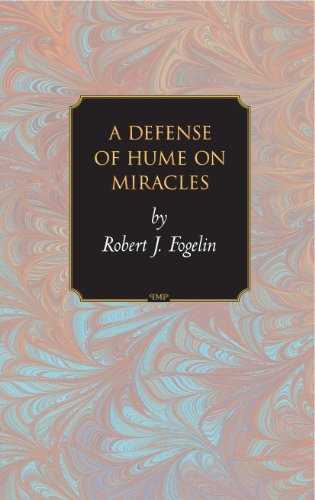
Since its publication in the mid-eighteenth century, Hume’s discussion of miracles has been the target of severe and often ill-tempered attacks. In this book, one of our leading historians of philosophy offers a systematic response to these attacks. Arguing that these criticisms have–from the very start–rested on misreadings, Robert Fogelin begins by providing a narrative of the way Hume’s argument actually unfolds. What Hume’s critics (and even some of his defenders) have failed to see is that Hume’s primary argument depends on fixing the appropriate standards of evaluating testimony presented on behalf of a miracle. Given the definition of a miracle, Hume quite reasonably argues that the standards for evaluating such testimony must be extremely high. Hume then argues that, as a matter of fact, no testimony on behalf of a religious miracle has even come close to meeting the appropriate standards for acceptance. Fogelin illustrates that Hume’s critics have consistently misunderstood the structure of this argument–and have saddled Hume with perfectly awful arguments not found in the text. He responds first to some early critics of Hume’s argument and then to two recent critics, David Johnson and John Earman. Fogelin’s goal, however, is not to “bash the bashers,” but rather to show that Hume’s treatment of miracles has a coherence, depth, and power that makes it still the best work on the subject.
User’s Reviews
Reviews from Amazon users which were colected at the time this book was published on the website:
⭐Fogelin is a lucid and temperate writer, and if this little book gave more bang (60 odd pages) for the bucks, I might recommend it. The book is worth reading, I think, but not buying at this price, unless you happen to be a library.Four problems ruin Fogelin’s argument (described accurately by favorable reviewers below).First, as Tim McGrew points out in a journal review also referenced by another reviewer, most early commentators did seem to interpret Hume as offering a conclusive a priori argument against miracles, and when he had the chance, Hume did not deny it.Second, Fogelin quotes a late version of a key Humean passage, that downplays the radical character of Hume’s argument. Early versions are stronger.Third, when Hume says that universal testimony to a worldwide eight day period of darkness could potentially establish that it had occurred, he is not (as Fogelin often implies) at all conceding that strong testimony could establish a miracle. Hume makes it clear that even in that case, some NATURAL explanation should be sought and would presumably be found.Fourth, if Hume beats his chest and makes extravagent claims for a naive argument, why is it the fault of his critics for showing that that argument (naively understood) fails? It’s a writer’s job to make his point clear. Hume could be an incisive writer, but failed in this case to make his point clear. It does seem probable, as McGrew argues, that much of his charm lies precisely in that ambiguity: pin him down to a clear argument, and it tends to evaporate like the point of a sword from the Barrow Downs.Hume’s argument has, in our day, degenerated into two cliches: (1) “Extraordinary claims require extraordinary evidence,” and (2) various question-begging assertions about miracles that take Hume’s apparent argument at face value, and that save his disciples the trouble of trying to find out if miracles really do happen. Fogelin does us a favor, by digging deeper into Hume, and in effect showing that these two different arguments echo the war between Hume’s reason and his hubris. (The latter of which Fogelin dismisses with a tolerant “boys will be boys” attitude, that he fails to show Earman.) What Fogelin fails to do, and that might be worth doing, is to develop (1), the stronger interpretation of Hume, and see what if anything his skeptical but not altogether close-minded approach might contribute to the modern debate over miracles. (In light, especially, of subsequent arguments that miracles actually do occur, and not nearly so rarely as Hume assumed.)Good fodder for this debate might be Craig Keener’s mammoth empirical argument for miracles — 20 times the length of this book, not much more expensive, and with several chapters chock full of examples, for some of which Keener offers a first or close second-hand account. Keener also touches on Hume and the philosophical debate, along with just about every other related issue.
⭐This book is short and to the point. Quick read if you’re familiar with the subject matter. I wish the kindle edition would let you click the footnotes and allow you to go back and forth between the footnotes and the main text
⭐Fogelin proposes that Hume’s treatment of miracles includes what Fogelin calls the reverse and direct methods. The reverse method considers what we have observed in the past about miracle reports and concludes that they have not been credible. The direct method, on the other hand, considers a particular miracle report with its quantity and quality of witnesses. Fogelin suggests that this part of Hume’s treatment of miracles shows that Hume is open to the possible credibility of miracle reports.Prior to Antony Flew, many scholars believed that the Hume of chapter ten, “On Miracles” (from his Enquiry Concerning Human Understanding) takes what Fogelin would call the results of the reverse method to mean that miracle reports can never be credible. They claim as much, for one thing, because Hume argues, quite clearly and strongly, in section 12 that because miracles are a violation of invariable laws of nature they can never be credible. Moreover, these scholars maintain that Hume begs the question by arguing against particular miracle reports (claims, that is, that the laws of nature have been variable at certain times and places) in a manner similar to the following:1. Nature in our experience has always been uniform and any testimony of an event inconsistent with such uniformity is false. [Major Premise]2. A miracle report involves an event inconsistent with such uniformity. [Minor Premise]3. Therefore, a miracle report is false. [Conclusion]Everyone agrees that if this is at the heart of Hume’s argument in his famous chapter on miracles, then he clearly begs the question. The major premise (and all that follows) just restates the very thing challenged when evidence for a miracle report is presented.Fogelin’s main task, then, is to show that Hume doesn’t make this argument in his chapter on miracles.In my opinion, Fogelin fails to defend Hume on miracles. This is not, to be sure, because Fogelin does not make an impressive effort to do so. It is, rather, because Hume himself consistently appeals to the invariability of the laws of nature. We see Hume doing this in part 2 repeatedly, even when by Hume’s own admission particular miracle reports are well supported.This means Hume is not interested in fairly and impartially applying the direct method to particular miracle reports, as Fogelin would have us believe. Instead, there is in Hume’s treatment of miracle reports unavoidable instances of what we might call a reverse method partiality or a priori assumption (both of which Fogelin vehemently denies). This is just another way of saying that, on Hume’s account, no matter how strong the evidence is for a miracle, it is not credible because it is a violation of the laws of nature.When Fogelin runs into this very problem in part 2 with the miracle accounts associated first with the Cardinal De Retz and then with the Jansenist Abbe, Fogelin acknowledges that Hume is flat out contradicting Fogelin’s interpretation of Hume (pp. 22-23). He concedes that he is observing a reverse method partiality in Hume’s treatment of these miracle reports. We might say that this is the “show me the money” moment for Fogelin’s defense of Hume on miracles. Fogelin needs an argument or explanation for why there is no such contradiction.What Fogelin does at this point is provide three excerpts directly from Hume’s text. He puts them in the form of a syllogism (see pp. 23-24). Unfortunately, every premise in this syllogism simply restates the reverse method partiality that was the problem Fogelin was supposed to address. That is, to argue that Hume does not contradict Fogelin’s defense of Hume from the question-begging charge on miracles, Fogelin himself (of all things) begs the question.The other misdirections in this book are props to this main failure. I’ll mention four of the more significant ones.1. Fogelin claims that the a priori assumption behind the question-begging charge against Hume on miracles, as an a priori, “cites no evidence” from experience (p. 17) but is purely conceptual in nature. False. This mischaracterizes that assumption. Fogelin also indicates that such an a priori is not found in Hume’s chapter on miracles. This is, hands down, true. However, Fogelin’s version of the a priori is easier to knock down. He would have had a more difficult time with the true a priori at work in Hume. That is, Fogelin fails to identify a second version of an a priori that is based on experience (or evidence) and is subsequently applied as a rule to experience. When Hume’s critics charge him with begging the question, they mean that Hume based on experience has derived a rule (the invariability of the laws of nature) and applied that to experience so as to preclude the possible credibility of miracle reports. Basically, at another critical point in his defense of Hume, Fogelin employs a straw man.2. Fogelin claims that in part 2 Hume impartially applies the reverse and direct methods to well supported, non-religious miracle reports. False. In part 2, Hume shows no interest in applying the direct method to either religious or non-religious reports of miracles. (Note: The example Fogelin uses to support this claim, the eight days of darkness, is by Hume’s definition a “marvel” or natural event not a “miracle.” Fogelin has no other examples but this.)3. Fogelin claims (as many scholars today do) that Hume’s conditional argument at the end of part 1 is to be taken at face value and indicates Hume’s openness to the possible credibility of miracle reports. False. That conditional argument is: “No testimony is sufficient to establish a miracle, unless the testimony be of such a kind, that its falsehood would be more miraculous, than the fact, which it endeavors to establish.” If you follow Hume’s reasoning carefully in part 1, sections 12-13 and then in part 2, sections 14, 35, and 40, you will see that Hume expects us to understand that the improbability (or more miraculous prospect) that a particular miracle report is false could never be greater than the miracle reported. On Hume’s account, it is always more probable that the one reporting a miracle is either deceived or deceiving (or both) than that the miracle they relate to others is true. If we don’t get that from Hume on miracles, we haven’t read him carefully enough. Hume’s conditional argument is, therefore, ironical in nature and not to be taken as a straightforward indication of his openness to the credibility of miracle reports.4. Fogelin claims there is to be found in the Hume of part 2 a clash of proofs between the results of the reverse and direct methods. False. Again, Hume in part 2 demonstrates no interest in applying the direct method to well documented miracle reports. When Hume consistently and solely relies on the reverse method conclusion (miracles as violations of laws of nature) to dismiss the possibility of a credible miracle report, there is no clash of proofs but only one sword waving. This claim is misleading—a red herring.In sum, for these and other reasons space fails me to go into, Fogelin fails to defend Hume from the question-begging charge. If anyone would like a fuller critique along the lines I’ve just offered, I have written a book entitled, “Robert Fogelin’s Curiously Faux Defense of Hume on Miracles” (available at Amazon).
Keywords
Free Download A Defense of Hume on Miracles (Princeton Monographs in Philosophy Book 10) in PDF format
A Defense of Hume on Miracles (Princeton Monographs in Philosophy Book 10) PDF Free Download
Download A Defense of Hume on Miracles (Princeton Monographs in Philosophy Book 10) 2010 PDF Free
A Defense of Hume on Miracles (Princeton Monographs in Philosophy Book 10) 2010 PDF Free Download
Download A Defense of Hume on Miracles (Princeton Monographs in Philosophy Book 10) PDF
Free Download Ebook A Defense of Hume on Miracles (Princeton Monographs in Philosophy Book 10)