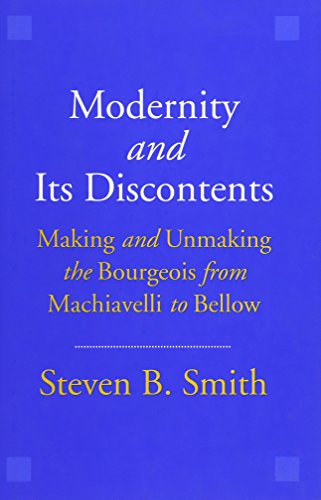
Ebook Info
- Published: 2016
- Number of pages: 416 pages
- Format: PDF
- File Size: 1.49 MB
- Authors: Steven B. Smith
Description
Steven B. Smith examines the concept of modernity, not as the end product of historical developments but as a state of mind. He explores modernism as a source of both pride and anxiety, suggesting that its most distinctive characteristics are the self-criticisms and doubts that accompany social and political progress. Providing profiles of the modern project’s most powerful defenders and critics—from Machiavelli and Spinoza to Saul Bellow and Isaiah Berlin—this provocative work of philosophy and political science offers a novel perspective on what it means to be modern and why discontent and sometimes radical rejection are its inevitable by-products.
User’s Reviews
Editorial Reviews: Review “[Smith is] superb at bringing abstract ideas to life. . . . Smith’s heart is with an urbane liberal like [Isaiah] Berlin, for whom . . . ‘modernity is not a problem to be overcome but a challenge to be met.'”—James Miller, New York Times Book Review”Modernity and Its Discontents represents the fruit of decades of deep reflection on the achievements and vulnerabilities of modern thought, and of the world that is has generated and reflected. The book is immensely rich.”—Joshua L. Cherniss, Review of Politics”Each chapter . . . is a master class on the relationship between academic scholarship and text-centered teaching, linked by a shared concern with the blessings and curses of the modern self in its quest for intellectual coherence and moral significance.”—Choice”A superb collection.”—Commonweal”Steven B. Smith’s timely and thoughtful new book offers an insightful and impressively wide-ranging discussion of modernity and its internal tensions. It will be widely read and discussed for years to come.”—Charles L. Griswold, Bowne Professor of Philosophy, Boston University”Steven B. Smith’s powerfully lucid intellectual history of modernity offers a new take on the dialogue between ancients and moderns, showing how a diverse group of modern philosophers and writers became more aware of their own ideas and identity by engaging with perennial issues. As an account of who we in the West have become, Modernity and its Discontents should inform discussions of what we might mean by progress in the future.”—Michael S. Roth, President, Wesleyan University”Whether you are a lover of modernity or a pre-modern or post-modern critic, this is a book that will engage, enlighten, and provoke you. The chapters are free-standing essays, but they add up to an important argument—and they are at the same time intellectual fun, of a very high order.”—Michael Walzer, Institute for Advanced Study, Princeton, NJ”This is the history of ideas as it should be done—which is to say, a rich and probing and significant book. Steven B. Smith has fully mastered the modern intellectual tradition, and he has a gift for clarity that does not come at the expense of complexity. He refreshes many valuable things. It must be a joy to be his student.”—Leon Wieseltier About the Author Steven B. Smith is Alfred Cowles Professor of Political Science and Philosophy at Yale University.
Reviews from Amazon users which were colected at the time this book was published on the website:
⭐Steven Smith succeed in both presenting what is at stake in the bourgeois/bürger or middle class of merchants, intellectuals and professionals quest to create a political philosophy. All the enlightenment philosophers are presented with amazing clarity and wit. His take on the enlightenment critiques cant possible cover all, but Steven Smith succeed in keeping both a story line and the excitement up through the critical presentation of the “anti enlightenment perspectives”.If I should critique the book it would be its lack of discussion of Dewey, which he himself recognize has plaid a key role in the American liberal/progressive tradition and that in my opinion the concluding chapter don’t really points toward what he finds the relevant future discussion.But still I read it is an exciting novel!
⭐That one can claim to write a major consideration of modernity and it’s discontents and simply disregard out of hand some of the 20th century’s most important writers on the subject strikes me as irresponsible. No thinker on bourgeois reason and civility has done more to challenge the self-image of the rational ego than Freud. And none has done more to link Freud’s insights to the barbarism that was the Enlightenment’s dialectical other than Theodor Adorno. Smith quotes a line or two from DIALECTIC OF ENLIGHTENMENT, the shattering text that Adorno co-wrote with Max Horkheimer, in which the two draw on not only Freud but also Marx, Weber, Nietzsche, Durkheim, Maus, and other to explore the persistence of myth in the modern world and demonstrate how myth haunts reason. “Enlightenment, understood in the widest sense as the advance of thought, has always aimed at liberating human beings from fear and installing them as masters. Yet the fully enlightened earth radiates disaster triumphant.” As a statement of the challenge facing any defender of bourgeois society with its claims to rational self-management, this could hardly be clearer or more powerful. Smith’s response is to look the other way. Thus, while some of the individual essays in Smith’s book provide useful insights into individual authors, its overall success necessarily falls far short.
⭐What a fantastic book! Incredibly well written, interesting, and engaging. Several chapters with new perspectives on some of the greatest political and social philosophers and their ideas. I plan to re read immediately.
⭐This book is so fantastic! Dr. Smith makes great observations on major theorists. He is smart and funny, making this book a pleasure to read.
⭐I like the way he writes this contemporary assessment.
⭐Excellent review of major post-16th century philosophy.
⭐As described and fast shipping.
⭐This collection of literary reflections has the modest, clear and insight-driven quality that for me characterizes all Steven Smith’s books and lectures. But I can think of nothing else quite like it in English. It does for the Bourgeoise what Auerbach did for literary realism in Mimesis. As he notes early on, the Bourgeoise was the greatest innovation of the Enlightenment. Revealing the rise and decline in the eyes of representative literary artists says a great deal about the tensions, weaknesses and divisions that characterize modern society and in turn our self-perception. This is a serious work of political thought expressed with clarity and simplicity. Some assembly required.
Keywords
Free Download Modernity and Its Discontents: Making and Unmaking the Bourgeois from Machiavelli to Bellow in PDF format
Modernity and Its Discontents: Making and Unmaking the Bourgeois from Machiavelli to Bellow PDF Free Download
Download Modernity and Its Discontents: Making and Unmaking the Bourgeois from Machiavelli to Bellow 2016 PDF Free
Modernity and Its Discontents: Making and Unmaking the Bourgeois from Machiavelli to Bellow 2016 PDF Free Download
Download Modernity and Its Discontents: Making and Unmaking the Bourgeois from Machiavelli to Bellow PDF
Free Download Ebook Modernity and Its Discontents: Making and Unmaking the Bourgeois from Machiavelli to Bellow