Ebook Info
- Published: 2009
- Number of pages: 497 pages
- Format: PDF
- File Size: 1.76 MB
- Authors: John Rawls
Description
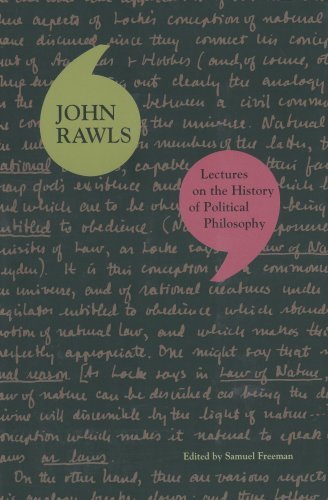
Constantly revised and refined over three decades, Rawls’s lectures on various historical figures reflect his developing and changing views on the history of liberalism and democracy. With its careful analyses of the doctrine of the social contract, utilitarianism, and socialism, this volume has a critical place in the traditions it expounds.
User’s Reviews
Reviews from Amazon users which were colected at the time this book was published on the website:
⭐As the editor of this volume notes, “One great benefit of these lectures is that they reveal how Rawls conceived of the history of the social contract tradition, and suggest how he saw his own work in relation to that of Locke, Rousseau, and Kant, and to some degree Hobbes as well” (pg. x). Rawls was reluctant to publish these lectures: “It was only after he was prevailed upon to publish his ‘
⭐…that he agreed to allow his lectures on the history of political philosophy to be published as well” (pg. xv).Rawls says his goal in these lectures is to “try to identify the more central features of liberalism as expressing a political conception of justice when liberalism is viewed from within the tradition of democratic constitutionalism. One strand in this tradition, the doctrine of the social contract, is represented by Hobbes, Locke, and Rousseau; another strand, that of utilitarianism, is represented by Hume and J.S. Mill; whereas the socialist, or social democratic strand, is represented by Marx, whom I consider largely as a critic of liberalism” (pg. xvii). Rawls goes on to admit that his approach “do[es] not present a balanced introduction to the political and social philosophy” (pg. xviii).The “Lectures on the History of Political Philosophy” are, more specifically, a history of modern contractual political philosophy. These lectures will provide added clarity to the tensions between his book
⭐and his
⭐. For example, Michael Sandel’s, whose appraisal of Rawls works mostly off of “A Theory of Justice” alone, wrote in his book
⭐that Rawls offers “deontology with a Humean face” which entails, according to Sandel, that Rawls doctrine “justice is the first virtue of social institutions” a teleology based an a metaphysical notion of the self which is the exact thing Rawls wanted to avoid; Sandel says, “teleology to the contrary, what is most essential to our personhood is not the ends we choose but our capacity to choose them. And this capacity is located in a self which must be prior to the ends it chooses.” Thus Sandel takes offense against Rawls’ Kantian style distinctions like “original position,” behind a “veil of ignorance.”However, with “Justice as Fairness” and other writings (e.g. Kantian Constructivism) Rawls became more clear that there is no noncircular argument for democratic ideas; he says in “Justice as Fairness: A Restatement,” that, “since justice as fairness is intended as a political conception of justice as a democratic society, it tries to draw solely upon basic intuitive ideas that are embedded in the political institutions of a democratic society and the public traditions of their interpretation.”Rawls shows in these lectures on the history of philosophy how his philosophy is sufficiently historical and contingent to avoid much overworked metaphysics: “the same effect as that of a veil of ignorance may result from a combination of other elements. Thus, rather than exclude information, we can allow people to know whatever they now know and yet make the contract binding in perpetuity and suppose the parties to care about their descendants, indefinitely into the distant future. In protecting their descendent’s as well as themselves, they face a situation of great uncertainty. Thus, roughly the same arguments, somewhat modified, pertain as with a thick veil of ignorance” (pg. 19; see also footnote 7 pg, 269).These lectures, however, are not so much about Rawls’ theory of justice. Rawls writes charitably about others throughout, when he does criticize it is insightful. These lecture notes are surprisingly detailed at times, with footnotes and full citations. A benefit for researchers will be the generous index at the book’s end.
⭐In his seminal work “A Theory of Justice,” philosopher John Rawls developed a “Veil of Ignorance” theory. He postulated that a person can’t participate in drawing up a fair social contract unless he or she has no idea what their place will be in the resulting society. This is an elegant barrier to the double standard. For example, a person that believes in having slaves but not in being one might argue for legitimizing slavery in the social contract, but putting him behind a veil of ignorance (where he doesn’t know whether he’s going to end up being the slave or the slave owner) is a great leveler.Impressed by his thinking, I wanted to read more of his work so I started with his “Lectures on the History of Moral Philosophy.” Whoa! As my published review explains, Moral Philosophy was much too deep for me. Not only was it abstract and etherial, I didn’t find it useful or interesting.In contrast, Rawls’s “Lectures on the History of Political Philosophy,” turn out to be much more interesting, much easier to follow, and more relevant in everyday context. The odds of hearing Hobbes, Locke or Hume mentioned are a lot higher than the odds of hearing anyone mention Leibnitz or Kant.That said, for many people buying this book could turn out to be like buying a treadmill. You have fantasies of how you’ll use it when you walk out the door, but sometimes it doesn’t work out that way. If nothing else, it’s a lot easier to store and it makes a great research tool.
⭐transformative and highly original
⭐It’s John Rawls that alone is enough to get a 5 star – in fact one of my goals in life is to be like Rawls as a philosopher, professor and author. -MichaelAngela- M.A.Philosophy (currently in Business School 2nd Master’s degree) Author of Beauty Matters the Moral Issues
⭐It was for a friend and she loves it.
⭐Exactly what I wanted. I buy books for instructors who forgot to order on time or ones that are out of print.
⭐Wonderful book. I really identified with the protagonist.
⭐This very good book is a well edited transcript of Rawls’ lecture notes from his political philosophy course. The heart of the book is a series of lectures on major contributors to social contract theory – Hobbes, Locke, Rousseau. These are clear, insightful, and sympathetic discussions of these thinkers with Rawls emphasizing the role of each philosopher’s response to his contemporary problems in formulating their ideas. Rawls discusses as well some other thinkers not part of this tradition, Hume and JS Mill for utilitarianism, and Marx as representing a view completely outside the liberal tradition. Not surprisingly, aspects of each writer that Rawls found particularly interesting and important in formuation of his own distinguished contribution to the social contract tradition emerge from these discussions. This is particularly clear of his sympathetic discussions of Rousseau and particularly JS Mill. In Rawls presentation, Mill, not strictly a member of the social contract tradition, provides a progenitor of Rawls concept of public reason in the formulation of social institutions. As a plus, there are also transcripts of lectures on the important but lesser known Henry Sidgwick and Joseph Butler.In his primary work, Rawls is not always easy to read. These lectures, however, are generally lucid.
⭐I haven’t finished reading this compendimum of John Rawls lectures yet, but so far it has opened up my eyes to the beliefs of some of our most important philosophers and promises to have been a worthy contribution to studying philosophy.
⭐Book is fine but was not as described – there were lots of previous notes in the book covering some of the text and highlighted sections which were not disclosed.
⭐Ich wollte mich das erste mal mit der Philosophie von John Rawls beschäftigen. Dafür ist das Buch jedoch überhaupt nicht geeignet. Es wurde von einem wissenschaftlichen Assistenten Rawls’ geschrieben und es werden vor allem dessen Vorlesungen wieder gegeben . Für den Einstieg also ungeeignet. Auch für solche, die sich bereits mehr mit politischer Theorie oder Rawls im Speziellen beschäftigt haben, ist wohl ein Buch, in dem das Material aufbereitet ist, besser.
⭐
Keywords
Free Download Lectures on the History of Political Philosophy in PDF format
Lectures on the History of Political Philosophy PDF Free Download
Download Lectures on the History of Political Philosophy 2009 PDF Free
Lectures on the History of Political Philosophy 2009 PDF Free Download
Download Lectures on the History of Political Philosophy PDF
Free Download Ebook Lectures on the History of Political Philosophy