Ebook Info
- Published: 2010
- Number of pages: 288 pages
- Format: PDF
- File Size: 0.83 MB
- Authors: John Rawls
Description
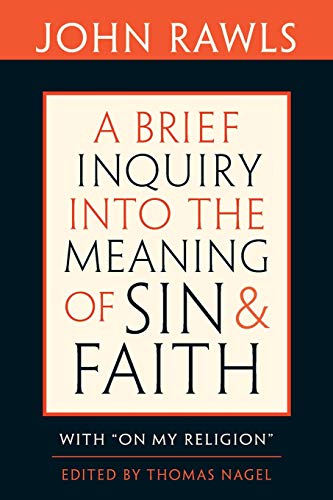
John Rawls never published anything about his own religious beliefs, but after his death two texts were discovered which shed extraordinary light on the subject. A Brief Inquiry into the Meaning of Sin and Faith is Rawls’s undergraduate senior thesis, submitted in December 1942, just before he entered the army. At that time Rawls was deeply religious; the thesis is a significant work of theological ethics, of interest both in itself and because of its relation to his mature writings. “On My Religion,” a short statement drafted in 1997, describes the history of his religious beliefs and attitudes toward religion, including his abandonment of orthodoxy during World War II. The present volume includes these two texts, together with an Introduction by Joshua Cohen and Thomas Nagel, which discusses their relation to Rawls’s published work, and an essay by Robert Merrihew Adams, which places the thesis in its theological context.The texts display the profound engagement with religion that forms the background of Rawls’s later views on the importance of separating religion and politics. Moreover, the moral and social convictions that the thesis expresses in religious form are related in illuminating ways to the central ideas of Rawls’s later writings. His notions of sin, faith, and community are simultaneously moral and theological, and prefigure the moral outlook found in Theory of Justice.
User’s Reviews
Editorial Reviews: Review “What a pleasure to read John Rawls’s senior thesis at Princeton, which he submitted in 1942, long before his book A Theory of Justice (1971) established him as America’s most respected liberal philosopher of law. Rawls’s later writings are as pareve (neutral) as could be–they have no hint of the religious passion and wisdom that permeates his senior thesis. Robert Merrihew Adams has a long accompanying essay reviewing what is the most exciting in Rawls’s thesis.”―Tikkun“No recent secular moralist has been more influential than John Rawls…[A Brief Inquiry into the Meaning of Sin and Faith] undoubtedly reveals an interesting stage in the development of a highly significant philosopher.”―Anthony Kenny, Times Literary Supplement“Allows us to see how a very intelligent believer, who once considered the priesthood, lost his Christian faith as a young man.”―James Wood, New Yorker“[A] fascinating account of the evolution of his religious convictions.”―R. Bruce Douglass, Christian Century“[A] fascinating account of the evolution of his religiousd convictions.”―R. Bruce Douglass, Christian Century About the Author John Rawls was James Bryant Conant University Professor at Harvard University. He was recipient of the 1999 National Humanities Medal.Thomas Nagel is University Professor, Professor of Law, and Professor of Philosophy at New York University.Joshua Cohen is Marta Sutton Weeks Professor of Ethics in Society at Stanford University and coeditor of Boston Review.Robert Merrihew Adams is Clark Professor of Philosophy, Emeritus, Yale University.
Reviews from Amazon users which were colected at the time this book was published on the website:
⭐Rawls has been a leading thinker in post-60s secular liberalism, influencing a lot of the politicianslike Obama, the Clintons, Al Gore, Mario Cuomo, etc. While those claim some kind of belief, theirpublic philosophy tends to be more secular and morally neutral, and of course being neutralautomatically gets biased to the left. For instance, Rawls had views regarding how people use theirmoney due to drugs or whatever.This book is Rawls’ Princeton thesis. For me it was fascinating that the premier secular thinkerwas so deeply theological as a bachelor. The main interest is in Protestant neo-orthodox thought,with Karl Barth, Emil Brunner, Reinhold and Richard Niebuhr, and Anders Nygren. Neo-orthodoxyisn’t really a particular school. For instance, even Rawls knows that Paul Tillich cannot be saidto be orthodox in his understanding of Christian theology. It basically means big names in 20thcentury Protestantism. Similarly, in my area of specialty on the Catholic side, la nouvelle theologieafter Vatican II split up into the Ratzinger side and the Rahner/Kung side, and were no longer part ofthe same movement in a meaningful way.He saw himself as an orthodox Christian belonging to the Episcopalian church. There’s a strongpolemic against Pelagianism, earning salvation. This is seen in Rawls’ later work with the viewthat the needs of the poor cannot be earned morally. There’s a strong emphasis on community.Much of this would actually fit with Catholic thinkers like von Balthasar. The Trinity is the basisfor human relationships with God and with one another. This is the grounding for Rawls’ understandingof love and sin. Sin is egoism and egotism. Basically, sins based on our physical passions and desireslead to more spiritual, intellectual sins of pride. Satan is more evil than any human because hisrebellion was purely prideful and spiritual. Rawls’ understanding of love and forgiveness issimilarly related to the community. Again, there’s much in common with Catholic penance, buthe doesn’t know it.Inspired by his Protestant neo-orthodoxy, he is down on what he calls the “naturalists”, an odd termto lump in Plato, Aristotle, Augustine and Aquinas, which I consider the basic framework for Catholicfaith and reason. (Yes, I know they contradict each other). Far from being naturalists, they openedup transcendence and ultimately the supernatural, as Henri de Lubac has studied. But Rawls is usingthese terms in a completely different way. He is more sympathetic to Origen, even though he wasweird, because Origen has been viewed as a heretic for much of history while the other four havegenerally been in the mainstream of orthodoxy. (Yes, I know that Plato and Aristotle were beforeChrist).Rawls’ loss of faith was due to the Holocaust and the loss of his close friend in battle. He couldno longer see God as providence in history, although he didn’t appear to fully go to atheism.He was probably some sort of deist. But it’s fascinating to me that these ideas derived fromthe community of the Trinity basically were converted into a secular understanding ofcommunity. The notion of love changes, however.Rawls wasn’t truly a theologian-the editor’s introduction notes that his read on Augustinewas superficial. Despite his influence from Plato, Augustine had a deeply passionaterelationship with God shown in the Confessions. But Rawls, while he hadn’t read deeplyenough, for a bachelor had already read a lot of the right stuff, in my opinion. He basicallyhad a good sense of which ancient and medieval thinkers were important.
⭐A Brief Inquiery into the Meaning of Sin and Faith: With “On my Religion” plantea al menos dos problemas que no deberían desatenderse: uno relativo a la interpretación de los contenidos sustantivos de la teoría liberal de John Rawls, y otro relativo a la interpretación de la obra de Rawls como un corpus intencional y deliberado publicado o aprobado por su autor.Resulta claro que los textos en cuestión permiten que la Introducción de la edición, a cargo de dos de los discípulos más connotados del filósofo de Harvard, sugiera una ruta de interpetación de la obra de Rawls muy poco atendida, a saber, la de una teoría política compatible, y a veces hasta asimilable, a los puntos de vista comprehensivos o sustantivos propios de las doctrinas religiosas. Este tipo de interpretación no sólo recalcaría el caracter contextual y pragmatizado del liberalismo rawlsiano, sino que avisaría de su relación muy cercana con preocupaciones teológicas o religiosas que las lecturas estandar de Rawls había considerado de poca importancia o de plano irrelevantes. En este caso, la publicación de estos dos textos, muy lejanos uno de otro en el tiempo,tendería a diluir la fuerza de la neutralidad de la justicia rawlsiana, tan vigorosamente defendida bajo el criterio de la prioridad de lo justo sobre lo bueno (the priority of the Right over the Good) o de la indepedencia de la concepción política de la justicia respecto de los contenidos de primer orden de las doctrinas comprehensivas filosóficas, religiosas o morales. No queda claro que empezar a entender a Rawls como un autor cercano a las doctrinas religiosas que él, de manera explícita, deriva hacia el espacio o dominio no público, constituya un logro teórico que hubiera que celebrar.Respecto del segundo tema, habría que decir que el criterio de los editores de los textos es discutible. Si el propio John Rawls había optado, primero, por no dar siquiera difusión y mucho menos enviar a una editorial esa tesis de licenciatura cuyos contenidos son, en efecto, teológicos, tal vez deberíamos entender que no la consideraba parte de un cuerpo teórico que el considerara digno de poner a debate en ese espacio de razón no pública, pero esencial, que es el debate académico y filosófico. Exhumar ese texto del olvido al que su propio autor lo condenó no parece ser atender a la intención rawlsiana de construir y perfeccionar una teoría liberal de la justicia centrada en el valor de la neutralidad y la equidad o imparcialidad(fairness).Así que el texto nos deja con una impresión ambigua. Gracias a su publicación conocemos un poco mejor al Rawls autor y también sabemos un poco más de su proceso de maduración filosófica. Al mismo tiempo, debilitamos el valor de la neutralidad y validamos la desatención de los editores a la voluntad de un hombre que había decidido silenciar algún producto suyo que, a la vista de su propia construcción teórica posterior, parece que consideró indigno de ser publicado, es decir, estudiado y debatido por otros.Dr. Jesús R. ZepedaUniversidad Autónoma Metropolitana (Ciudad de México)It’s not what you are looking for.
⭐Si sta ormai pubblicando tutto di questo importantissimo (ed estremamente schivo) filosofo della politica del XX secolo. Questa sorta di autobiografia (che mi sembra giusto si stia divulgando dopo la sua morte) aiuta molto per comprendere la sua filosofia della giustizia, anche nella sua evoluzione negli anni. Per chi studi al’autore e la filosofia politica (non solo contemporanea) è un testo di grande utilità. Interessanti anche i contributi critici.This small book was both unreadable and revealing to me. Before John Rawls went to war he was a deeply sincere candidate for the Anglican (Episcopal) Ministry. This part of his tale, published with his executor’s and wife’s permission after his death was, to me, unreadable as it is couched in the sacredotal terminology of a true believer. I found his post-war revelations (why he fled from his pre-war objective and the church not only very believable but why he turned to philosophy instead of religion. I sensed at the end he still seemed to have difficulty convincing himself that morality could stand without religion.
Keywords
Free Download A Brief Inquiry into the Meaning of Sin and Faith: With “On My Religion” in PDF format
A Brief Inquiry into the Meaning of Sin and Faith: With “On My Religion” PDF Free Download
Download A Brief Inquiry into the Meaning of Sin and Faith: With “On My Religion” 2010 PDF Free
A Brief Inquiry into the Meaning of Sin and Faith: With “On My Religion” 2010 PDF Free Download
Download A Brief Inquiry into the Meaning of Sin and Faith: With “On My Religion” PDF
Free Download Ebook A Brief Inquiry into the Meaning of Sin and Faith: With “On My Religion”