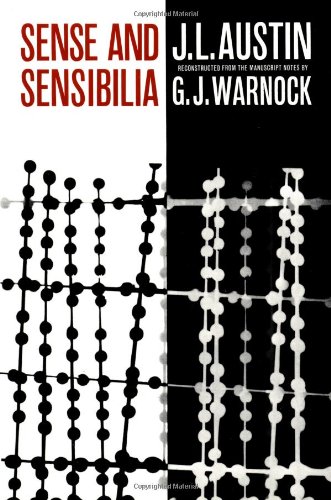
Ebook Info
- Published: 1964
- Number of pages: 144 pages
- Format: PDF
- File Size: 4.91 MB
- Authors: J. L. Austin
Description
A very nice book!
User’s Reviews
Editorial Reviews: Review “An excellent book presenting many of the major issues of ordinary language philosophy–very readable.”–Mark Hamilton, Ashland University”The clarity, the wit, and the patience of the writing are liable to deceive the reader on only one point, namely the amount of hard work that lies behind these thoughts….This book is the one to put into the hands of those who have been over-impressed by Austin’s critics….[Warnock’s] brilliant editing puts everybody who is concerned with philosophical problems in his debt.”–The Guardian
Reviews from Amazon users which were colected at the time this book was published on the website:
⭐This is a very interesting book. It belongs in the tradition of ordinary language philosophy. Austin believes that many philosophical problems arise because philosophers are not careful enough about how words are actually used. Philosophers ask, for example, questions like “what is real?” without understanding the different ways in which the term “real” is actually used in everyday speech. This gives rise to a whole host of pseudo-problems and mistaken philosophical doctrines. By analyzing words more carefully it is possible to dissolve those pseudo-problems and mistaken philosophical doctrines.One of the primary goals of this book is to critique sense-datum theories of perception. Sense-datum theories claim that we do not ever perceive material objects directly. What we perceive are sense-data, and we infer material objects from those sense-data. Bertrand Russell presents this view of perception in his book
⭐. Austin argues that this view of perception is based on confusions about how we use words like “illusion” and “appears”. Austin also argues against the notion that there are a certain class of statements that always serve as an epistemological foundation for another class of statements. It is often claimed, for example, that statements about sense-data are certain and serve as a foundation for our knowledge of material objects. But, as Austin points out, what kinds of statements serves as foundations, or evidence, for other statements depends on context. Austin ultimately argues for a kind of anti-foundationalism.My own training is in Continental philosophy, so I am not as familiar with the tradition of philosophy that Austin is responding to. However, it seems to me that Austin is actually making an argument, throughout the book, that in some ways is not that different from Kant’s. Kant argued that our concepts only have empirical validity, and are only legitimately used when they are employed empirically. Kant argued against any kind of transcendent use of our concepts. Austin seems to me to be arguing something similar. We all understand how words are used in our everyday lives, but when we try to use those same words in a metaphysical, or transcendent, sense, we fall into all sorts of confusion, and wind up creating pseudo-problems for ourselves.When we talk about the word “real” for example. Philosophers often want to know about ultimate reality, and they wind up asking strange questions like “How can we be certain that this telephone is real?” In this context “real” is taken metaphysically. What is being asked about is the ultimate metaphysical status of the telephone. But what do we ordinarily mean when we ask “Is that telephone real?” Austin would argue that if we pick up the phone and we are able to use it to call people then this is all we ordinarily mean when we say the phone is real, and that is just what it means to be a real phone. This is one example of how Austin analyzes our everyday use of words in order to dissolve their metaphysical use, and the pseudo-problems the metaphysical use of terms gives rise to. We know the difference between a real phone and a fake phone in our everyday lives (of course, the reader should keep in mind that the term “real” can mean many different things in different contexts, I am simply focusing on one meaning which contrasts “real” to “fake” for the sake of an example).Austin is a very clear writer, or speaker, since I guess this volume was based on lectures. Whatever the case may be, the book is very readable even without a strong background in analytic philosophy. Austin is a great polemicist, for lack of a better term, by which I simply mean: he is great at constructing arguments, and reducing other people’s arguments to absurdity. The book really is a pleasure to read and contains a wealth of interesting insights. More than I have been able to contain, or even hint at, in this review. I highly recommend it to anyone interested in analytic philosophy, language philosophy, theories of perception, or epistemological problems.
⭐John Langshaw Austin (March 28, 1911 – February 8, 1960) was born in Lancaster and Educated at Balliol College, before serving with MI6 during World War II. Later he became White’s Professor of Moral Philosophy at Oxford from 1952 until his death in 1960. His language philosophy lectures form the basis for this book, which was compiled by G. J. Warnock with help from J. O. Urmson. The title was clearly chosen for its similarity to that “other” J. Austen’s work, “Sense and Sensibility”.J. L. Austin challenged the sense-data theories of perception of the day. Specifically he takes aim at Alfred Jules Ayer’s “The Foundation of Empirical Knowledge”. He also talks about H. H. Price’s “Perception”, and G. J. Warnock’s book on “Berkeley”. Even though the book suffers a little from being formed from lectures rather than Austin writing a book on the subject, Warnock has done an excellent job of compiling the lectures, and the result is a very readable book, which can be enjoyed by readers of all backgrounds.The entire book is only a little over 140 pages long, consisting of a foreword by G. J. Warnock, and then 11 sections based on the lectures which Austin gave between 1947 and 1959. It is unfortunate that Austin himself never put together a book, for it would be interesting to see how well it would match what G. J. Warnock has put together here. In lieu of that, I think readers will find this book accessible, humorous and insightful.
⭐One of those rare breed of philosophers who can actually write, with a whimsical humor, Austin was one of those chiefly responsible for demolishing the pretensions of the positivists, an arrogant group of Anglo-American intellectuals (with a few Poles and Viennese thrown in) who believed that the secrets of the Universe can be found by analysing the language of one particular intelligent biped, and treating its syntax in the same manner as the laws of physics are deduced with mathematics. Austin was one of those who pointed out the obvious; language evolved as a means of communication between people; as such words are far too complex enteties to be reduced to simple meanings that can then be played with in the form of symbols and all the ‘problems’ of philosophy thus magically solved. His skewering of A. J. Ayer, one of the principle exponents of this doctrine, is especially satisfying. The book itself contains almost no technical vocabulary at all,and hardly any words over ten letters, which is an achievement in itself. On the negative side it is completely deconstructive; it offers no positive insights into the mysteries of life whatsoever, if that is what you are looking for. But within its limits it is a gem, and in its day it virtually rescued philosophy from oblivion. One noteworthy factor about it; almost as much credit as the author must be given to the editor G.J. Warnock, who compiled it from lecture notes, and even includes a rather devastating critique of one of his own works in the final chapter.
⭐I am a fan of John L. Austin. This is a great book with keen insights and critiques of the sense-data theory. The book came in such a timely manner–thank goodness!–since a paper I was writing depended on it. The book was in good condition : ) No complaints here at all.
⭐Bertrand Russell seems to have complained that Austin clipped philosophy’s wings. Undoubtedly, Austin doesn’t soar into any empyrean. There are no great abstract or abstruse constructs in his thinking, there are no special philosophical languages, one is not adrift when reading him in any uncharted sea of unfamiliar concepts. Instead, one’s nose gets rubbed hard, and very entertainingly at times, in the basic realities (excuse the term for the moment) of common everyday speech.On the other hand, it was this same Russell who derided the German philosophers (including the mighty Kant himself) who followed Hume, after a period of dumbstruck silence, with highly obscure philosophies. The very opaqueness of these, opined Russell, is a good indication of how unsuccessful they were in refuting Hume. I think he was right, but I think his love of mathematical and logical modelling has led him into a similar trap when it comes to his own contemporary Austin. Hume’s placid and implacable reasoning drove abstract thought into the buffers. You can’t drive through them, and if you try to go around them you get into a swamp. You can go there if you want, or you can try to fly upwards into something more ostensibly sublime, or you can burrow downwards, or you can go round in circles – there is just nowhere further to go on the same lines. With Austin the problem is something similar – he’s a spoiler. A contemporary of mine, irritated by my enthusiasm for Austin, called him ‘simple-minded’. I believe exactly the opposite is the case. When Austin states the obvious it’s not from simple-mindedness, it’s a matter that his mental footwork is just more agile than most and he leaves others standing. To call his reasoning common sense is true in a way but misleading. Time after time he reduces earnest theories to rubble simply by demonstrating that their authors have not taken into account the way words are used and how the circumstances of their use vary from case to case. Austin has the brainpower and articulacy to pinpoint the theoretical flaws in much highfalutin’ philosophical reasoning, but I suppose it’s humiliating to reflect how many a London cab-driver, lacking such powers, would have come to similar conclusions.Anyone bewildered or distressed by philosophies that seem to cast doubt on ‘reality’ and undermine one’s basic world-view should read this book. It takes concentration, but it is readable in the extreme. Most of it is concerned with refuting Ayer, who was at that time maintaining that we do not ‘perceive’ objects ‘directly’, but only receive (or perhaps ‘perceive’) ‘sense-data’ (aka ‘sensibilia’) of such. Ayer has since recanted, but into what I don’t know. Taking my own reasoning and not Austin’s for a moment, this is at best an odd way to talk. To say ‘I see the chair’ makes sense. To say ‘I perceive the chair’ probably still makes sense, and ‘perceive’ could be taken to include the sense of touch as well, if, say, I and the room were in darkness or I were playing blind-man’s-buff. On the other hand ‘perceive’ is a word I associate with the intellect more than with the senses, as in ‘I perceive a difficulty with this reasoning’. It also seems to me that ‘perceive’ could apply to a memory of the chair or to just imagining the chair, in which uses it has nothing to do with the senses or sense-data. I’m also not clear whether one ‘perceives’ the so-called sense-data, because if so I might be perceiving sense-data of the sense-data and so on in an infinite series. Whatever it all is, it ain’t English, and I don’t believe it’s sense either. Similarly with Reality – when one asserts that something is ‘real’ what is one implying it might be if not ‘real’? Real cream normally means not-synthetic cream, a real duck might be not a decoy duck or not a toy duck, and any of these possibilities might be ‘real’ as opposed to illusory. The trap many philosophers fall into is in effect taking this last and highly untypical possibility as the only possibility, with detrimental effects on their own brains and those of their readers. When they try to build a solemn theory of some meaningless abstraction called Reality on such a basis, I’d say they are clutching at straws and trying to make bricks without them, and I hope Austin might have liked this phrase.If Austin, who died in his late 40’s, had lived just a little longer I would have been at the stage to attend his annual lectures Sense and Sensibilia. He apparently did not write out complete scripts, and this short book manifestly would not have been everything he said in 8 lectures lasting 50 minutes each. G J Warnock has restored what he can from Austin’s notes, including, with exemplary altruism, a final chapter that pillories himself for his remarks on Bishop Berkeley, who is famous for allegedly maintaining (whether he did or not) that objects may or may not be there if nobody is around to see them. It is all ‘linguistic’ philosophy in the obvious sense that it takes its basic stance on the usage of words. Other types of linguistic philosophy get short shrift from Austin. Ayer for one is pulled up short for trying to argue that certain conceptual differences are only alternative expressions for the same thing, and Carnap’s attempts to find a type of sentence (yes, really) that will of its own nature be certain and irrefutable get the characterisation ‘wild’. Such efforts pursue the will-o’-the-wisp of ‘certain knowledge’ at the expense of ordinary understanding, says Austin. He’s right, say I, and clearheadedness in using our own mother tongue will protect us from not only some strange if pretentious errors but from the distress these may bring with them.
Keywords
Free Download Sense and Sensibilia in PDF format
Sense and Sensibilia PDF Free Download
Download Sense and Sensibilia 1964 PDF Free
Sense and Sensibilia 1964 PDF Free Download
Download Sense and Sensibilia PDF
Free Download Ebook Sense and Sensibilia