Ebook Info
- Published: 1984
- Number of pages: 160 pages
- Format: PDF
- File Size: 0.71 MB
- Authors: Charles Hartshorne
Description
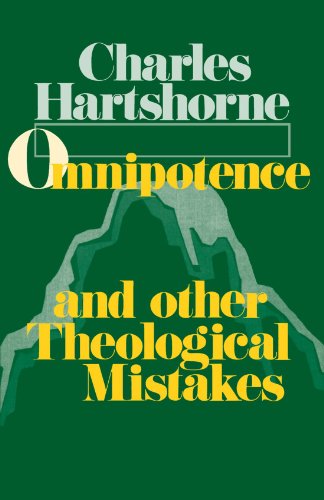
This book presents Hartshorne’s philosophical theology briefly, simply, and vividly.Throughout the centuries some of the world’s most brilliant philosophers and theologians have held and perpetuated six beliefs that give the word God a meaning untrue to its import in sacred writings or in active religious devotion:God is absolutely perfect and therefore unchangeable2.omnipotenc3.omniscienc4.God’s unsympathetic goodness,5.immortality as a career after death, and6.revelationble Charles Hartshorne deals with these six theological mistakes from the standpoint of his process theology.Hartshorne says, “The book is unacademic in so far as I am capable of being that.” Only a master like Hartshorne could present such sophisticated ideas so simply. This book offers an option for religious belief not heretofore available to lay people.
User’s Reviews
Editorial Reviews: Review “Hartshorne speaks with not just conviction, but passion. He cares, and that caring comes through loud and clear. By and large Hartshorne is a very abstract thinker, but this book has a very concrete concern with practical issues of importance to all thinking persons―abortion, environment, love, creationism and fundamentalism as negative forces in our society, nuclear arms, how to read the Bible, birds and animals in their relation to humans, etc. ― Donald W. Sherburne
Reviews from Amazon users which were colected at the time this book was published on the website:
⭐Charles Hartshorne is one of the greatest and most important philosophers of religion of the 20th century, and I mean the *entire* 20th century: he lived from 1897 to 2000, covering the entire span of that century and dying at the age of 103. Along with Alfred North Whitehead, he was a principal developer of the modern process philosophy of religion.Both Whitehead and Hartshorne believed their insights were critical for overcoming centuries of discord, misunderstanding, and philosophical errors that both religion and science were making that were actually standing in the way of their mutual progress. But most of Hartshorne’s writings were intended for an audience of professional philosophers and were very carefully crafted to stand up to erudite criticism. This presented an imposing barrier for more widespread dissemination of his important ideas. Therefore in his old age he decided it was time for a more “popular” and informal presentation of his ideas, and this book is the result.Unlike his more formal works, this work was composed at a furious pace, almost as a stream of consciousness, and perhaps for that reason, there are long passages that are as difficult to comprehend as you will find in his more formal works. Part of what makes some of these passages difficult is the extremely long and complicated sentences out of which they are composed: you sit there wading through a series of parenthetical clauses looking for the subject and predicate, and reading the sentence over and over, trying to put it together. It’s difficult for a scholar to switch gears and write for an audience that is not trained in comprehending long, involved arguments, and perhaps just as much care has to be taken to present complex arguments for laymen as it takes to present them to professional scholars, only in an entirely different style that Hartshorne had never really trained himself for.That said, this book is full of peerless gems of wisdom that jump out at you with astonishing force and persuasion. Hartshorne was a professed Christian, but his view of God will be met with shock by a lot of Christians, even heresy. He believes that for the sake of the religious future of the world, religious belief should be entirely informed by the modern scientific view of the world. Among other things, this means that the way God is in the world is not as a worker of miracles that require an interruption in the natural flow of events, but as a persuasive force in competition with all of the other natural sources of persuasion, including the freedom of the individual itself. He sees this process going “all the way down” the hierarchy of individuals in the natural world: from human beings, to nervous systems, to biological cells, to macro molecules, to simpler molecules, and down to the most fundamental atomic particles. Every such individual, before it makes a free decision to achieve an aim made possible by its very nature, has at least some minimal ability to respond to competing aims from the rest of the world, including the initial aim of God Himself/Herself (Hartshorne’s non-sexist terminology when referring to God with a pronoun), which always gets in there first but is never guaranteed to prevail. Thus, God is in the world in an entirely *natural* way, never in a supernatural way. And this way of God being in the world is not simply a result of a decision on the part of God not to interfere, but is *intrinsic* to the very nature of God himself and the world. According to Hartshorne’s metaphysics, it’s impossible for it to be any other way.To do justice to the various aspects of Hartshorne’s philosophy would require a review as long as this little book itself. There are just a couple more points I want to make. When reading this book, I sense a principle that Hartshorne uses in deciding what the nature of God must be. In discussing God’s nature, Hartshorne always arranges his philosophy of religion to allow God to be seen in the most positive light possible. You will see none of the embarrassments in traditional theology as it tries to reconcile an all-powerful God with an all-good God, or limitations in God’s ability to sympathize and feel all of the joys and sorrows of *every* individual, regardless of where it lies in the hierarchy of complexity. Hartshorne’s God is the most lovable, most worshipful God ever portrayed in the history of the philosophy of religion. You don’t worship Hartshorne’s God because of some ultimate reward in the afterlife — which is essentially a selfish reason for worship, but because Hartshorne’s God is intrinsically lovable: we “fall in love” with his awesomely lovable God that is as metaphysically perfect as possible, and hence we cannot help but worship this God: we are drawn to worship this God simply because it is so worshipful, not because of threats if we don’t or because of rewards if we do.The last point I want to make about this book is that probably because of the haste in which it was written, some things are glossed over or slip by without enough explanation, and you’re left with the feeling that perhaps errors have been made. Of course Hartshorne (as well as Whitehead himself) is often at pains to point out that process philosophy is a work in progress and that it should never present ideas as Absolute Truth, but the philosophy should grow through a dialog among many philosophers with different backgrounds and orientations. But there is one passage in the book that seems to me is particularly careless that also leaves the impression that the conclusion is central to the argument of the book. There is a line in his chapter on neo-Darwinian evolution (which he professes to accept and understand as well as any intelligent layman can be expected to) that is suspect: “[T]he only positive explanation of order is the existence of an orderer. Hence evolution is not, I hold, fully intelligible without God.” To keep this review within reasonable bounds, you’ll have to take my word for it that the rest of the paragraph this quote was taken from makes perfect sense. But just to read the quoted sentence, it looks as if it’s a sound bite “proof” for the existence of God. But it seems to me that the “orderer” of order in the biological world is simply natural selection, and at least what is missing is a “proof” that the existence natural selection is “proof” for the existence of God. This just seems like carelessness, and unfortunately it happens here and there throughout the book.This last reservation shouldn’t deter you from reading this book, however. If you have an open mind at all — for example if you are agnostic and just don’t know whether there is anything more fundamental behind the scientific picture of the world “behind it all” — you will definitely find a feast for thought in this book. It’s just that it would be good to have some idea of the book’s limitations before you start digging in, and digging in is exactly what you’ll have to do: it isn’t your typical layman’s guide to a difficult topic that has been carefully crafted to make it both accurate and reasonably digestible for the non-professional.
⭐The first half of this book about theological problems is good and makes some very decent points. They are not perfectly laid out philosophically but they are easy enough to understand for the layperson interested in theology.However, the back half of the book is basically Hartshorne bashing Christians with very weak rhetorical arguments along with bad philosophy. I’m not a Christian and I found this part weak and cheap pandering.For example, a good portion of the second half of this short book is spent enthusiastically supporting abortion and making fun of “pro-lifers”. I wish it was more sophisticated than that but it isn’t. Hartshorne suggests, in his chapter on divine love, that a fetus has “no conscious selfhood” therefore there is no problem killing it. He later remarks that “A child speaking with some fluency, say three years old, is already, for all we know, beyond the mental level even of an ape. but a fetus or newborn infant is well below that level” Hartshorne implies that fetuses, newborn babies as well as humans with lower IQ’s than apes can be ethically euthanized or at least don’t possess enough personhood to deserve the option to keep living. I’ve heard better abortion arguments from half-baked college students.Hartshorne also seems to suggest that there is no immortal soul. After death, we just live on in the memory of God. This partly helps him justify abortion.Lastly, the second half of this is infested with what I would call, boomer Love idolatry. Somewhere in the 70’s boomers did so many drugs and read enough lousy fake Hindu gurus that they made terrible arguments about God being love. Maybe we have the Beatles to blame. All of these ideas are incoherent and make no sense at all.Overall, this has some good ideas but is lazily written and not worth $30. If this is under $10, that would be reasonable.
⭐If you read theology for fun, this is the book for you! Hartshorne is often convincing but always interesting. He knows his subject and presents it well. His writing style is clear and does not require that the reader have a strong background. I have only two reservations. The first is that his arguments are occasionally summaries of points he makes in greater detail elsewhere, and so he is a little less convincing here, and that no one should read this book at night if they have to get up early the next day. Insomniacs beware!On the other hand, if you want a book to wake someone up, this is an excellent gift.I enjoyed the way his vision makes some of the more pecular things Jesus said sound perfectly reasonable. How often has anyone addressed why you should love your neighbor as yourself? Why should you give to everyone who asks of you and not just the deserving? What does it mean to love God with your whole heart.
⭐This is informal vintage Hartshorne, articulating and defending (somewhat) his characteristic positions on God, mind/body, creation/evolution, and his ethic of universal love. It’s a good introduction to Hartshorne’s views, though he could have used an editor to tidy up the prose.
⭐I find Hartshorne’s work to be as contradictory as the theology he attempted to refute. Not that he didn’t provide valuable insight. I give this book a three star rating because it’s great for the process theologian–and a great read for those interested in process theology. However, I don’t find this book convincing.
⭐Not an easy read: challenging! Answers some questions, raises other questions! I am taking it a chapter at a time.
⭐Perhaps one of the most important theological books for anyone who has doubts about classic Christian doctrine, but wants to remain a follower of Jesus.
⭐One of the very best books for the layperson who seeks to question traditional doctrines and acquire an intelligent and basic understanding of theological issues.
⭐Written in such a way which makes it difficult to digest. Although overall, this is essential reading for any Theology student. But I would say a basic contextual knowledge is really necessary in order to make the most of this book. Try Brian Davies’ “An Introduction to the Philosophy of Religion’, as it is far easier to understand, and in my opinion, better written, and is good for helping to contextualise Hartshorne’s views.
⭐Poorly written and very expensive for what it is. The author was trading on his reputation as a scholar built on other achievements when he cobbled this together. Do not waste money on this.
Keywords
Free Download Omnipotence and Other Theological Mistakes in PDF format
Omnipotence and Other Theological Mistakes PDF Free Download
Download Omnipotence and Other Theological Mistakes 1984 PDF Free
Omnipotence and Other Theological Mistakes 1984 PDF Free Download
Download Omnipotence and Other Theological Mistakes PDF
Free Download Ebook Omnipotence and Other Theological Mistakes